I have been in the Crypto industry for six or seven years, and in the last two years, I have also delved into the AI field while residing in Silicon Valley. A clear sensation from being in both circles is: within the mainstream Silicon Valley community, the term Crypto is mentioned less and less, but the activities undertaken by Crypto are increasingly being utilized.
I want to bring back some signals from the AI side for Crypto practitioners to consider.
This dislocation is most apparent in YC.
YC Winter 2026 has just been announced, with 5 out of 149 companies related to Crypto. This number is not high, but if you pull some historical data, you will find a very clear story behind these 5.
A Set of Data
YC started investing in Crypto projects in 2014 and has invested in a total of 177 companies since then. I pulled the numbers for each batch, and the changes are very intuitive:
In 2018-2019, there were 3-7 companies per batch, steadily climbing. In 2020, there were 5-7 companies per batch, gaining speed. In 2021, it jumped to 13-15 companies per batch. In 2022, it peaked—Winter had 24 companies in one batch, Summer had 20 companies, totaling 44 Crypto companies in a year.
Then there was a cliff.
In 2023, there were still 10-13 companies per batch, holding steady for a year. Starting in 2024, it began to collapse—Winter had 7 companies, Fall had 4 companies, and Summer dropped directly to 1 company. For an entire summer, YC invested in only 1 Crypto company.
In Winter 2025, there was a brief rebound to 10 companies, but Spring and Summer fell back down to only 2 companies per batch.
By Winter 2026, there were 5 companies.
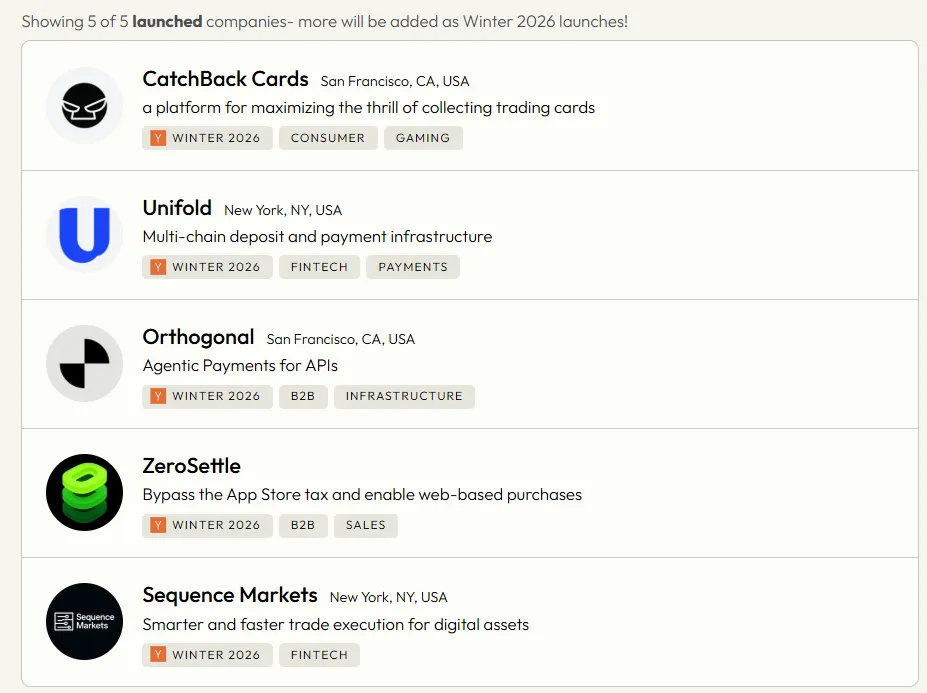

If you are a Crypto practitioner, seeing "from 1 back to 5" might feel like a sign of warming. But if you look at what these 5 companies are actually doing, you will find that they are almost two different species compared to those 24 companies in 2022.
What were the Crypto companies YC invested in in 2022? DeFi protocols, NFT infrastructure, DAO tools, L2 scaling, blockchain games, social tokens.
What are these 5 companies doing in 2026? Stablecoin deposit APIs, cross-border neo-banks, trade execution engines, AI Agent payment gateways, attention exchanges.
Not a single one is doing blockchain, not a single one is working on protocols, not a single one is involved in any traditional "Crypto track" you could name.
This is not a warming; this is a blood transfusion.
Three Certain Projects
First, let’s quickly go through three relatively understandable ones.
Unifold, a team from New York, is like Stripe for Crypto deposits. A set of API+SDK allows any App to integrate cross-chain and cross-token on-chain deposits in less than 10 lines of code. Co-founder Timothy Chung previously worked at Streambird (wallet as a service, later acquired by MoonPay and became MoonPay Wallets), and has also worked at Polymarket and Instabase. Another founder, Hau Chu, graduated from Cornell Tech. This is a typical developer tool business—users don’t need to know that the underlying is Crypto.
SpotPay, a team from San Francisco, is a cross-border neo-bank based on stablecoins. CTO Thomas previously worked at Google and was the 4th engineer at Brex. CEO Zsika also comes from Google, with an MBA from Stanford, and grew up in the Caribbean and Latin America, experiencing firsthand how painful cross-border remittances can be. The product is straightforward: one account for overseas payments, local payments, global spending (with a physical card), and interest-bearing savings. The underlying runs on stablecoins, but the front-end is just a Fintech app, with no visual relation to Crypto.
Sequence Markets, a team of 5 from New York, is focused on smart trade execution for digital assets. They help institutional investors with smart routing across exchanges, getting better prices and lower slippage. Completely non-custodial, they do not touch user assets, only doing technical layers—a typical "selling water" model.
The common point among these three is clear: Crypto is a pipeline, not a selling point.
Two Projects Worth More Discussion
Orthogonal—AI Agents will use Crypto when spending
This is a project that I think Crypto practitioners should take seriously.
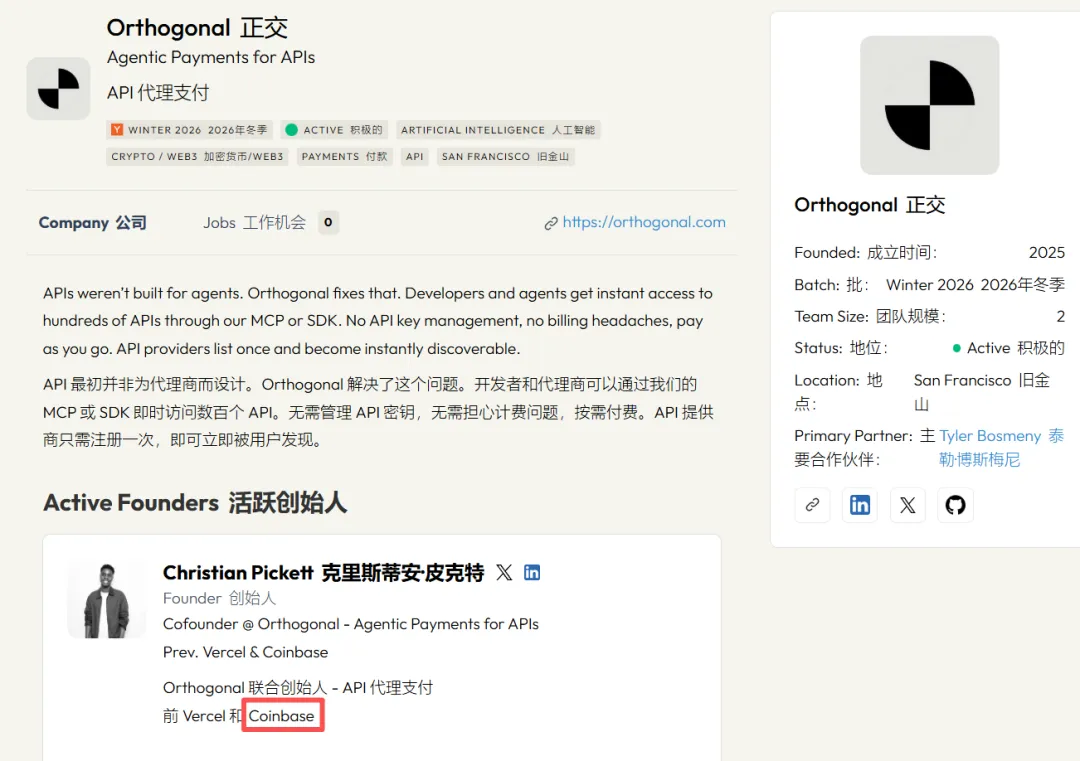
Founder Christian Pickett previously worked on payments at Coinbase and has also worked at Vercel. Bera Sogut worked on reCAPTCHA and Maps APIs at Google and has also worked at Amazon Robotics, a two-time ACM ICPC world finalist.
The problem they aim to solve is as follows: there are increasingly many AI Agents now, and these Agents need to call various paid APIs to complete tasks. However, Agents do not have credit cards or bank accounts and cannot go through the registration-binding card-payment process like humans do. The current approach is for developers to preload Agents or bind their API keys, which can suffice when there are few Agents, but when thousands of Agents need to autonomously call hundreds of paid services, this system cannot hold up.
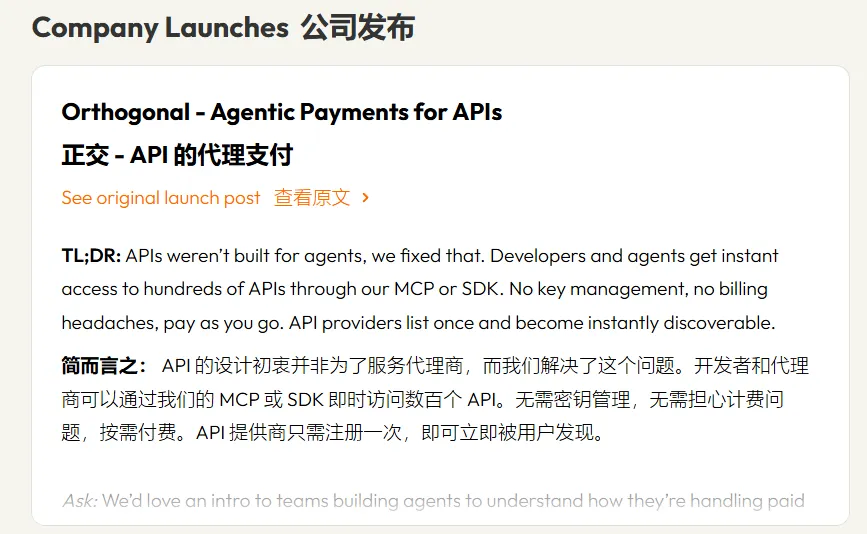
Orthogonal has created a unified gateway: Agents connect through MCP or SDK and can instantly access hundreds of paid APIs, paying per request without needing to manage API keys or establish billing relationships. Once API providers are listed, they can be discovered and called by all Agents. The underlying uses Crypto for settlements and supports the x402 protocol—an on-chain realization of HTTP 402 Payment Required.
Why is this matter related to the Crypto industry? Because real-time micro-payments from machine to machine are precisely what traditional financial systems struggle to do—credit cards have transaction fee thresholds, and bank transfers have delayed arrivals; these frictions that can be tolerated in human transactions become critical issues in scenarios where Agents call APIs thousands of times a day. Crypto's programmability, instant settlement, and permissionless nature are perfectly suited for this scenario.
Noteworthy is the timeline: YC emphasized "Infrastructure for Multi-Agent Systems" in its Fall 2025 RFS (Request for Startups), and half a year later, it invested in Orthogonal. Early supporters include a group of YC alumni companies making Agent products, such as Precip (W24), Riveter (F24), Andi (W22), Fiber AI (S23), indicating that this need is not a theoretical deduction but a concrete reality.
There’s an interesting intersection: the recent viral article by Orange mentioned "Agents are the new masters of software," and SaaS should shift from 2B, 2C to 2A (to Agents). If this judgment holds, payments between Agents become a foundational infrastructure problem that must be solved—Orthogonal bets on Crypto to address it.
Forum—Turning "attention" into tradable assets
This project's imagination is the largest and the risk is also the greatest.
Founder Owen Botkin previously did long and short stock trading at Balyasny (one of the top global hedge funds). Joseph Thomas was an engineer at NASA and DreamwaveAI. The partner assigned to this project by YC is Jared Friedman—one of YC's core partners.
Forum aims to create "the first regulated attention exchange." Specifically, it will build an index from data gathered from search engines, social media, and streaming platforms to quantify the level of attention a particular topic, brand, or cultural phenomenon receives, and then allow users to go long or short on changes in that attention.
For instance, if you judge that a brand is about to lose public attention due to a PR crisis, you can short its attention index. If you think a cultural phenomenon is rapidly gaining traction, you can go long.
Their core argument is that attention is the primary driver of commercial success in the digital age; advertising, traffic, and user growth, ultimately all boil down to the monetization of attention. Yet, attention itself has never been directly priced and traded.
This project's current tags do not mention Crypto/Web3, but the concept of "regulated exchange" combined with "creating new asset classes" will likely involve tokenization. The Spring 2026 RFS from YC introduced the term "new financial primitives" for the first time, and Forum is precisely stepping in that direction.
For the Crypto industry, the paradigm represented by Forum diverges far from stablecoin payments—if the objects of tokenization are no longer JPEGs or real estate shares, but rather "attention", something previously unquantifiable, then this is a completely different story. Of course, whether it can be successfully implemented is still too early to say.
Changes in RFS
Besides looking at what YC has invested in, it is also worth noting what YC openly says it wants to invest in.
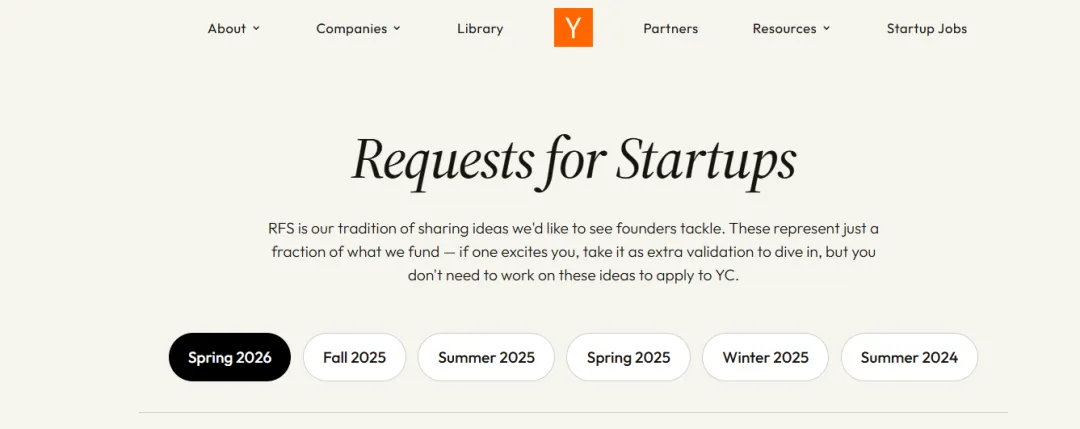
YC releases RFS (Request for Startups) each quarter, which acts as its official topic guideline. I’ve summarized the Crypto-related content from the three most recent issues:
In Summer 2025: 14 directions were outlined, and not a word of Crypto was mentioned. Even the discussion on "AI for Personal Finance," which involves investment and tax optimization, did not mention Crypto at all. YC's attention has been wholly taken up by AI.
In Fall 2025: still no dedicated Crypto entry, but two directions buried hints—"AI-Native Hedge Funds" (the digital asset market operates 24/7, with open data, which is inherently suited for AI quant) and "Infrastructure for Multi-Agent Systems" (which is exactly the scenario Orthogonal later entered).
In Spring 2026: changes appeared. Daivik Goel specifically wrote a directive for "Stablecoin Financial Services," directly referencing the GENIUS Act and CLARITY Act, the two US stablecoin bills, stating that stablecoins are in a regulatory gray area between DeFi and TradFi. The exact wording was: "The regulatory window is open. The rails are being laid."
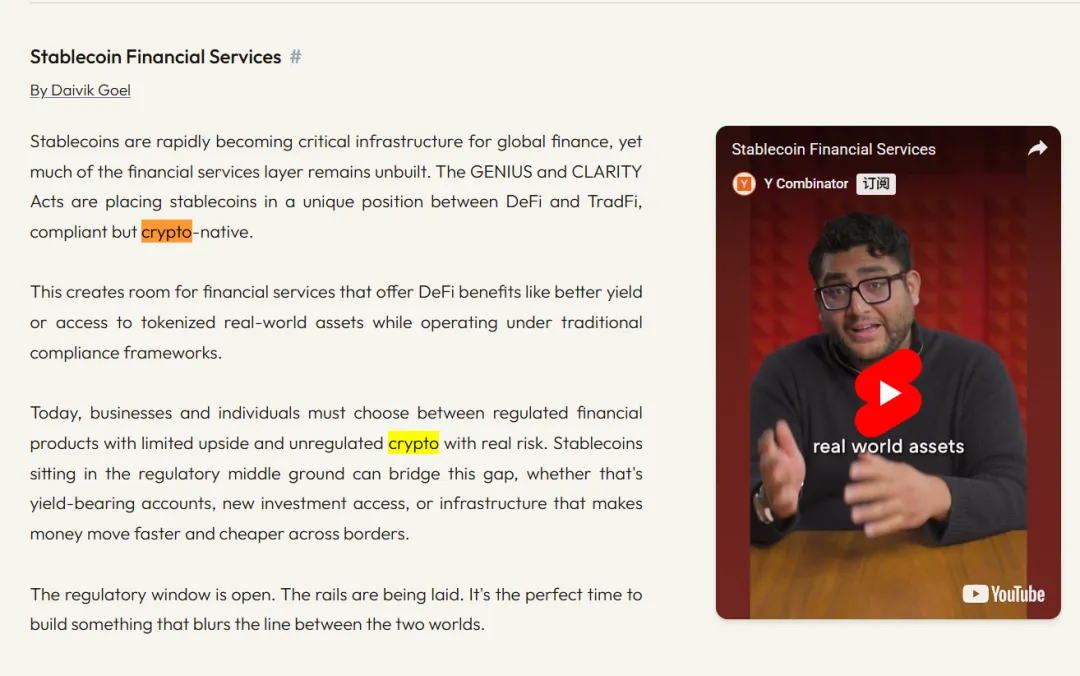
In the overall introduction of the RFS during the same period, the term "new financial primitives" was mentioned for the first time, alongside AI-native workflows and modernized industrial systems.
This is YC's first time in two years to have a dedicated topic for Crypto-related directions in the RFS. The wording is also very specific—not mentioning "blockchain" or "Web3," but precisely "stablecoin financial services", providing specific directions: yield-bearing accounts, tokenized real-world assets, cross-border payment infrastructure.
My Perspective
As someone involved in both Crypto and AI, I believe this data is actually good news for us Crypto practitioners—just that the way it’s good news may differ from many people's expectations.
YC has not given up on Crypto, but YC has redefined what kind of Crypto companies are worth investing in.
In summary: YC is no longer investing in Crypto; YC is investing in companies that use Crypto.
What’s the difference? The former’s value proposition is "I am building the Crypto ecosystem," while the latter’s value proposition is "I am solving a real problem, and Crypto happens to be the most suitable tool."
Users of the former need to understand what wallets, gas fees, and on-chain interactions are. Users of the latter have no idea they are using Crypto—SpotPay's users think they are using a bank app, Unifold's clients think they are integrating a payment SDK, and Orthogonal's Agents do not even have the concept of "thinking".
What does this mean for us?
First is the good news: the stablecoin payment track has broadly reached a consensus in Silicon Valley, moving from an internal consensus. YC has a dedicated topic in the RFS, the advancement of the GENIUS Act and CLARITY Act, Stripe acquiring Bridge—these signals together indicate that the compliance pathway for stablecoins is being cleared. For teams consistently working in this field, the funding environment and market perception are improving.
Secondly, there are new opportunities: Agent payments are a demand that has organically emerged from within the AI industry, and Crypto practitioners have a natural advantage in seizing it. Real-time micro-payments from machine to machine, programmable currency, permissionless settlement—these concepts we have discussed for several years suddenly have the most concrete application scenarios in the Agent economy. This is not us searching for scenarios, but scenarios coming knocking at the door.
Of course, there are realities that need to be recognized: the profile of competitors has changed. SpotPay's CTO was the 4th engineer at Brex, and Orthogonal's founders come from Coinbase and Google—these individuals are not Crypto natives, but they come with the engineering capabilities and product methodologies of traditional tech companies. To compete with them, we in the Crypto industry need more than an understanding of the blockchain; we also need to catch up on product experience and engineering concepts.
Additionally, while L1/L2, DeFi protocols, NFTs, and DAO tools have value, they are currently not prioritized within the vision of mainstream accelerators and VCs in Silicon Valley. This does not mean these directions are finished, but if you are working in these areas, your funding strategy and narrative may need to be adjusted.
Finally, regarding the data line "24→1→5," I believe the most accurate interpretation is not "Crypto is recovering" nor "Crypto is declining," but rather: Crypto is being redefined.
YC has spent two years realizing that the greatest value of Crypto may not be to become an independent industry but to become the infrastructure for other industries. Whether this judgment is correct still needs verification over time. However, as someone involved in both tracks, I see numerous opportunities belonging to Crypto practitioners—provided we are willing to change our perspective on ourselves.
Crypto does not need to disappear, but the best products in Crypto might have users feeling the presence of Crypto the least.
This is not a compromise; this may be the most significant victory.
You may disagree with this judgment, but this is currently the position expressed by the most influential startup accelerator in Silicon Valley with real financial backing.
Data Source: YC Directory (Crypto/Web3 tag, All batches total 177), YC Winter 2026 Launch List (149 companies), YC Request for Startups (Summer 2025 / Fall 2025 / Spring 2026 three issues). Details of the 5 Crypto-related projects come from the YC official website and public information from various companies.
Author: aiwatch, over six years in the Crypto industry, recently delving into the AI field for the past two years, residing in Silicon Valley, focused on GenAI product analysis and research in the intersection of Crypto and AI.
免责声明:本文章仅代表作者个人观点,不代表本平台的立场和观点。本文章仅供信息分享,不构成对任何人的任何投资建议。用户与作者之间的任何争议,与本平台无关。如网页中刊载的文章或图片涉及侵权,请提供相关的权利证明和身份证明发送邮件到support@aicoin.com,本平台相关工作人员将会进行核查。


