Author: Changan I Biteye Content Team
The weather is not like an election, with no positions; not like the NBA, with no home team. Yet for some reason, this market attracts domestic users. The reason is simple: everyone has their own feelings, everyone thinks they understand Shanghai's weather.
But "feeling knowledgeable" and "making money" are two different things.
Biteye shares three things today:
Understand the settlement rules
Establish a method for predicting the weather
Use systems to find trading opportunities that others cannot see
1. First, clarify: how is this weather market settled?
1. The temperature for settlement is not what you think it is
Many people have a misconception when participating for the first time: they compare the highest temperature predicted by their phone weather app, but the app displays the temperature for urban Shanghai, while Polymarket uses actual measured data from Shanghai Pudong Airport (ZSPD meteorological station) for settlement. This data is publicly released through Wunderground, a US weather platform, and PM directly reads WU's records as the settlement basis.
Two places, two numbers. Pudong Airport is located on the eastern side of the city, close to the Yangtze River estuary, and is influenced by sea breezes, so the temperature is usually lower than that of the urban area. This difference may not be noticeable normally, but at the boundary of temperature ranges, it can mean the difference between a correct or incorrect bet.
This is why you might see confusion in the weather market comment section: "It clearly feels warmer today than yesterday, why is the displayed maximum temperature lower?"
2. The number is correct, but the unit is not what you think it is
WU's data comes directly from the METAR messages reported hourly by the airport (the global aviation universal weather telegram format).
There is a detail hidden here: METAR records are in Fahrenheit integers, and WU displays this number directly, without conversion or correction.
Meanwhile, most weather forecasting systems and meteorological models output temperatures with decimal points. The more refined your model is, the easier it is to overlook this most basic aspect.
3. Shanghai temperature patterns
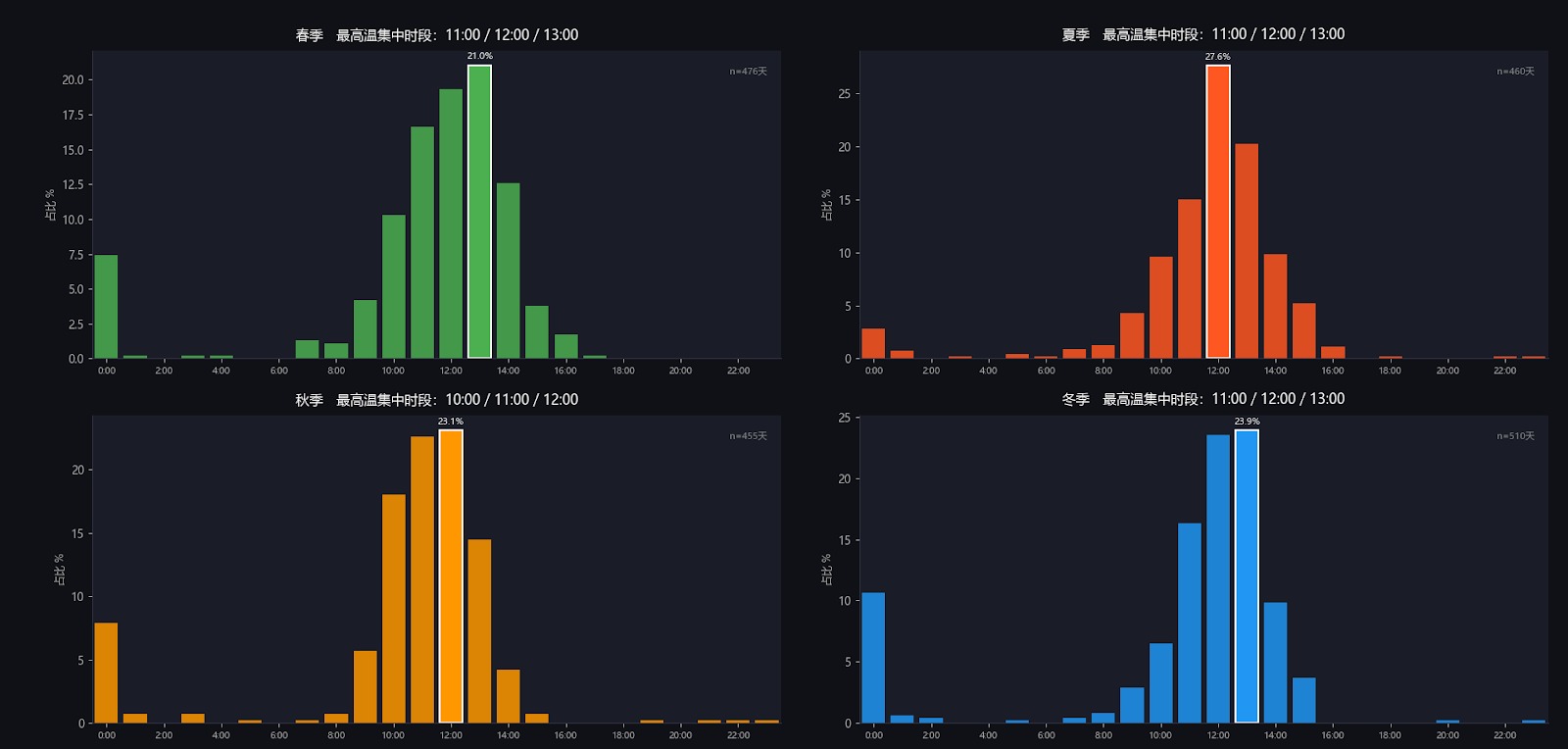
Analyzing nearly 1900 days of data from ZSPD station, the occurrence of the highest temperature in Shanghai is more concentrated than expected:
All four seasons are highly concentrated from 11:00 to 13:00,
The concentration at 12:00 in summer is the highest, with this single hour accounting for 27.6% of the entire season.
The peak period in autumn is slightly earlier, with 10:00 also being one of the high-frequency periods.
Knowing the patterns is the first step, but the patterns won't monitor the market themselves. What time will the highest temperature occur each day, whether it will be refreshed, and how far it is from the range.
So I built this system: to accurately predict which Celsius range the maximum temperature will fall into before each day's settlement.
2. Five methods, three have worked
Once the market rules are understood, the next question is: how to predict the highest temperature of the day?
As a meteorology novice, the first step is to ask ChatGPT: how does the meteorological industry calculate the day's highest temperature, and what are the established methods? ChatGPT provided a theoretical framework, and Claude turned the framework into code. The two AIs collaborated, and in one weekend, the system was set up.
A total of five methods were tested, ultimately only three worked.
Working methods:
1️⃣ WC + ECMWF Integrated Forecast
To predict the highest temperature, you first need data. Two sources were used:
Weather Company (WC) is a commercial weather API that provides hourly forecast data with high accuracy;
ECMWF is the European Centre for Medium-Range Weather Forecasts' global weather model, more sensitive to large-scale weather systems.
Each source has its strengths and weaknesses, so they are weighted and voted. The weights are dynamically adjusted according to the type of weather that day: on clear days, trust WC more; in weather with high cloud cover and wind speed, trust ECMWF more.
2️⃣ Real-time correction: using warming data to calculate the peak value
The forecast is based on calculations made last night, but today’s weather is always changing. So what this module does is use real measured data from this morning to estimate how high today's maximum can go.
The logic is not complex; I found that in Shanghai, 8-9 AM is the fastest warming period. After obtaining the real-time temperature at this moment, the system checks historical data: on average, how many more degrees it normally rises at the same season and time.
Then two corrections are added:
If there are many clouds, apply a discount multiplier; the thicker the cloud cover, the more it hinders warming.
Strong winds also apply a discount; strong winds will accelerate heat loss. This results in an "extrapolated estimate".
Air pressure, dew point, and humidity are also included in the calculations, but since back-testing showed these factors had less impact and lower correlation, they were removed.
However, relying solely on extrapolation is not stable enough; here I used the concept of Kalman gain, which simply means taking a weighted average between the "extrapolated results" and the "original forecast", and this weight will automatically change over time.
At 6 AM, extrapolation only accounts for 20%, mostly relying on the forecast
By noon, extrapolation accounts for 72%
After 1 PM, it almost completely trusts the measurements, accounting for 85%
The later it gets, the more important the immediate events become; the earlier it is, the greater the reference value of historical forecasts.
After 2 PM, the system judges that the peak has likely passed and directly locks the highest temperature result for the day from historical records, no further calculations made.
3️⃣ Is today a warming day?
This is the most satisfying module in the entire system, making a judgment every early morning: will today’s highest temperature be higher than yesterday's?
Every morning between 2-4 AM, the system collects a batch of weather data and feeds it to this model:
Pressure changes over the past 3 hours and 12 hours
Wind direction and speed in the early morning, cloud conditions
Yesterday's temperature fluctuations, the temperature trend over the past three days, whether yesterday's temperature was high or low
Plus the month, season, which day of the year it is, and whether it rained yesterday
The model outputs five categories: warming day, slightly warming, stable, slightly cooling, cooling day, while also providing confidence levels.
However, this method has varying accuracy across different seasons.
Most accurate in winter: when cold air comes, the pressure rises sharply, and the north winds strengthen, the signals are extremely clear, and the model can identify it at a glance.
Worst in autumn: the tug-of-war between warm and cold air masses, with temperatures rising one day and falling the next, causes historical patterns to fail the quickest in this season.
Methods eliminated:
Fourier numerical forecasting
Initially, I tried using Fourier analysis to fit the cyclical patterns of historical temperatures to see if it could directly predict the highest temperature for the day.
The result was that it could only tell you "historically, this season averages this temperature". The randomness of Shanghai's weather is too high; the Fourier fitting produces a smooth average curve, not the real daily fluctuations. The error is 3.6°C, and it systematically underestimates by 100%, so it was directly discarded.
ERA5 peak time prediction
ERA5 is a global historical reanalysis dataset from the European Climate Centre, used to predict at what time the day’s highest temperature will occur.
Back-testing results:
≤1 hour accuracy 59.6%
≤2 hours accuracy 81.3%
It sounds decent, but the problem is that PM's accuracy is higher, leaving a very short judgment window for traders. If it cannot make a peak judgment within half an hour, it is better to look at Polymarket's data, so this method was discarded.
3. System practice: Two cases and reflection on shortcomings
Polymarket's weather market opens trading four days in advance, and popular temperature ranges are typically fully priced early in the opening. Directly buying on high probability ranges has a poorer risk-reward ratio.
So the strategy I adopted was: wait for signals and wait for the time window after warming before entering the market.
Thus, based on my built weather system, I made the following two operations:
Case 1:
In the early morning of the 16th, a report was pushed on the Telegram channel: Tomorrow is a cooling day. The reason is that the cloud cover that night is thick, and both the seasonal and annual order characteristics point in the cooling direction.
At this point, I did not immediately place a bet. The early morning signal was only the first layer of reference. 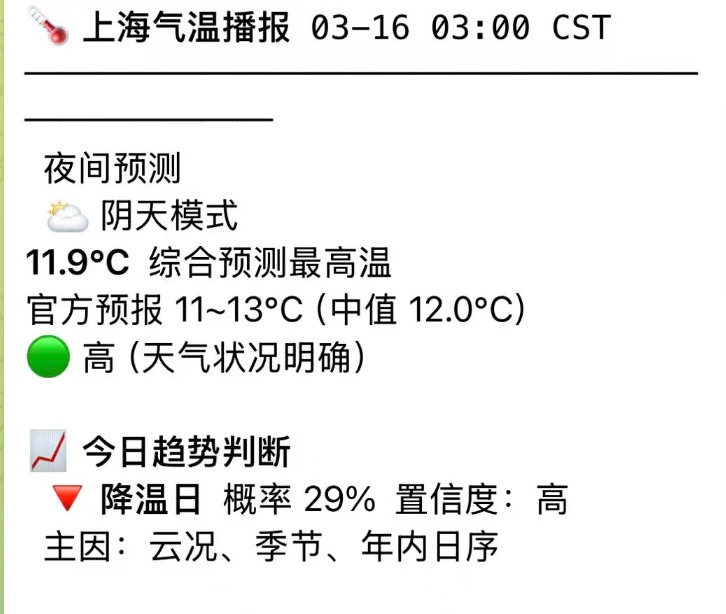
By 11 AM, the system pushed a real-time report on the warming period. At that time, the actual highest temperature had reached 12°C, and the probability scoring for a +1°C rise was given: today's chances of rising another degree are 42%, leaning towards no further warming.
Combining this with the morning's logic regression signal leaning towards cooling, the signals from the two modules were consistent, making the signal clearer than in the early morning. So I bet that the maximum temperature on the 16th would not exceed 13°C.
Settlement for that day: 12°C. The previous day, the 15th, was 15°C, a full drop of 3 degrees. 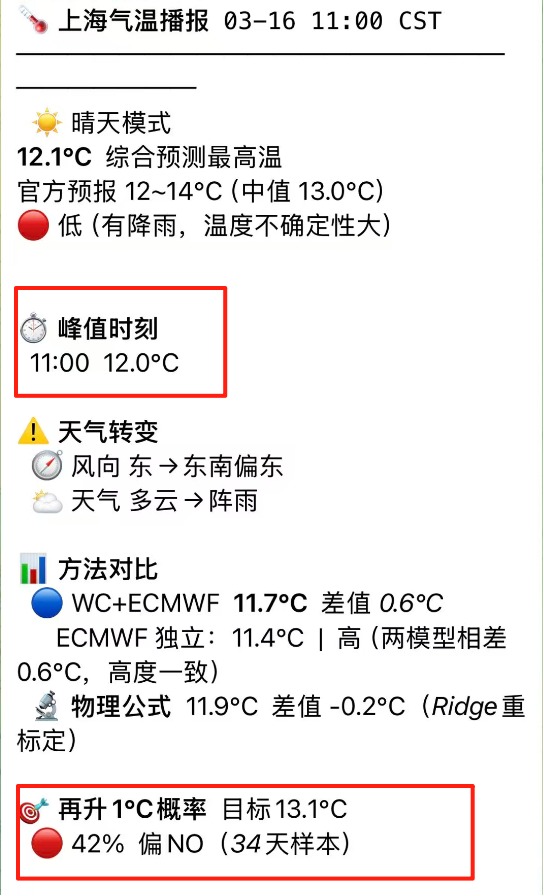
Case 2:
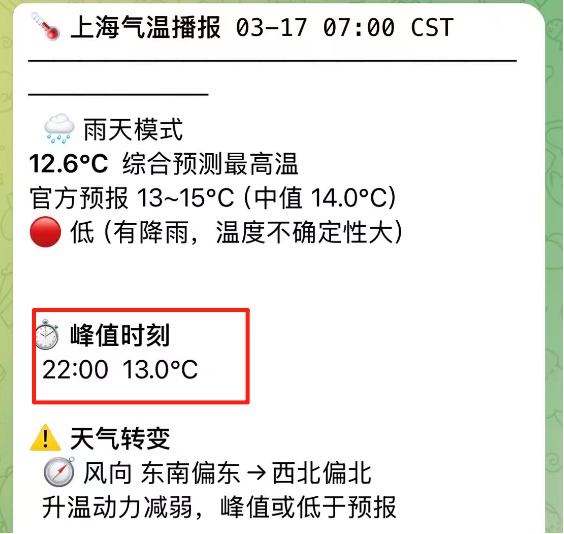
For example, regarding Shanghai's weather on the 17th, the weather system could serve as an early warning: at 7 AM, the push notification displayed an abnormal peak time: 22:00
Normally, the highest temperature on clear days occurs from 1-3 PM, but today the peak is at 10 PM, indicating this is not heat from sunlight but rather warm moist air being transported at night. It rained all day, with cloud cover of 97-100%, and almost no sunlight.
At this time, I opened Polymarket to see that the pricing for 12°C was still at 53%. Some in the community were confused: it’s already afternoon, and the temperature is only 11°C. The normal peak period has long passed; why is everyone still buying 12°C?
This confusion stems from everyone still using the logic of clear weather to judge the rainy day's market.
The system is not confused. It identified the weather type for today early in the morning, noted the abnormal peak time, and recognized a significant deviation between the current temperature and market expectations. This is an information gap, and an information gap is a trading opportunity.
This is precisely the significance of building this system: it makes it easier to identify opportunities; and provides quicker warnings in the face of risks.
What shortcomings does the system still have
Creating a system over a weekend, it’s impossible to avoid flaws:
The accuracy in autumn is only 63.7%, close to flipping a coin. The tug-of-war between warm and cold air masses occurs repeatedly in this season; temperatures can rise today and fall tomorrow, causing historical patterns to fail the quickest in autumn.
Pressure characteristics cannot be accessed in real trading. While training the model, I used pressure changes as a feature, and the back-testing results were satisfactory. The signal when cold air is passing through is very clear. However, in real trading, the current interface cannot obtain real-time pressure data.
Coastal corrections are still waiting for data activation. The sea breeze effect at Pudong Airport is real; the system has built corresponding corrective modules, but there are not enough back-testing samples yet.
Finding these issues in a system that ran for only one weekend is already a gain. I will continue to improve it as we go.
Conclusion
Meteorology has developed over hundreds of years, using satellites, supercomputers, and global models, yet weather forecasts still cannot guarantee 100% accuracy for tomorrow. It's not that scientists aren't trying hard enough, but the atmospheric system itself is chaotic, and a degree off in initial conditions can lead to completely different results.
This system that ran for just one weekend will also make mistakes. The accuracy in autumn is close to that of flipping a coin; if the cold air arrives early, the system may not respond, and the sea breeze effect has not yet been fully captured.
But that doesn’t matter. Making predictions in the market doesn’t require being right every time, just having an advantage in odds, seeing one more layer of information than the market.
Shanghai's weather market is still in its early stages, and I will continue to track this system, refining it as I go. If you are also involved in the Polymarket weather market, feel free to discuss in the comments: what methods do you use to judge entry timing? What unexpected settlement results have you encountered?
免责声明:本文章仅代表作者个人观点,不代表本平台的立场和观点。本文章仅供信息分享,不构成对任何人的任何投资建议。用户与作者之间的任何争议,与本平台无关。如网页中刊载的文章或图片涉及侵权,请提供相关的权利证明和身份证明发送邮件到support@aicoin.com,本平台相关工作人员将会进行核查。


