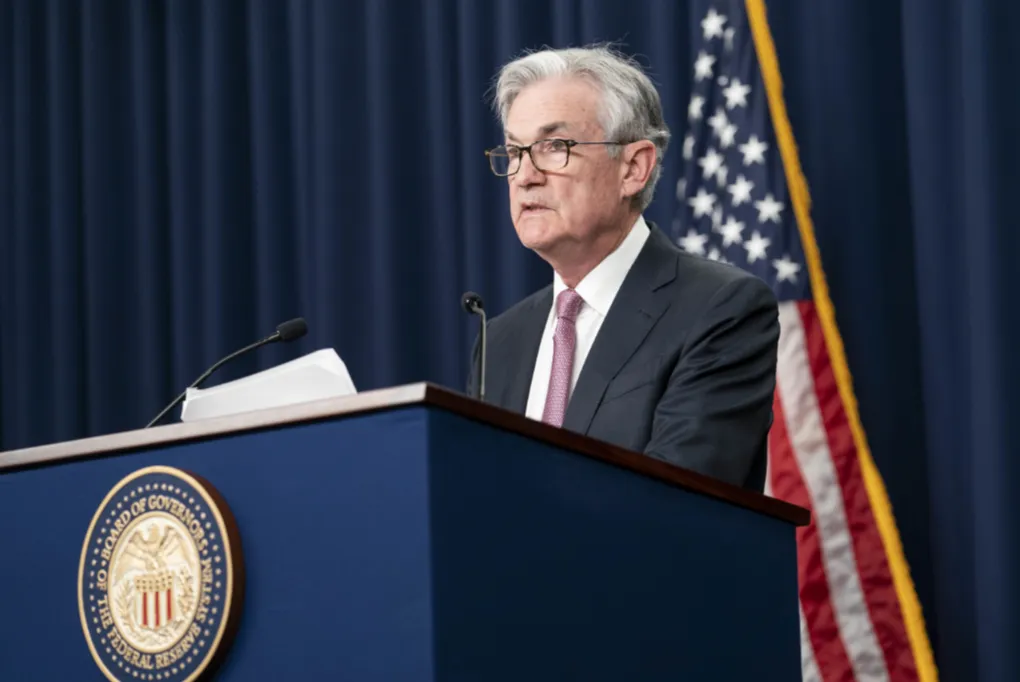
On March 18, 2026, Eastern Standard Time, the Federal Reserve Open Market Committee concluded its interest rate meeting, keeping the federal funds rate unchanged in the 3.5%-3.75% range, continuing the inaction since the end of last year. The latest dot plot indicates that committee members expect the midpoint of the 2026 rate to be around 3.4%, which corresponds to only one 25bp rate cut throughout this year, starkly contrasting with Trump's public demand for a "significant rate cut." Under this "quasi-stagflation + hawkish" expectation, dollar liquidity has not loosened significantly, and the cryptocurrency market is constrained by high interest rates and tightened credit, while also facing amplified regulatory and macro uncertainties; the market sentiment has shifted from fantasy of "water flooding Jinshan" to cautious searching for stock game and structural opportunities.
Only One Rate Cut: The New Script from the Fed
The dot plot after this meeting anchors the midpoint of the 2026 rate at 3.4%, indicating that the decision-makers currently only expect one symbolic 25bp rate cut for the whole year, rather than the continuous easing cycle the market had been repeatedly betting on. Behind this script is a judgment about the stickiness of inflation and the resilience of employment: the Federal Reserve prefers to sacrifice some growth elasticity rather than reigniting asset bubbles and overheating consumption before inflation fully recedes.
On the pricing front, the futures market has already expressed its stance. According to CME tool data, the probability of investors expecting a 25bp rate cut in June is only about 11%, meaning the market hardly anticipates the Fed opening the easing floodgates proactively in the visible quarter. The interest rate expectation curve has steepened significantly compared to last year, with the short end remaining at high levels, real rates rising, creating systemic discounting pressure on overvalued, long-duration assets.
Notably, the Fed explicitly mentioned in its post-meeting statement that geopolitical risks in the Middle East have been included in policy considerations, but emphasized that this alone is insufficient to change the baseline scenario. In other words, even with rising external uncertainties, the committee is unwilling to "support" the market through preemptive rate cuts, opting instead to continue monitoring inflation and employment data changes. This posture, marked by clearly named risks yet a refusal to loosen, underscores a cautious "tightening rather than loosening": within their framework, short-term volatility in financial markets is bearable, but further damage to monetary credibility cannot be gambled with.
Under the Shadow of Quasi-Stagflation, Why Is the Liquidity Gate Not Opening?
Institutions like China International Capital Corporation summarized the current state of the U.S. economy as "quasi-stagflation": on one hand, inflation stickiness persists with core price pressures not easing; on the other hand, growth momentum begins to slow, some leading indicators weaken, and profit and employment in certain industries have started to diverge. This "neither cold enough nor hot enough" macro backdrop is nearly the worst combination for monetary policy—any significant easing could be interpreted by the market as again condoning inflation.
In this expectation, the Fed finds it challenging to support the asset market through consecutive rate cuts or balance sheet expansions as before. High interest rates are forced to persist longer; risk assets must undergo a more thorough repricing: whether it's U.S. growth stocks or Bitcoin and high-Beta tokens on the chain, future cash flows and long-term narratives must be reassessed under higher discount rates. Those valuation systems heavily reliant on "liquidity illusion" will be the first to expose vulnerabilities.
For crypto assets, quasi-stagflation means the threshold for incremental funds has been raised. Institutional asset allocation tends to favor short-duration, high credit quality instruments, while retail investors, facing pressure from wages and living costs, show decreasing marginal demand for high-volatility assets. The on-chain world thus becomes more reliant on the internal rotation and narrative switching of existing funds: from Bitcoin to Ethereum, and then to various hot sectors, each localized price increase is more about redistribution of chips than new real money continuously flowing in. This explains the recent contradiction in the market where "new concepts keep emerging, but the overall volume fails to increase."
Trump Wants Dramatic Rate Cuts, Powell Stays Steady: The Collision of Two Logics
On another narrative front, Trump continuously demands the Fed to "significantly cut rates," and his political appeal is easy to understand: in an election cycle, loose monetary policy means a better stock market, more optimistic consumption expectations, and a more perceivable "economic report card." For political figures reliant on emotional mobilization and wealth effect, the lower the interest rates, the more advantageous it is to create a façade of "prosperity," which also helps alleviate the pressure of fiscal constraints and debt load on public opinion.
In contrast, the Fed, as a technocratic agency, offers a mild path of one 25bp rate cut in the dot plot, emphasizing a "data-dependent" and "inflation-first" professional stance. The message the decision-makers are trying to convey to the market is: monetary policy will not become an electoral tool, and short-term political cycles should not override long-term price stability goals. This restraint, while maintaining institutional credibility, inevitably creates tension with some demands from the White House and Congress.
This tug-of-war creates additional uncertainty regarding future policy paths. The market must continuously reprice between "if political pressure escalates, will the Fed be forced to become more dovish" and "if it insists on independence, will it tolerate deeper asset adjustments." For an already highly volatile cryptocurrency market, such uncertainty is a double-edged sword: downward, any "hawkish surprises" could trigger concentrated liquidations on-chain; upward, a hint of "political intervention leading to unexpected easing" could quickly escalate into a new risk chase. The high-Beta characteristics render the crypto market a magnifier of emotions and liquidity in this political-economic game.
From Private Credit to Crypto Enterprises: The Chain Reaction of Tightened Credit
CICC noted in its research report that the emergence of private credit risks may trigger a spontaneous tightening of financial conditions. This means that even if the Fed's nominal interest rates remain unchanged, the market might raise risk premiums, shorten durations, and tighten credit due to concerns about the quality and leverage structure of certain assets. Once the credit pulse shifts from expansion to contraction, the effective supply of liquidity within the financial system could experience an "invisible turning point," with the pressures on real and financial assets often manifesting later.
Within the crypto industry, this tightened credit has been concretized into two vastly different survival states. On one hand, the Algorand Foundation announced a 25% workforce reduction on March 18 while holding a significant amount of assets, choosing to actively cut expenses and shrink its organization in response to rising fundraising difficulties and project valuation adjustments. This "defensive balance sheet reduction" is essentially a preemptive response to a pessimistic future financing environment.
On the other hand, there are paths like Fold company, which lost $69.6 million in 2025 yet achieved a 34% customer growth: choosing to expand its user base despite ongoing losses, betting on scale effects and future compliance/collaboration dividends. This type of business model is highly dependent on external funds; during periods of tightened financial conditions, its financing window is significantly shortened, and risk tolerance is compressed.
From primary to secondary markets, the tightening of financial conditions impacts the crypto ecosystem in a chain reaction: primary financing rounds decrease, valuation discounts deepen, and project financing cycles are prolonged; in the secondary market, market-making and arbitrage capital costs rise, liquidity depth declines, price fluctuations are amplified, and the "silence" frequency of tail assets increases. In such an environment, small-cap tokens find it more difficult to traverse cycles; projects that can truly endure must either be supported by stable cash flow and real demand or be embedded in a larger narrative of institutional and infrastructure restructuring.
Traditional Wall Street Goes On-Chain: Tokenized Stocks and the New Race of Crypto
As macroeconomic easing expectations continue to be suppressed, another long-term mainline is quietly taking shape—traditional financial infrastructures are beginning to systematically go on-chain. On the regulatory front, the SEC has approved Nasdaq to launch a pilot program for tokenized stocks, utilizing the DTCC settlement system, meaning one of the largest capital markets in the world is connecting on-chain bookkeeping with traditional settlement networks, exploring how to reconstruct the technological foundation of securities trading within the existing compliance framework.
The advancement of such tokenization projects is shifting the focus of market narratives: in an environment where expectations of "easy money bull markets" are being repeatedly dampened, funds and practitioners are partially shifting their attention from short-term price games to longer-term questions of "how financial market structures are being transformed by blockchain." The efficiency of trading and settlement, asset programmability, and costs of cross-border transfers—these technical details, once reserved for industry discussions, are now being included in the realistic planning of Wall Street.
However, the rise of tokenized assets also means intensified competition for funds and attention with native crypto assets like Bitcoin. When allocating institutional funds, there inevitably needs to be a balance between "traditional assets on-chain" (tokenized stocks, bonds, etc.) and "pure crypto assets" (BTC, ETH, and their ecosystems): the former enjoys a clearer regulatory path and cash flow foundation, while the latter represents higher sovereign currency hedging and decentralized premiums. From a valuation perspective, as more traditional assets move on-chain, discussions around "how risk premiums should be allocated among different types of blockchain assets" will compel the pricing logic of crypto assets to align more closely with traditional finance—at least within the framework of some investors, Bitcoin will no longer solely be "digital gold" but also one of the "risk factors in the on-chain asset universe."
No Longer Expecting a Flood, What Will Drive the Next Round?
In summary, the Fed's hawkish rate path, the policy constraints under quasi-stagflation expectations, and potential triggers of credit tightening in areas such as private credit collectively create multiple pressures on the liquidity of the crypto market. In contrast to the straight-line story of "central banks easing—risk assets rising together" seen in previous cycles, the current environment features more cautious faucet openings and slower financial intermediation transmissions; on-chain assets are facing the realities of higher costs and lower tolerances.
In such a world, the narrative of relying on a "liquidity bull" is retreating, replaced by the emergence of "integration of applications and institutions bull": on one side, tokenization, compliant custody, and on-chain settlement are embedding crypto technologies into the institutional framework of traditional finance; on the other side, fully-fledged on-chain applications with users and cash flow are being revalued. Future winners are more likely to be those protocols and enterprises that can survive under the triple constraints of regulation, technology, and business models, rather than high-leverage gamblers solely dependent on macro trends.
Looking forward to the next few quarters, three main threads are worth tracking: first, whether the rate path will encounter turning points due to inflation or political pressure, forcing the Fed to adjust between "only once" and "multiple small rate cuts"; second, the evolution of credit events, particularly whether systemic risks emerge in the private credit and shadow banking sectors, accelerating spontaneous tightening of financial conditions; third, the progress of interoperability between traditional finance and on-chain markets, including more pilot projects for tokenized assets, connections between mainstream exchanges and on-chain infrastructure, and the establishment of channels for compliant funds to enter crypto. Amid these intertwined clues, the next trend in the crypto market will likely no longer be determined by a single "water level height," but rather reshaped by a new order formed after the contest of institutions, technology, and capital.
Join our community to discuss and grow stronger together!
Official Telegram community: https://t.me/aicoincn
AiCoin Chinese Twitter: https://x.com/AiCoinzh
OKX benefits group: https://aicoin.com/link/chat?cid=l61eM4owQ
Binance benefits group: https://aicoin.com/link/chat?cid=ynr7d1P6Z
免责声明:本文章仅代表作者个人观点,不代表本平台的立场和观点。本文章仅供信息分享,不构成对任何人的任何投资建议。用户与作者之间的任何争议,与本平台无关。如网页中刊载的文章或图片涉及侵权,请提供相关的权利证明和身份证明发送邮件到support@aicoin.com,本平台相关工作人员将会进行核查。