Original Authors: Zhang Qianwen, Cheng Chuying
Introduction
As crypto assets evolve from simple trading activities to specialized asset management, more Web3 project teams, quantitative teams, and high-net-worth individuals are beginning to adopt a fund structure to operate crypto assets. In this process, the choice of fund legal structure is no longer a mere formality, but a fundamental decision that directly relates to risk isolation, tax treatment, and long-term compliance operations.
From a regulatory perspective, the differences between various jurisdictions in fund establishment systems, regulatory requirements, and tax arrangements determine the respective adaptive investment strategies and fundraising targets. Whether it is multi-strategy quantitative trading, primary market investments, or family office asset allocation, there is no "optimal structure," only a "suitable structure" that matches the business model.
This article will break down the six major mainstream crypto fund structures worldwide, analyzing their core mechanisms and applicable scenarios to provide references for compliance layout for managers.
Cayman SPC: An "Umbrella Company" Suitable for Multi-Strategy Parallel Operations
SPC (Segregated Portfolio Company) is a corporate form in the Cayman Islands, characterized by the ability to establish multiple independent investment portfolios (SP) under one legal entity.
- Core Mechanism: Risk Isolation
The assets and liabilities of each SP are legally separated. For instance, if Strategy A incurs losses, its creditors can only seek payment from A, and cannot touch the funds of Strategy B. This is crucial in the highly volatile crypto market, effectively preventing one strategy's "blowup" from pulling down the entire operation.
- Applicable Scenarios:
When managers operate both high-risk and low-risk strategies simultaneously, SPC allows for each to be accounted separately without interference. Furthermore, if new products are to be launched, a new sub-fund can be established directly under the existing SPC without needing to re-register a company, making it cost-effective and quick. It is suitable for teams looking to rapidly incubate new strategies.
Cayman ELP: A "Partnership Structure" Suitable for Primary Market Investment
Unlike the corporate structure of SPC, ELP is a partnership structure established under the Exempted Limited Partnership Act. It does not have independent legal personality but consists of a contractual relationship between general partners (GP) and limited partners (LP). ELPs are widely used in the fields of venture capital (VC) and private equity (PE).
- Core Mechanism: Clear Division of Duties
GP (General Partner) is responsible for managing funds and investments and bears unlimited liability (in practice, a limited company is usually used as the GP to isolate risk); LP (Limited Partner) only provides capital and does not participate in management, with liability limited to their investment amount.
- Applicable Scenarios:
Primary market investments involve complex profit distribution, which can be flexibly agreed upon in the partnership agreement regarding how and when to distribute profits. Additionally, the ELP has tax transparency, meaning the fund does not pay taxes at the fund level, and the LP list does not need to be disclosed to the public, balancing tax efficiency and privacy protection.
BVI Approved Fund: An "Entry-Level Compliance Solution" for Small Teams
For small and nascent teams, the BVI (British Virgin Islands) Approved Fund offers a compliant option with low barriers and controllable costs.
- Core Mechanism: Filing System, Simplified Regulation
Establishment is quick, generally taking two to three days to approve after materials are submitted. There is no requirement to hire an auditor or a local custodian, significantly reducing operational costs.
- Applicable Scenarios:
It is suitable for teams managing less than $10 million, still in the strategy validation phase. This allows for establishing a compliant entity at a lower cost while accumulating performance records. The upper limit of investors is 20, with a maximum asset size of $100 million, suitable for fundraising from acquaintances or communities.
Singapore VCC: Balancing Compliance and Practicality in an "Onshore Fund Structure"
VCC (Variable Capital Company) is a fund form introduced by Singapore that retains the flexibility of offshore funds while having the regulatory backing of the Monetary Authority of Singapore (MAS).
- Core Mechanism: Umbrella Structure + Tax Incentives
VCC can also support the establishment of multiple sub-funds with asset isolation. Most importantly, it can apply for 13O/13U tax exemptions, allowing eligible investment income to be tax-exempt and dividends not subject to withholding tax.
- Applicable Scenarios:
Suitable for teams looking to set up an office in Singapore, obtain work visas, and build family offices. With internationally recognized compliance status and privacy protection for investors (the shareholder register is not public), it is very appealing to those seeking stable long-term capital.
Hong Kong LPF: A "Cross-Border Fund Channel" Connecting the Asian Market
LPF (Limited Partnership Fund) is a localized fund structure launched by Hong Kong, benchmarked against Cayman ELP, registered and managed locally under Hong Kong law.
- Core Mechanism: Localized Limited Partnership
The structure is similar to the Cayman ELP, but all legal matters and communication with banks are conducted locally in Hong Kong, avoiding barriers due to time difference or language.
- Applicable Scenarios:
If the team primarily operates in Asia, LPF is very convenient for lawyer coordination, bank account opening, and daily maintenance. Additionally, with Hong Kong's Unified Fund Exemption (UFE)制度, qualifying funds can enjoy profits tax exemption, making the tax environment quite friendly.
Hong Kong OFC: An "Open-End Fund Structure" Suitable for Public Offerings or ETF Issuance
OFC (Open-Ended Fund Company) is a type of open-end fund structured as a corporation, with independent legal personality that can flexibly respond to investors' subscription and redemption requests.
- Core Mechanism: Variable Capital, Flexible Structure
OFC can increase or decrease shares based on subscription and redemption demands, breaking the limitations of traditional corporate capital reduction. It can serve both private placements and public offerings (subject to SFC approval).
- Applicable Scenarios:
The Hong Kong government encourages the development of OFCs by offering reimbursement of up to 70% of establishment costs (capped at HKD 1 million per fund), effectively reducing startup costs. Additionally, the OFC is one of the mainstream structures for issuing virtual asset ETFs and public fundraising in Hong Kong, suited for high-liquidity trading strategies.
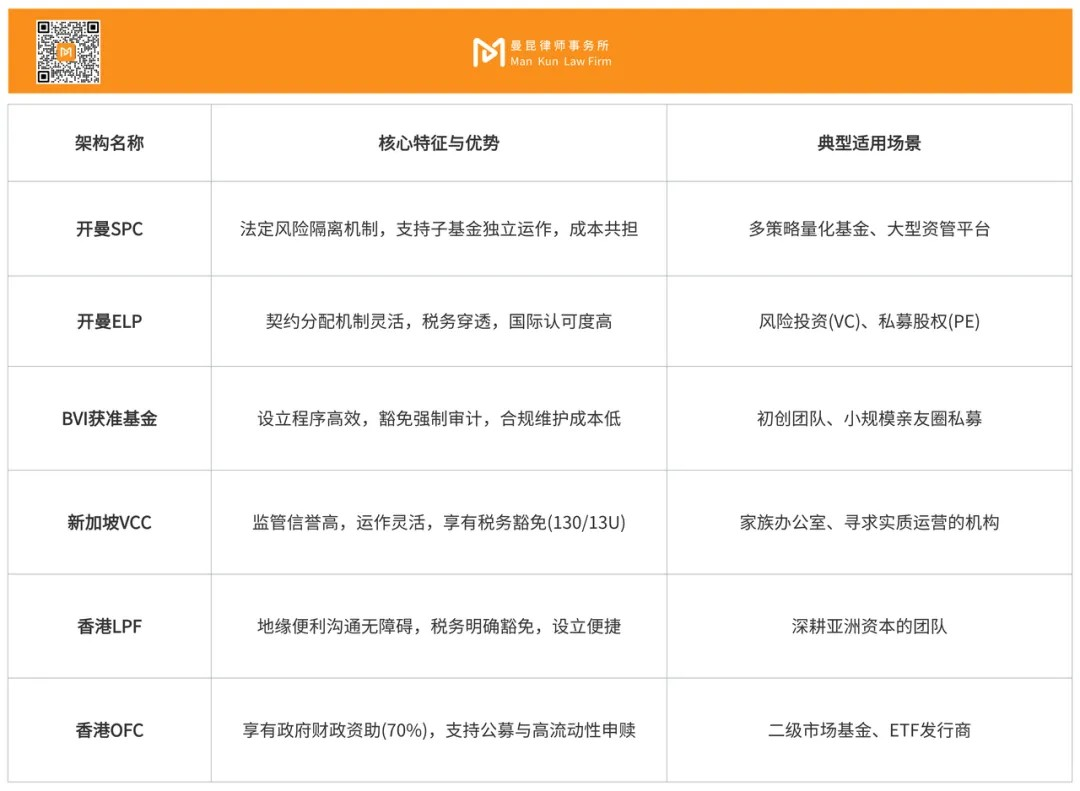
Overview of Core Features of Six Structures
Based on the above analysis, the legal characteristics and applicable scenarios of the six mainstream fund structures are summarized as follows:
Conclusion
In the field of crypto assets, the question of fund structures has never been about "whether to establish," but rather "when to establish and in what form to establish". Different legal structures correspond to not only how taxes are paid and how regulations are enforced, but also how risks are borne, how investors participate, and how future operating models will be developed.
The fund structures introduced in this article do not have inherent good or bad qualities; the key is whether they match your business model, investment strategy, and target investors. For managers who have already or plan to operate crypto assets in the form of funds, clarifying and establishing structural issues sooner rather than later acts as an important risk control measure.
免责声明:本文章仅代表作者个人观点,不代表本平台的立场和观点。本文章仅供信息分享,不构成对任何人的任何投资建议。用户与作者之间的任何争议,与本平台无关。如网页中刊载的文章或图片涉及侵权,请提供相关的权利证明和身份证明发送邮件到support@aicoin.com,本平台相关工作人员将会进行核查。


