Author: Raoul Pal The Journey Man
Translated by: Baihua Blockchain
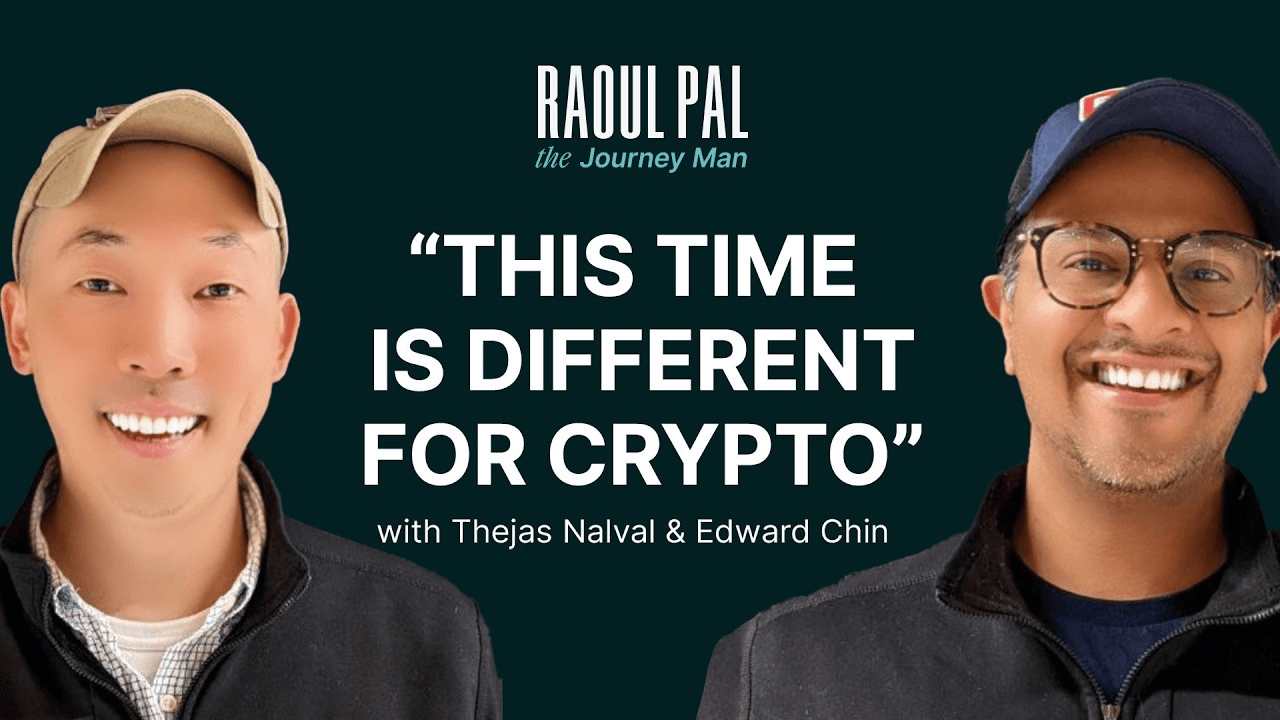
As Bitcoin oscillates during the crash and altcoins even experience extreme pullbacks of 99% in a single day, most people flee in fear, while true hedge fund hunters are decoding furiously behind the scenes. Is the 1010 crash a tragedy of liquidity exhaustion, or is it a "desperate survival" of large institutions caught in inventory?
This article deeply examines the private conversation between Raoul Pal, founder of Real Vision, and top trader at Parataxis Capital. We will tear apart the superficial market structure, revealing the survival tricks of market makers in the ETF era, and directly address the ultimate proposition that makes all investors anxious: Has the mysterious "four-year cycle" come to an end? More importantly, we will explore for the first time a severely undervalued trillion-dollar variable—AI Agent Economy. As hundreds of billions of sleep-free robots flood onto the blockchain, what kind of exponential explosion will the potential market size of cryptocurrencies welcome?
This is not just a ruthless recap about arbitrage and liquidation, but a survival guide to the exponential era of 2030.
Part One: The Leap from Traditional Finance to Cryptocurrency
Raoul Pal: Hey guys, it's great to have you on Real Vision. Before we dive deep into the market discussion, please introduce your backgrounds and how you got to where you are today.
Ed: Great, Raoul. I am Ed (Edward Chin), founder and CEO of Parataxis Capital. We've been deeply involved in the crypto space for about 7 years. Our core business is a multi-strategy hedge fund. I come from a traditional finance background, having spent over a decade in TMT (Technology, Media, Telecommunications) investment banking, involved with traditional debt, equity, and mergers and acquisitions.
About seven years ago, we recognized the trend you've been discussing—the institutional adoption of digital assets. We wanted to take an institutional approach to provide exposure with manageable risk. Currently, we operate multiple mutual fund tools and SMA (Separately Managed Accounts), covering quantitative systematic, thesis-driven, and credit strategies.
TJ: Thank you, Ed. I'm TJ (Tejas Narwal), co-founder and CIO of Parataxis. My background is similar to Ed's, but most of my career has been on the trading side. I spent over a decade at Goldman Sachs.
Raoul Pal: Did we overlap during our time at Goldman? I left in 2000.
TJ: I started in 2005. I worked in the equity program trading department here in the U.S. In 2012, I first heard about Bitcoin in the trading floor, as an engineer next to me was mining it, and he got me to buy my first Bitcoin.
For traders, in the traditional stock world, your edge usually comes from scale, speed, or inside information. But the opposite is true for cryptocurrencies; your edge comes from actual operations, industry connections, and being able to execute tasks that large banks currently cannot. In 2017, I joined the crypto space full-time, afterwards met Ed, and we decided to start a business during the bear market of 2018.
Raoul Pal: It seems everyone launches funds at the worst times in the market. XPAM launched in November 2021, looking back, that was a "great" time.
TJ: That's true. But we believe in the long-term growth of this industry, and the market is full of inefficiencies. A hedge fund that can exploit these inefficiencies and opportunities can establish a significant competitive advantage.
Ed: I started my career during the collapse of Lehman Brothers in 2008, the year Satoshi Nakamoto's white paper was just released. I encountered Bitcoin in 2010, but back then I chose high-yield bonds (laughs). At the end of 2019, during the initial outbreak of COVID, we launched our first fund. We experienced the massive leverage liquidation on BitMEX in March 2020, and those moments really make you question your life.
Part Two: Evolution of Multi-Strategy and Global Layout
Raoul Pal: What was your initial strategy? Were you both running the entire book at that time?
Ed: Yes, initially it was multi-strategy with a long bias. We had momentum, thesis-driven, and uncorrelated strategies. In the crypto space, if you constrain yourself to a single type of return, that arbitrage opportunity might disappear 12 months later, and the business will be gone.
TJ: We believe that the market is very volatile, and it makes sense to tactically switch between different risk exposures. Early investors wanted outperformance (Alpha) and convexity relative to Bitcoin.
Ed: We subsequently evolved deeper strategies. In 2021, we saw opportunities in the private credit space of digital assets, launching tools to provide DeFi yields for institutions. Between 2022 and 2025, we also took advantage of the collapsing prices of mining machines by acquiring equipment from bankruptcies like BlockFi and Celsius, becoming one of the largest private miners in the U.S.
The current natural evolution focuses on the regulated securities space. With the launch of BlackRock's ETF, we are thinking about how to maneuver the market within a regulated framework. We launched two Digital Asset Treasury Tools (DATs) in Korea, based on Bitcoin and Ethereum respectively.
Raoul Pal: Are those Korean tools trading at a discount or a premium?
Ed: They are currently trading at a 3 to 5 times premium.
Raoul Pal: You must be joking! But I can understand, as the supply side is severely lacking. Korean retail traders are extremely enthusiastic, but they do not have channels like spot ETFs or Coinbase and can only buy proxy products through brokerage accounts.
Ed: Exactly, that's the reason for the "kimchi premium." This is a classic case of a supply-constrained market.
Part Three: Decoding the 1010 Incident and Market Distortions of ETFs
Raoul Pal: TJ, you have a background in ETFs. Many are writing about how ETF flows impact prices and how hedging trades create a "false" prosperity through the futures market. Do you think this changes the market structure?
TJ: I think it has a huge impact when there is a massive one-way flow. If the market is all selling the ETF, market makers have to buy on the other side and take on a lot of Bitcoin exposure on their balance sheets. According to the Basel III requirements, the capital requirements for holding Bitcoin are very expensive.
This leads to a working theory: due to the high cost of financing these positions, market makers eventually have to sell these exposures back to the open market. If it's the S&P 500 index (SPY), market makers can easily hedge and hold, but for Bitcoin ETFs (like IBIT), the selling pressure will hit the open market directly.
Raoul Pal: Do you think that is the source of the selling pressure that often appears at 10 AM?
TJ: I'm not sure, but there are indeed some "tricks" in the market. The NAV of IBIT is calculated based on the volume-weighted average price (VWAP) from 3 PM to 4 PM. On low volume days, that price can be artificially manipulated.
Raoul Pal: That supports my argument about the 1010 incident. At that time, Binance's API crashed for market makers, and there were no buyers in the market, only automatic liquidation stop-loss orders. Retail traders and hedge funds were locked out, and liquidity completely evaporated. Some institutions may have been stuck with $10 billion in assets on their books at that moment.
Ed: I agree. This is similar to the flash crash caused by Knight Capital's algorithm going wrong in traditional finance in 2010. But the crypto market is the purest expression of a free market; the deleveraging process is extremely violent.
After the 1010 incident, the market structure indeed changed. Bitcoin had been outperforming the Nasdaq, but that relationship broke after 1010. At the same time, rising gold prices drained liquidity, hitting Bitcoin at the end of the risk curve.
Raoul Pal: Indeed, those illiquid altcoin positions cannot be cleared within a week. Coupled with liquidity exiting the system, it created a perfect storm.
Part Four: Has the Four-Year Cycle Come to an End?
Raoul Pal: How do you view the future market? Does the so-called "four-year cycle" still exist?
TJ: According to the four-year cycle theory, there should have been a "blow-off top" in the fourth quarter of last year, but it did not happen. The 1010 incident changed the psychology of Bitcoin whales, and many sell-offs were pulled forward.
At the same time, many traditional hedge funds were doing "buying spot ETFs + selling CME futures" arbitrage trades. When indiscriminate selling happened in November last year, I think those funds were deleveraging.
From the current perspective, although traditional investors are still focusing on the four-year cycle, with the entry of long-term capital like BlackRock and Michael Saylor, the holding structure has changed. I don't think the four-year cycle is as relevant as it used to be.
Ed: I must cautiously say these four words: "This time is different." But indeed, the trillion-dollar pools of capital that were previously inaccessible to this asset class are now entering through regulated packaging (ETF). Looking at the precedent of gold ETFs, once there is regulated packaging, although there are short-term fluctuations, the long-term trend is always upward.
Raoul Pal: I have always been cautious. I do not think the cycle has disappeared, but I believe the market is dominated by business cycles (ISM) and liquidity cycles. Historically, there has never been a case where cryptocurrency enters a long-term bear market while ISM is rising and liquidity is increasing. Rather than believing in the mysterious four-year cycle, it is better to acknowledge that it is fundamentally driven by macro cycles.
Part Five: Yield Risks and Counterparty Crises
Raoul Pal: Let's talk about option structures. Right now, everyone is selling covered calls to generate income; does this create vulnerability?
TJ: Currently, it mainly involves monthly options. When the market touches the concentrated range of strike prices, the market makers' Delta and Gamma management will trigger volatility. But as yields are compressed, the attractiveness of this strategy will decrease.
Raoul Pal: And MicroStrategy (MSTR). Michael Saylor created a complex capital structure through convertible bonds.
TJ: The premium of MSTR has converged some now. As long as Bitcoin rises, hedge funds will buy convertible bonds and short the stocks to arbitrage. But what worries me is that if you forcibly create yield without the tool itself generating income, the risks will accumulate elsewhere.
Raoul Pal: Aave's $14 billion deposits also make me a bit concerned. If the tide goes out, liquidity disappears, and concentrated risks may erupt.
Ed: When we assess new protocols, the first question is always: where does the yield come from? DeFi summer relied on token inflation, which is unsustainable. We prefer to trade ABS (Asset-Backed Securities) backed by real assets like Figure, rated by S&P, which diversifies concentrated risks. We have evolved from the primitive stage of "you lend me, I lend you" like Genesis and Three Arrows Capital.
Part Six: Policy Games and the Clarity Act
Raoul Pal: What do you think the chances are for the Clarity Act (cryptocurrency regulation bill) to pass? My hypothesis is that the crypto lobbying group is an important funder for the Republican Party, and Trump must make some account for the midterm elections.
Ed: I think the probability of passage is greater than 50%. Brian Armstrong (Coinbase CEO) just went to Trump's office.
Raoul Pal: Imagine the U.S. president forcing banks to sign a crypto bill; that would have been unthinkable in 2013.
Ed: Indeed. If the bill passes, institutions like pension funds and endowments will have one less huge barrier during compliance checks, and they can really start allocating.
Raoul Pal: Moreover, potential Treasury Secretary candidate Scott Bessent is a macro hedge fund manager coming from the Soros system. He understands the rules of the game: infusing liquidity, boosting the stock market, raising ISM, and making people happy.
Part Seven: AI Agent—A Severely Undervalued Step Change
Raoul Pal: Let’s talk about the vision for 2026 and beyond. I recently realized that we have severely underestimated the TAM (Total Addressable Market) of cryptocurrencies.
The current model is based on the adoption curve of human users—predicting 3 billion wallets by 2030. But that is completely wrong. What we are tapping into is hundreds of billions of AI Agents.
TJ: Right. We started training our AI models for systematic macro trading last year. The trend in future fund management will be hedging and games between AI models.
Raoul Pal: This means that the "population" of the crypto economy will experience explosive growth.
TJ: AI Agents need native currencies for instant settlement. They operate on-chain, without the need for sleep. This is not just "more people using the chain," but a geometric increase in the scale of the entire addressable market (TAM).
Raoul Pal: This is a step change. Population growth + productivity growth = GDP growth. AI Agents are like instantly pulling an economy larger than China into global trade, and they operate inherently on smart contracts and crypto rails.
Conclusion: Cautious, Optimistic, or Extremely Optimistic?
Raoul Pal: Finally, what is your attitude towards the remaining time this year?
TJ: I never predict specific prices, but I believe we will hit historical highs this year. As for "Alt Season," I think Bitcoin's performance will be better this year, with Bitcoin's dominance showing an upward trend.
Raoul Pal: Oh, TJ, are you telling everyone we can't have nice things? It's all your fault (laughs). Ed, what’s your view?
Ed: Capital will first gather around Bitcoin, but sectors with real product-market fit (PMF) cannot be ignored. For example, decentralized exchanges like Hyperliquid with huge trading volumes. The market will become very nuanced, with some quality L1 and application layers showing absolute outperformance, but those 40,000 junk tokens will be ruthlessly cleared.
Raoul Pal: Got it. We will see outperformance in certain "pockets" rather than a general rise. Thank you very much for your insights.
This article link: https://www.hellobtc.com/kp/du/03/6261.html
Source: https://www.youtube.com/watch?v=qP7AHKzBSi8
免责声明:本文章仅代表作者个人观点,不代表本平台的立场和观点。本文章仅供信息分享,不构成对任何人的任何投资建议。用户与作者之间的任何争议,与本平台无关。如网页中刊载的文章或图片涉及侵权,请提供相关的权利证明和身份证明发送邮件到support@aicoin.com,本平台相关工作人员将会进行核查。


