In the age of information explosion, what is truly scarce may not be the opinions themselves, but who can see those unavoidable physical bottlenecks earlier.
Written by: Bibi News
An anonymous user named Serenity on platform X has achieved a return rate of up to 45 times in 2026.
The 25 stocks he publicly invested in all had gains between 1 times and 10 times. Among them:
- Swedish semiconductor company SIVE rose from a market value of less than $150 million to over 20 times;
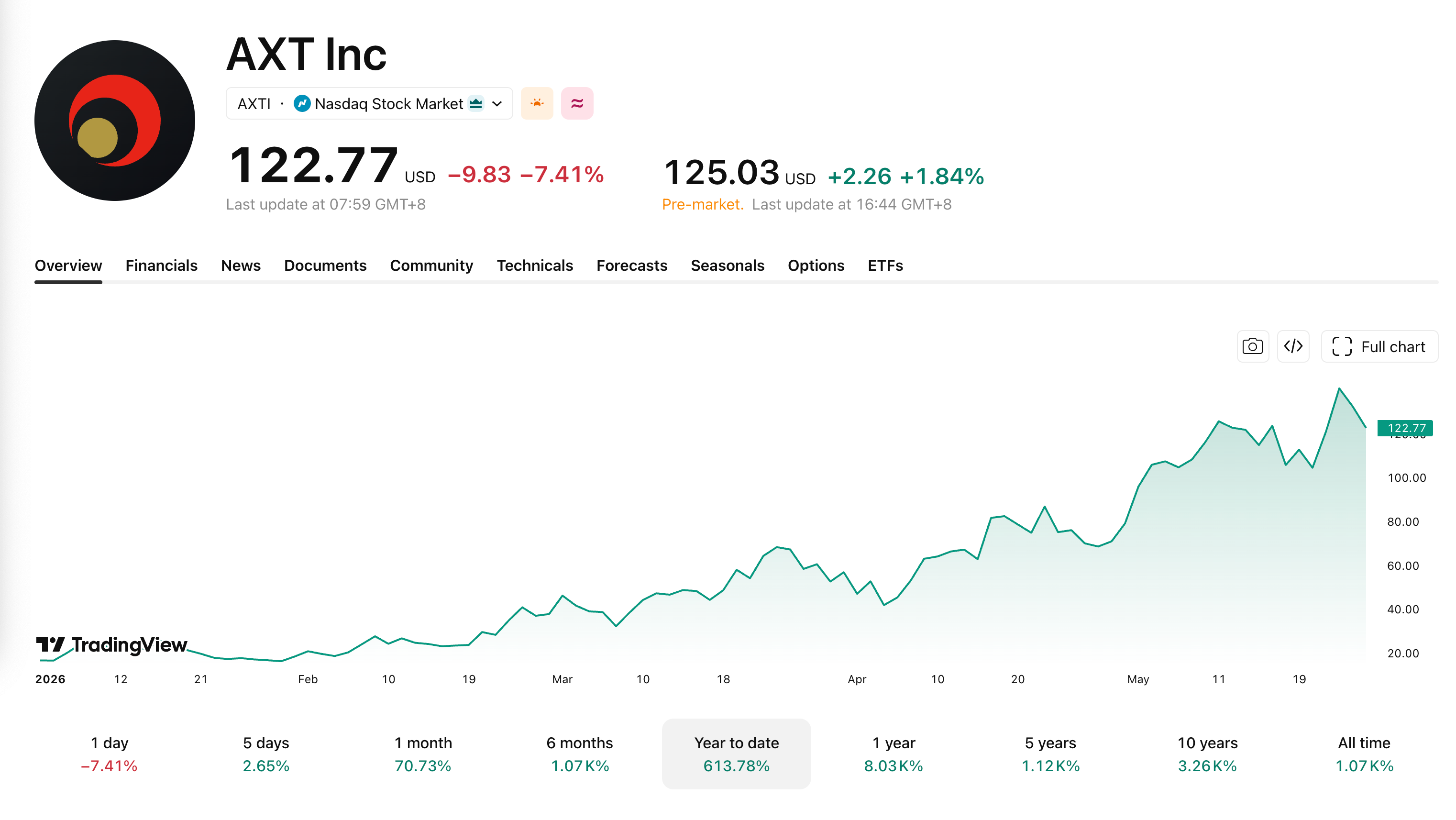
- American substrate material supplier AXTI started at $12 and is approaching the target price of $150 he wrote two years ago;
- British single-board computer manufacturer RPI experienced a single-day surge of 44% on earnings report day.
Since joining X less than a year ago, Serenity has amassed over 400,000 followers, with over 37,000 paid subscriptions. In the financial investment space, 30,000+ subscriptions are considered top-tier accounts, only slightly less than Musk.
In the Chinese community, people call him "White-haired Girl Stock God" based on his white-haired anime avatar.
Wall Street has also begun to pay frequent attention to him, listing his account as a must-see daily, with Bloomberg and Reuters quoting his research, and hedge funds tracking his posts.
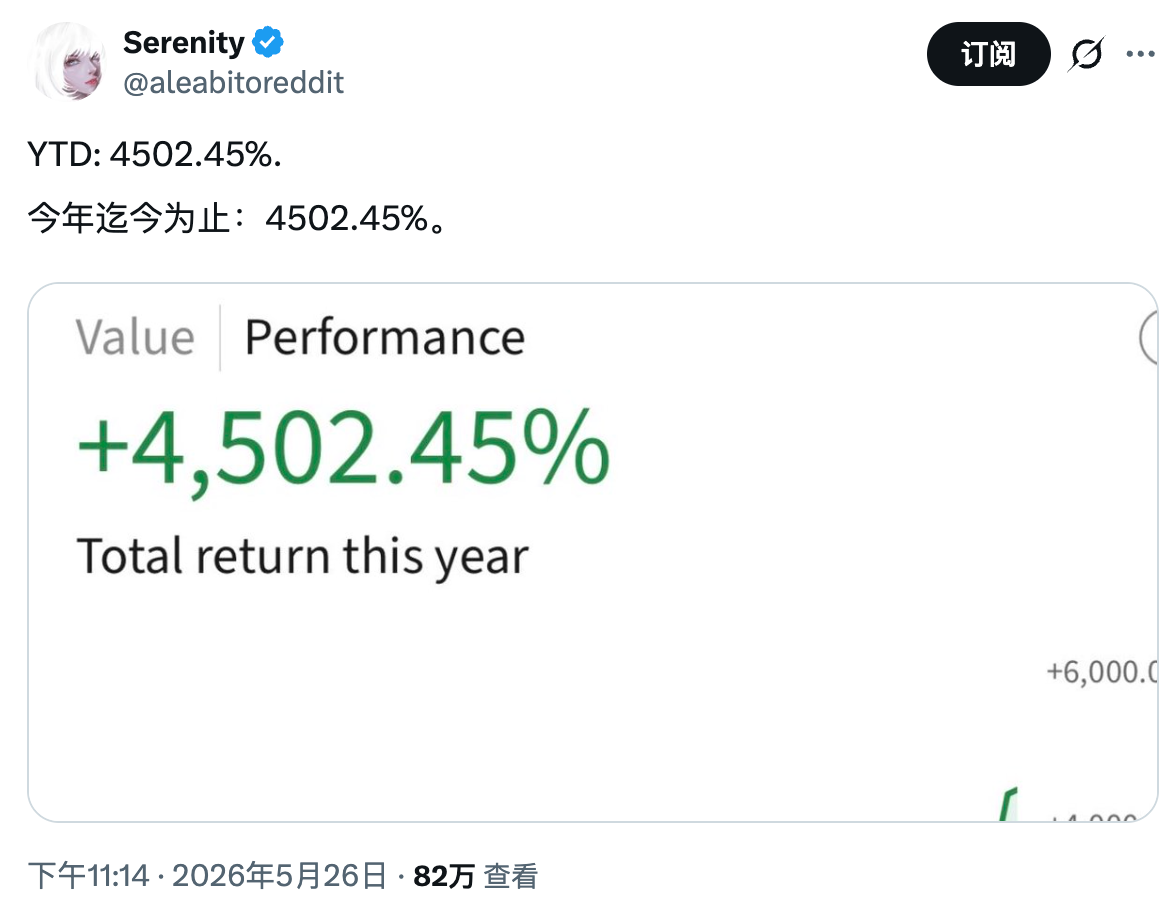
Who is Serenity?
Serenity describes his resume as a former AI research scientist, Nature paper author, member of the RISC-V Foundation, and having refused an offer from an AI team leader when NVIDIA's stock price was about $6 in 2018.
No one can verify these claims, but his track record makes it hard to question.
He first appeared with the account AleaBito on Reddit's WallStreetBets (WSB) — the most well-known retail investor community in the U.S., with this account registered on January 11, 2022.
WSB is known for its emotional calls, all-in option plays, and occasionally groundbreaking posts that disrupt market narratives.
Early AleaBito also brought this background, often using informal analogies for investment judgments.
Until early 2022, he posted an in-depth research post about AXTI on WSB, directly stating his target price: $15 to $150. The post contained no memes and no emotional slogans.
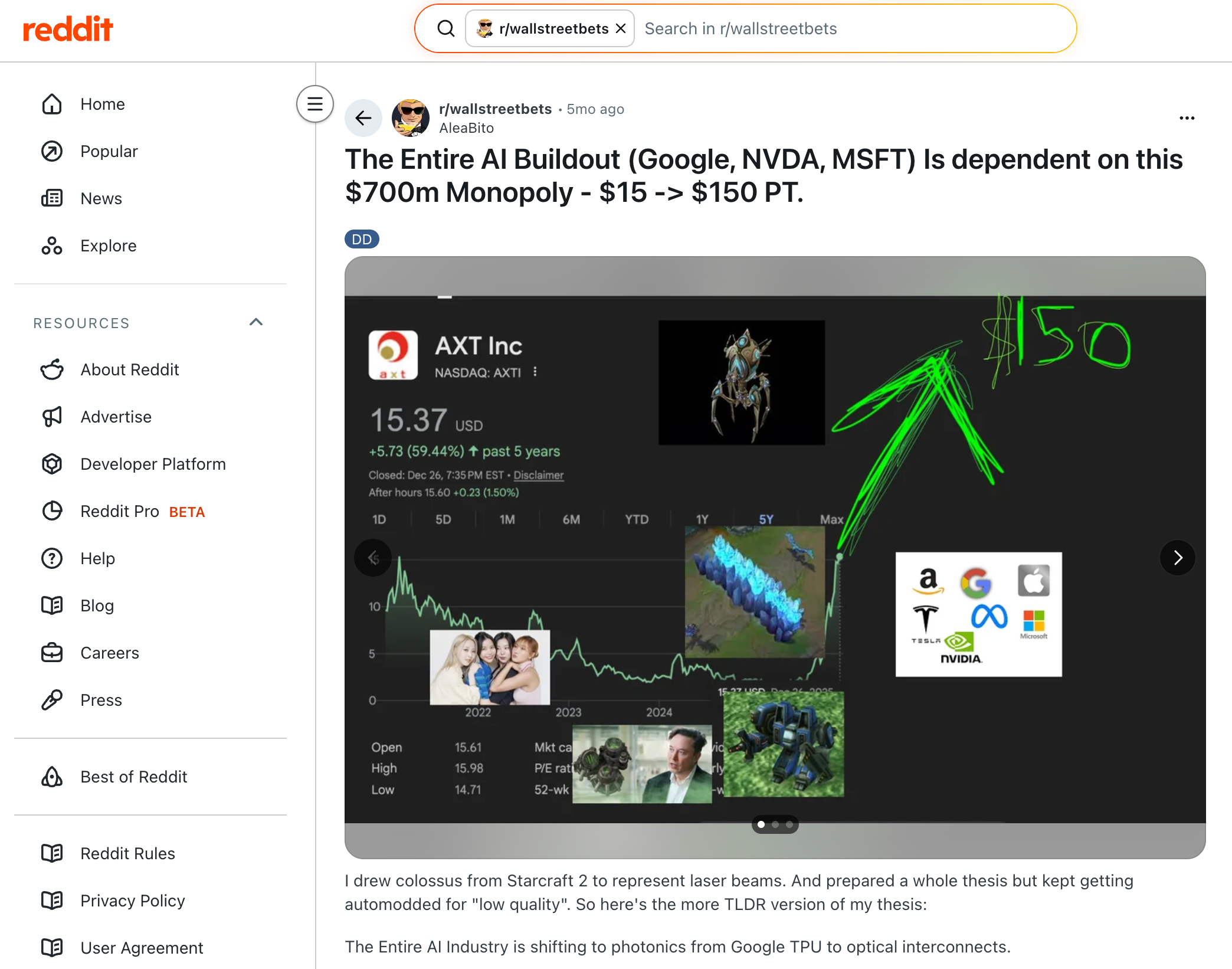
He personally drew a complete supply chain diagram from NVIDIA H100 clusters to optical engines to InP substrates, marking the global distribution of InP substrate capacities, where AXTI accounts for about 25% to 35%, and also sorted out material sources, geopolitical risks, and patent barriers.
The core argument was simple: the entire AI optical communication industry relies on this substrate; without it, the underlying material chain would break.
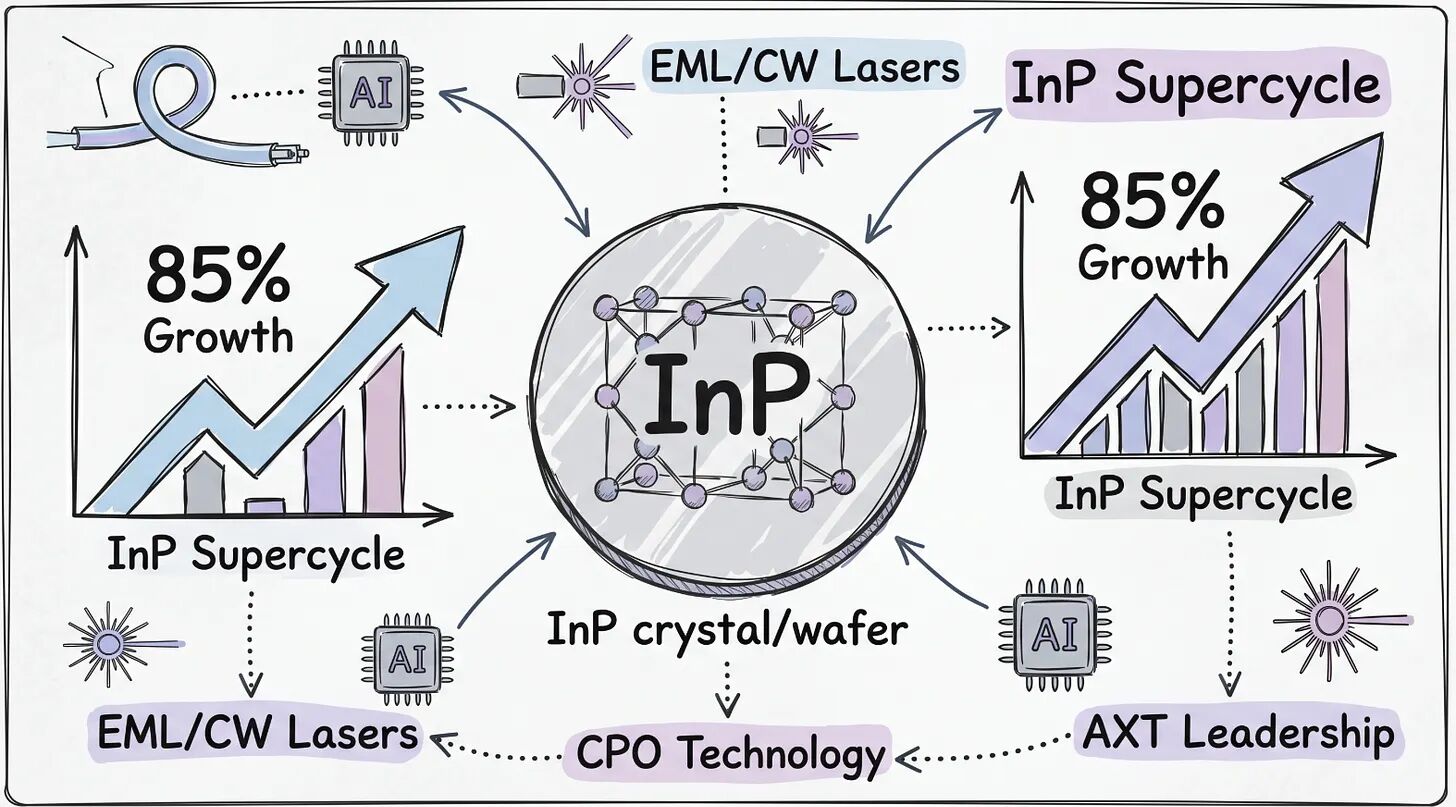
AXTI, full name AXT Inc., produces InP (Indium Phosphide) substrates, with a market value of about $200 million at the time and almost no institutional coverage.
The post was too technical and clashed with the atmosphere of WSB. The moderator permanently banned his account on the grounds of inducing speculation.
Afterwards, $AXTI started at $12 and eventually rose to over $70, with paper profits exceeding 1000% at one point.
In July 2025, he switched to X, starting to publish AI supply chain analyses in long thread format, containing detailed supply chain diagrams, material science paper citations, patents, and capacity maps.
In multiple posts, he repeatedly mentioned the same phrase: the earlier something is discovered, the more doubts will arise.
The Logic of Constant Breakdown
Serenity's investment methodology is referred to as the Perilla Leaf Theory in the Chinese community.
At top sushi restaurants, diners seek the fatty tuna, but what cannot be interrupted is that leaf from a small farm in Izu.
If there is no tuna, the menu can simply reduce a few dishes; if there are no perilla leaves, the whole restaurant can come to a halt.
The AI supply chain is similar. GPUs and large models are the tuna, while InP substrates, CPO lasers, and high-purity phosphorus materials are the perilla leaves.
This is also the most core investment logic of Serenity. Many people see AI companies frantically buying GPUs, but Serenity continues to break it down: how will GPUs communicate with each other? How is data transmitted? When tens of thousands of GPUs work simultaneously, what will be the first thing to break?
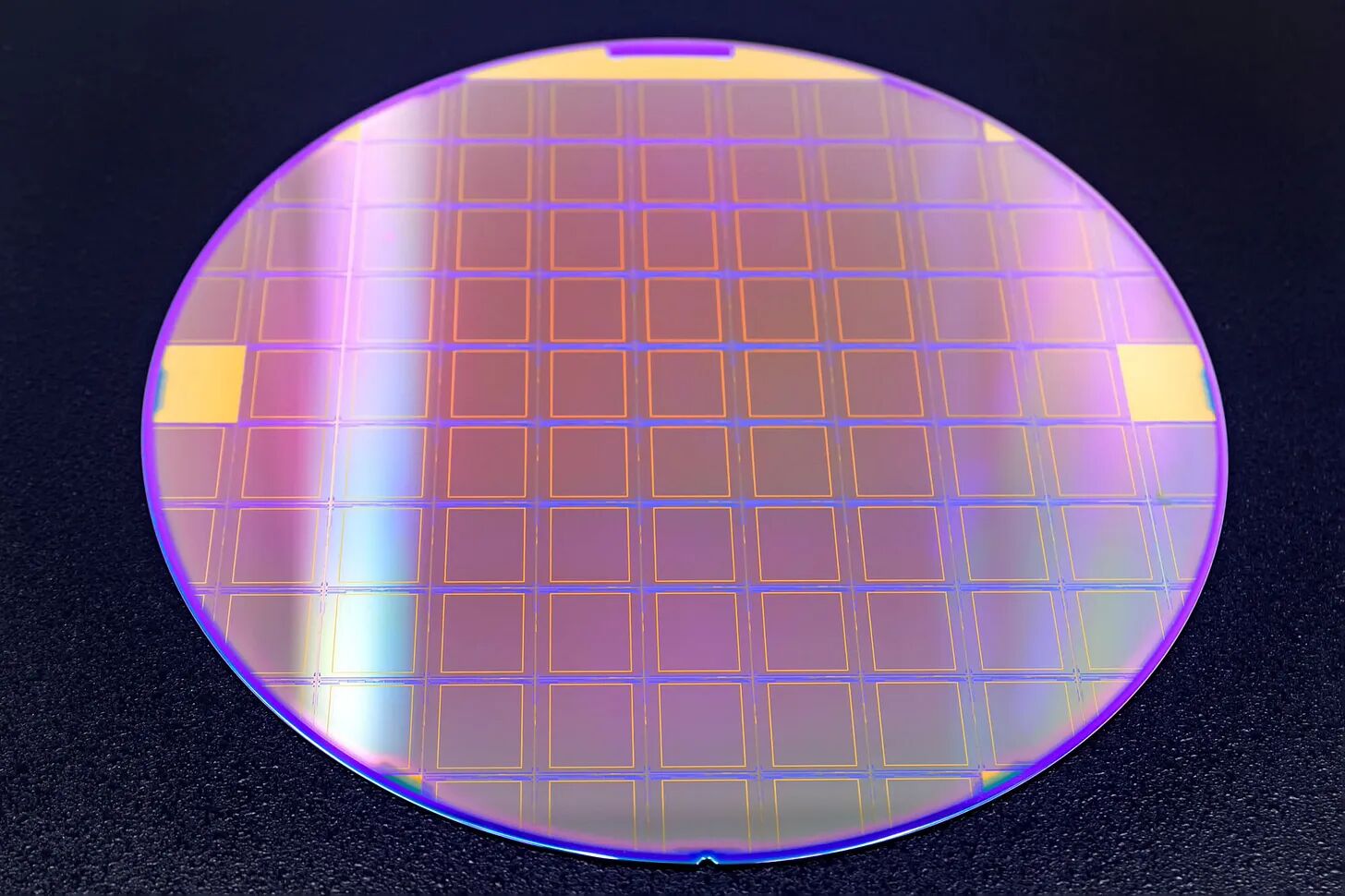
His answer is copper wire interconnects.
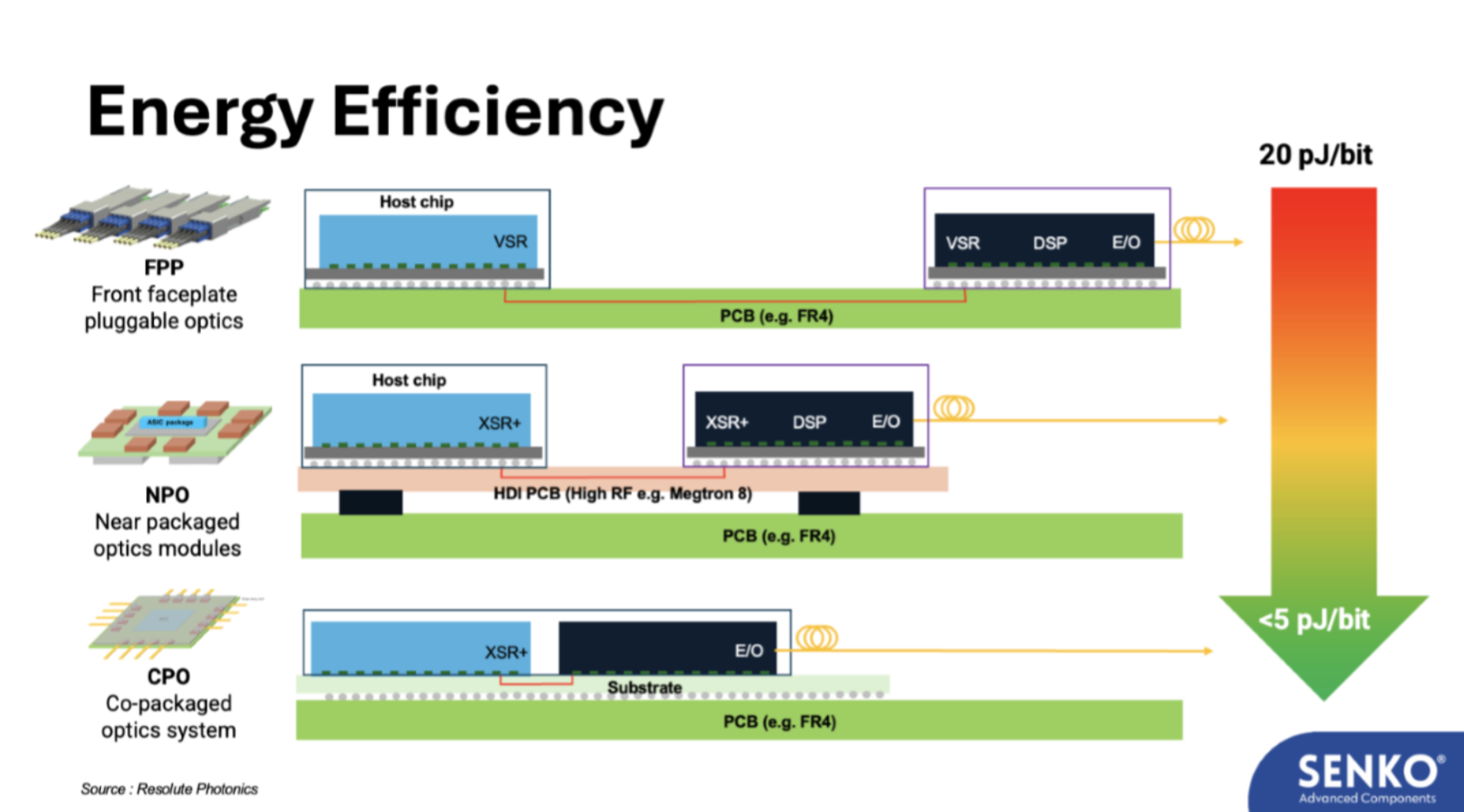
Previously, data centers mainly relied on copper wires to transmit electrical signals, but as AI clusters scaled up, traditional copper wire interconnect solutions hit physical limits in terms of power consumption and bandwidth.
When data centers begin to operate tens of thousands of GPUs in collaborative training, high-frequency electrical signals severely attenuate in copper wires, and the heat dissipation burden becomes enormous. In the end, the bottleneck is no longer GPU computing power but the inability to transmit information.
This is also why the CPO (Co-Packaged Optics) route emerged, packaging optical components with computing chips on the same substrate, compressing the originally several meters or even dozens of meters of data transmission distance to the millimeter level.
Tracing upstream along this CPO line, he identified five nodes he believes are truly bottlenecks:
Nano-level alignment components between optical fibers and chips, external continuous wave laser sources that CPO architectures must rely on, MBE equipment used for growing compound semiconductor epitaxial layers, high-purity phosphorus materials with purity requirements exceeding 6N, and SOI substrates for silicon photonic chips.
For each node, Serenity found a corresponding global scarce supplier.
He bypassed financial reports, starting from the capital expenditure of hyperscalers to reverse-engineer the pace of data center expansion, then to the physical boundaries of bandwidth/power consumption, and finally pinpointing which link is the narrowest bottleneck.
He digs into materials science papers, analyzes patents, sorts out capacity expansion plans, tracks supplier certification cycles, and pays attention to export control dynamics in various countries.
After completing a research draft, he inputs the entire logic into multiple AI models, letting them specifically search for loopholes, threats from alternative solutions, and potential valuation deviations. Only after this round of adversarial stress testing does he release his findings publicly.
The Most Representative Targets
In the past few years, the core targets that Serenity has publicly discussed mostly revolve around the same main line: physical bottlenecks in AI infrastructure.
From InP substrates, CPO laser sources, to optical transceivers, silicon photonics, and edge computing hardware, all of his strongly favored positions point to the same question: if AI continues to expand, what will become scarce first?
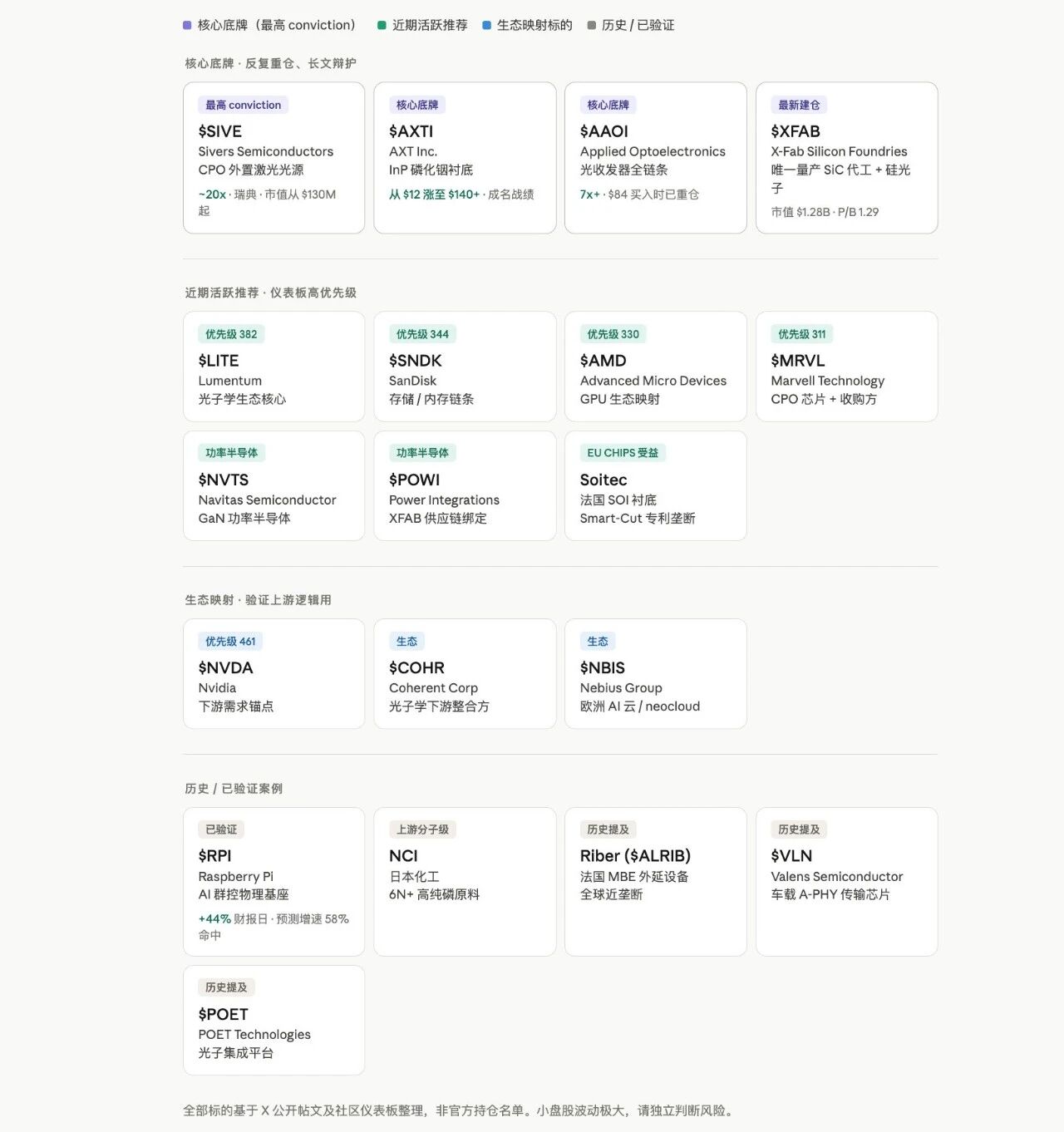
Among them, the most representative are $AXTI, $SIVE, and $AAOI.
The establishment of $AXTI is due to his early two-year notice of something that almost no one cared about at the time.
In early 2022, before ChatGPT was released, the market's attention was on GPUs, NVIDIA, and AMD, with competition over who could produce better training chips.
InP substrates are an extremely niche topic, a material that supplies a still undeveloped submarket, monopolized by a small company that is almost unknown.
He made an analogy with the Strait of Hormuz, approximately 20% of the world’s oil passes through the Strait of Hormuz, and whoever controls it controls everyone; what $AXTI is doing in the InP substrate line is just that.
$SIVE (Sivers Semiconductors) is currently his most steadfast holding.
This Swedish company provides the external continuous wave laser sources required for CPO architecture, one of the most scarce upstream assets in the optics and electronics co-packaged industry chain.
He started building his position when its market value was about $150 million, believing that $AVGO or $MRVL would likely end up spending $200 to $300 million to acquire it directly, securing the CPO laser supply chain.
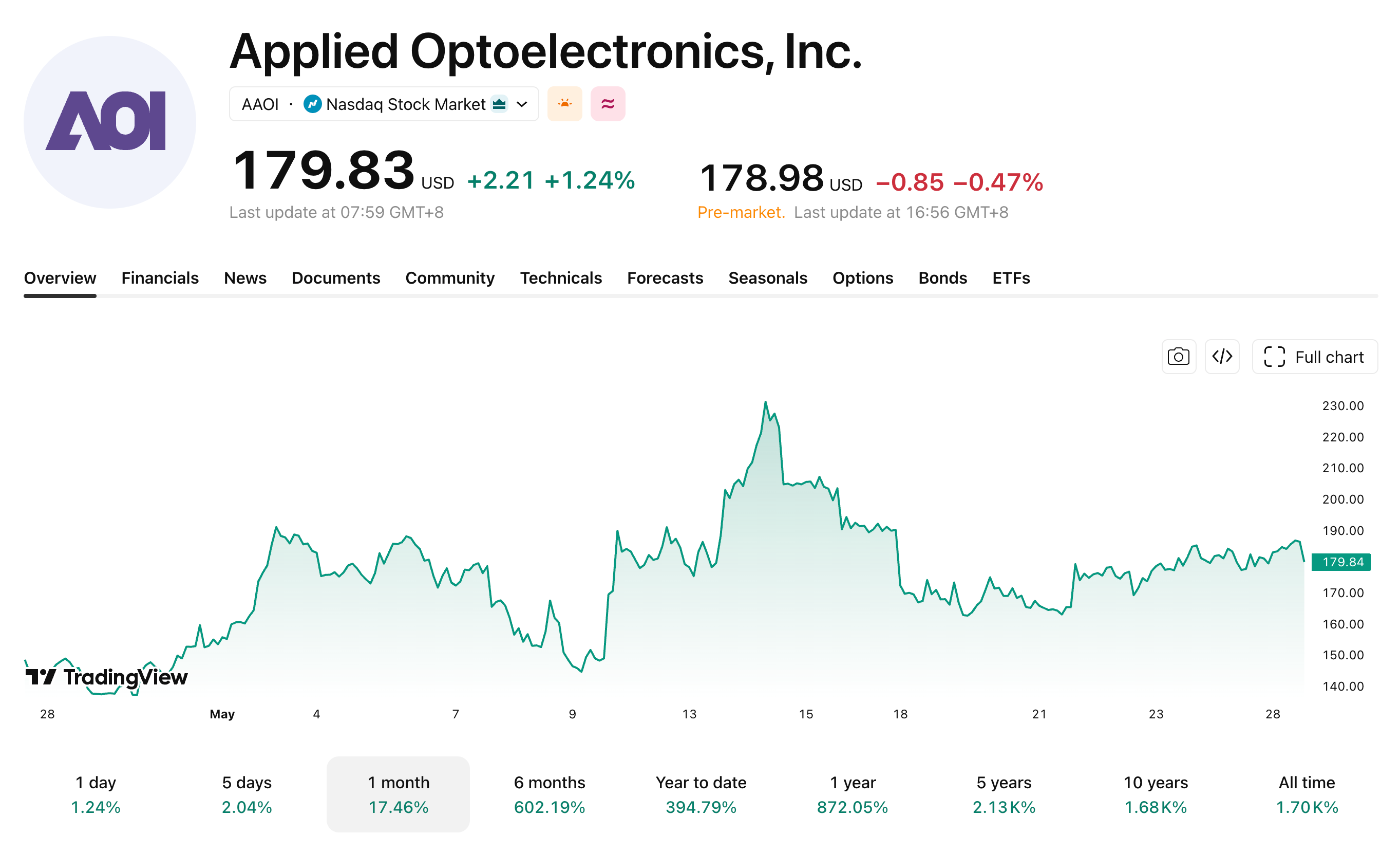
$AAOI (Applied Optoelectronics) is a full-chain player in optical transceivers, integrated from laser design, assembly to sales; he bought in believing its $660 million market value was severely underestimated, and its price has now surged over 7 times.
$RPI (Raspberry Pi) is a case that best proves his judgment.
Many people view $RPI as a low-cost single-board computer manufacturer for educational purposes, with little interest from institutions when it listed on the London Stock Exchange.
He, however, noticed that many AI startups were using $RPI as a physically isolated base for intelligent group control systems; this genuine procurement demand is transformative for a company worth only about £500 million.
He predicted two months in advance that the company's full-year revenue growth would be 58%, while the market consensus expectation was 14%; the actual number was 58%. After the earnings report was released, the stock price surged 44% in a single day, followed by another 27% the next day.
Of course, he also has moments of judgment failure.
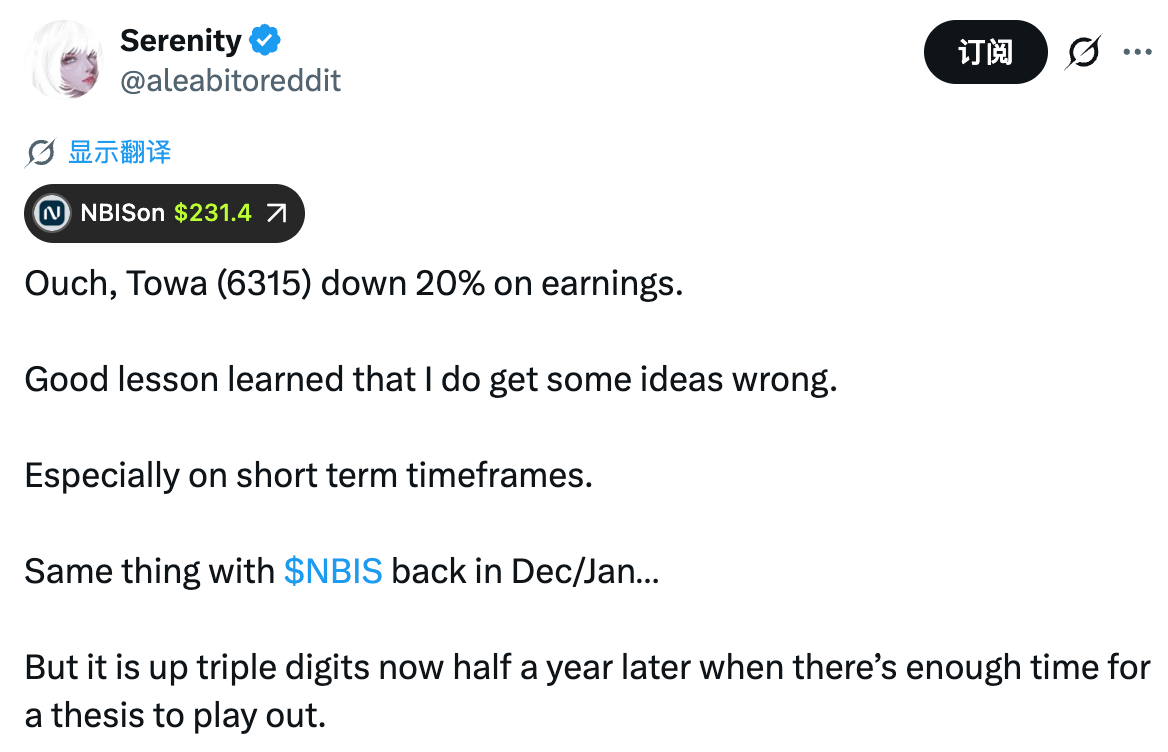
In 2026, he made a wrong bet on the earnings report of Japanese packaging equipment company $TOWA, causing the stock price to drop over 20% that day.
He posted that day: learned a lesson; I occasionally misjudge in the short term. The main reason was that one-time accounting factors and early customer costs compressed profits, but he believed that the logic for the second half of the year was not broken.
His latest target investment is $XFAB, the only high-volume SiC foundry in Europe and America, also possessing silicon photonics foundry capabilities, with a market value of about $1.28 billion and a price-to-book ratio of only 1.29.
The EU CHIPS Act 2 is expected to materialize soon, and evaluations of silicon photonics by NVIDIA and Nokia are also underway. From external characteristics, $XFAB and all his past hidden cards are highly consistent: small market cap, no coverage, located at the physical bottleneck of AI hardware, waiting for institutional rotation to validate.
What is Truly Scarce are Physical World Bottlenecks
Most of Serenity's core positions actually share the same main line: AI data centers will increasingly rely on optical interconnects and CPO architectures. Although the investment portfolio is dispersed among different companies, the underlying logic is highly consistent.
If in the future the interconnection routes of data centers change, or the pace of CPO advancement is slower than expected, these companies may also be affected simultaneously.
On the other hand, these types of targets mostly belong to small-cap companies with limited liquidity. For large institutional funds, the difficulties in position building, exiting, and managing positions are challenges, which is one reason Serenity could identify them in advance.
Most people, when discussing AI, focus on parameter scales, model architectures, and application scenarios.
Serenity discusses lasers, substrates, thermal losses, and molecular purity of phosphorus.
While the market is still debating which large model's benchmark looks better, he is already asking: at what scale will the data center cluster expansion hit a wall with copper wires? What is that wall physically? Where must one go to bypass that wall? Who is there?
Whoever holds the most scarce nodes on the physical chain of AI infrastructure will have the ability to charge tolls across the entire industry. This logic does not depend on any company's product decisions, does not rely on market sentiment, but solely on the laws of physics.
From an ordinary retail investor permanently banned from WSB to the anonymous supply chain detective now read daily by 400,000 fans, Serenity has almost continuously been breaking it down further.
From GPUs to optical modules, from optical modules to substrates, and then from substrates to materials and capacities.
In this age of information explosion, what is truly scarce may not be the opinions themselves, but who can see those unavoidable physical bottlenecks earlier.
免责声明:本文章仅代表作者个人观点,不代表本平台的立场和观点。本文章仅供信息分享,不构成对任何人的任何投资建议。用户与作者之间的任何争议,与本平台无关。如网页中刊载的文章或图片涉及侵权,请提供相关的权利证明和身份证明发送邮件到support@aicoin.com,本平台相关工作人员将会进行核查。


