This proposal opens up channels for cryptocurrency asset allocation for UCITS funds and the majority of non-UCITS retail collective investment schemes, but explicitly prohibits licensed funds from holding native cryptocurrencies directly.
Written by: Liam 'Akiba' Wright
Translated by: Saoirse, Foresight News
Core Overview
- The UK Financial Conduct Authority (FCA) is publicly seeking opinions on allowing UK UCITS funds and most non-UCITS retail funds (NURS) to allocate to cryptocurrency exchange-traded notes (ETNs), with a position limit of 10%.
- The new regulations will allow ordinary retail funds to indirectly position in crypto assets but still prohibit funds from directly holding native cryptocurrencies such as Bitcoin and Ethereum.
- Whether this policy can truly be implemented widely lies in the hands of fund managers; stringent disclosure, liquidity checks, and product suitability requirements may deter asset management institutions.
The UK Financial Conduct Authority is reviewing a new regulation that plans to allow UCITS fund products and the majority of non-UCITS retail funds to hold cryptocurrency exchange-traded notes, with holdings limited to no more than 10% of the fund's total assets.
This proposal is included in the FCA consultation document "CP26/17," which will further incorporate cryptocurrency exposure into the regulated public fund system. Previously, ordinary retail investors could already purchase crypto ETN products individually on exchanges, and the core issue the new regulation aims to address is how much of this type of note can be allocated within a diversified portfolio managed by licensed fund management institutions.
The regulatory answer is strict limitations. Funds can only allocate to these assets when the crypto ETN matches the fund’s publicized investment objectives and risk levels, and there is a hard cap on the overall position.
The proposal clearly states that directly holding Bitcoin, Ethereum, and other native cryptocurrencies for investment purposes is still outside the permissible scope. Public consultation regarding fund-related regulations will close on July 13, 2026.
Specific Allowed Position Limits
This new regulation draft introduces a channel for crypto asset investment with position limits for UK UCITS funds and non-UCITS retail funds, except for special exceptions. The position restrictions are calculated based on the total assets of the fund, allowing up to 10% of total assets to be allocated to cryptocurrency exchange-traded notes (crypto ETNs), which are transferable securities.
This ratio allows funds to moderately position in crypto assets while limiting it to a secondary allocation target. Balanced multi-asset funds can use crypto ETNs as small satellite positions. (Note: Satellite positions refer to flexible holdings at a small percentage, occupying 5%-20%, alongside high elasticity and high volatility niche assets to seek excess returns, with higher risks and greater aggressiveness, without changing the overall portfolio style. Crypto ETNs are typical satellite positions.)
Funds primarily targeting traditional retail investment portfolios remain fully integrated into the licensed retail fund regulatory framework; exposure to crypto assets can only be achieved through ETN products and is still subject to the 10% ratio constraint.
The FCA has differentiated regulatory rules for different types of funds: qualifying investor funds aimed at professional clients and sophisticated investors are not subject to the above-mentioned 10% position limit for retail funds.
Long-Term Asset Funds (LTAF) and non-UCITS retail funds operating in alternative investment fund structures are proposed to be completely banned from allocating to crypto ETNs, and the regulatory authority is also seeking market feedback on this restriction clause.

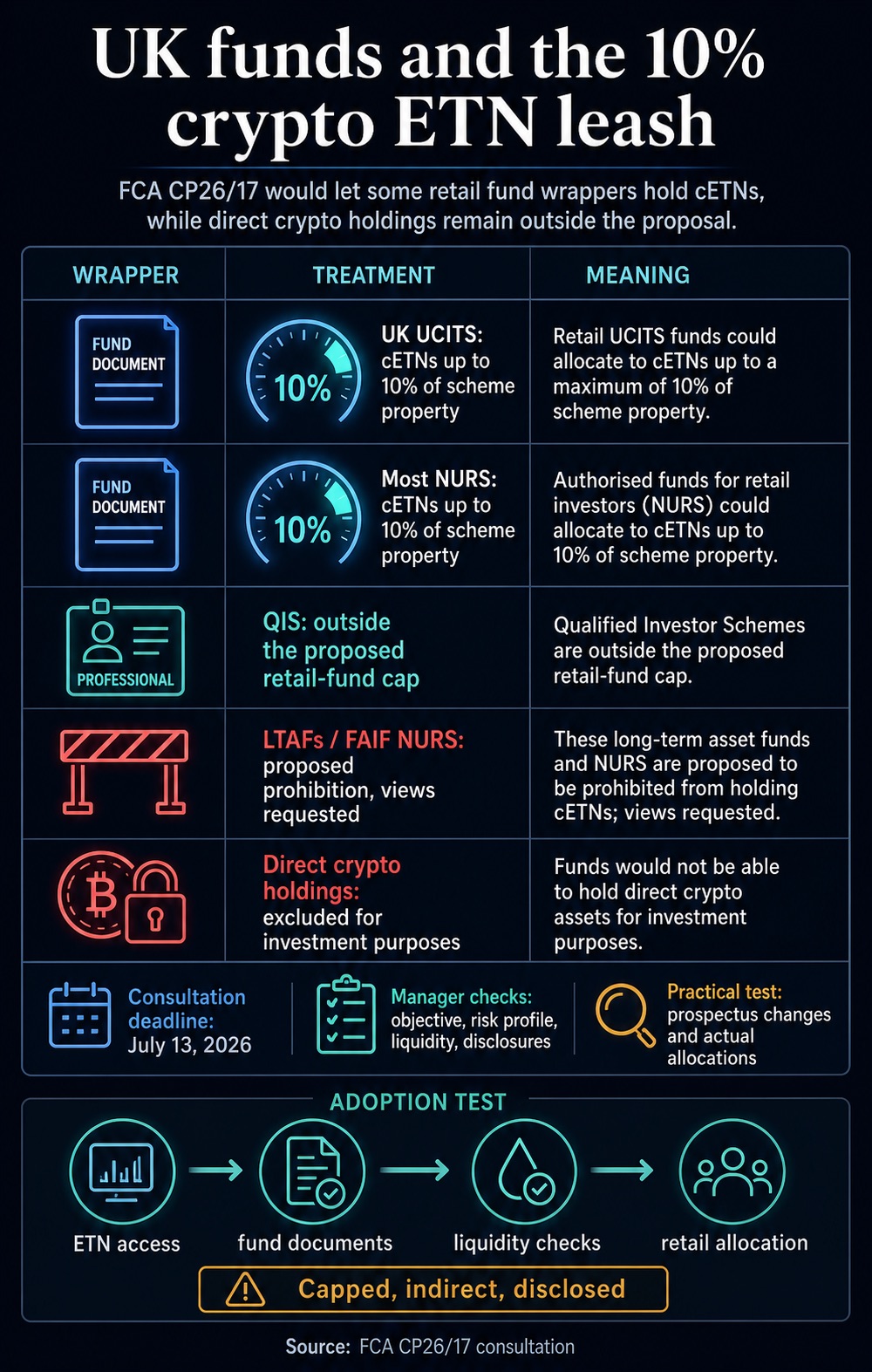
This image is a policy illustration from the FCA consultation document CP26/17: The UK plans to stipulate that UCITS and most NURS funds aimed at ordinary investors can allocate up to 10% to crypto ETNs, professional investor QIS has no upper limit, long-term asset funds are prohibited from allocation, and all funds still cannot directly hold cryptocurrencies. The policy consultation ends on July 13, 2026.
This differentiated regulatory framework constitutes the core of the proposal: regulation moderately loosens cryptocurrency investment channels through securities laws and fund rules while isolating the custody of native cryptocurrencies outside of fund investment portfolios.
Funds can purchase listed securities in compliant trading venues, thereby binding crypto asset price returns, while the underlying native crypto assets themselves are not included in the licensed fund's investment holdings.
This proposal continues the FCA's earlier policy direction — in 2025, regulation had already opened up the permissions for retail investors to trade crypto ETNs on FCA-recognized exchanges.
This policy officially comes into effect on October 8, 2025, allowing ordinary consumers to trade crypto ETNs on FCA-certified UK investment exchanges, with relevant financial promotion standards and consumer protection regulations also applicable.
Regulation continues to classify crypto ETNs as high-risk categories: retail crypto ETNs do not enjoy protection under the Financial Services Compensation Scheme, and the ban on crypto derivatives for ordinary investors remains unchanged.
The regulators believe that the current cryptocurrency market infrastructure and maturity have established a basis for controllable openness, but the high-risk nature of the underlying crypto assets still needs to be clearly labeled. The relevant proposals for funds also follow this regulatory logic.
Crypto ETNs have now become a conventional classified product on UK exchanges, with the London Stock Exchange continuously providing related trading services since the product's listing a year ago.
However, for fund products, leveraging ETNs to allocate cryptocurrency assets requires managers to take on an additional layer of compliance responsibility. Managers need to determine whether listed crypto ETNs meet investment qualifications, whether such exposure aligns with the fund's investment objectives, liquidity levels, risk limits, and retail information disclosure requirements.
The FCA requires fund managers to: fully understand the characteristics of the assets invested in by the fund, conduct thorough due diligence on investment targets, and continuously monitor whether the product meets investment objectives, operational strategies, risk limits, and liquidity standards; while assessing whether crypto assets and crypto ETNs can maintain sufficient liquidity under market pressure.
The 10% position limit is an intuitive risk control measure, but supporting compliance work like information disclosures and liquidity assessments are key to determining the actual usability of this investment authority.
The FCA states that licensed funds holding crypto ETNs will follow existing information disclosure rules, requiring managers to strictly comply with the regulations related to the fund's investment objectives, investment strategies, marketing promotions, consumer obligations, and crypto asset risk summaries.
It also stipulates: if the fund's net asset value fluctuates significantly or is expected to amplify volatility, UCITS fund managers must prominently indicate volatility risk warnings in product materials.
Managers planning to allocate crypto ETNs must clearly clarify the exposure attributes of crypto assets in fund documents and consumer-facing promotional materials, ensuring that product positioning is clear and unambiguous.
Even if only a small allocation to crypto ETNs is made, as long as the position size exceeds a negligible small proportion, it will become one of the core components of the investment strategy — the risk characteristics of crypto ETNs are significantly different from those of most traditional transferable securities.
The FCA also requires managers to evaluate the holdings of crypto ETNs in conjunction with the overall investment portfolio, comprehensively considering other high-risk assets in the portfolio, indirect exposures to crypto held through other funds, and securities that have price correlations with crypto assets (such as bonds issued by crypto companies).
Hence, the 10% crypto ETN holding limit does not cover other types of risk exposures related to crypto assets within the fund portfolio.
For retail investors, the practical effect of the new regulations is that crypto assets can more conventionally be incorporated into mainstream investment portfolios, but all related risk exposures will be clearly disclosed, continuously monitored, and uniformly assessed alongside other assets in the portfolio.
The True Test of Policy Implementation
The proposal only opens up investment channels, and whether it can be widely adopted ultimately depends on whether fund managers, sales platforms, asset custodial institutions, and distribution channels are willing to bear the costs of supporting document revisions, internal governance, and investor suitability checks.
There are two potential development scenarios in the market: the first is a moderate implementation of the proposal. Asset management institutions will use crypto ETNs as a minor allocation tool within diversified funds. If this situation occurs, the FCA's new regulations will mark a substantial shift in the industry: crypto asset exposure will no longer be limited to products that investors purchase individually or exclusively for professional investors; mainstream public funds can include crypto allocation under solid risk control.
The second scenario is that the policy may only have symbolic significance. Managers may judge that the 10% position limit, heavy disclosure obligations, liquidity risks, and brand reputation risks outweigh the benefits brought by allocating to crypto ETNs. Ultimately, only a few products will utilize this investment authority, and the actual scale of capital allocation after the policy implementation will be very limited.
Thus, it can be seen that this proposal is essentially a step towards the gradual standardization of the cryptocurrency market system, rather than a complete opening of public fund investments in crypto.
The FCA recognizes that the crypto ETN market has developed maturely and can open investment channels to certain licensed funds, but it simultaneously works to prevent crypto asset exposure from becoming a major risk source for retail investment portfolios.
The subsequent market implementation signals will be reflected in asset allocation operations of asset management institutions, updates to fund application documents, revisions of product explanations on sales platforms, and other behaviors.
After this public consultation concludes, UK asset management institutions have two choices: revise fund prospectuses, product summaries, and platform promotional materials to include terms for crypto ETN allocation; or allow this 10% position limit policy to remain on paper, serving merely as a symbolic open channel. Prior to this, while crypto assets could be indirectly allocated through fund products, they have always been subject to strict constraints.
免责声明:本文章仅代表作者个人观点,不代表本平台的立场和观点。本文章仅供信息分享,不构成对任何人的任何投资建议。用户与作者之间的任何争议,与本平台无关。如网页中刊载的文章或图片涉及侵权,请提供相关的权利证明和身份证明发送邮件到support@aicoin.com,本平台相关工作人员将会进行核查。


