While digging for Bitcoin, continuously liquidating.
Written by: Liam Akiba Wright
Translated by: Chopper, Foresight News
TL;DR
- In May 2026, Bitdeer mined 921 bitcoins, but at the end of the month held only 171 bitcoins.
- Behind the data contrast, Bitdeer is simultaneously laying out an AI cloud business, which theoretically could reduce the need to sell bitcoins for liquidity.
- However, operating data from May indicates that Bitdeer's bitcoin retention remains low, leaving uncertainties about whether AI business income can support corporate expansion and reduce coin sales.
Bitdeer's latest operating data reveals the reality contradictions behind the collective transformation of bitcoin mining companies to the AI track: while the company's mining output has significantly increased, the total amount of bitcoins held at the end of the month has drastically shrunk compared to the same period last year.
Bitdeer disclosed that in May 2026, they mined a total of 921 bitcoins, a sharp increase of 370% year-on-year; however, the month's end bitcoin holding was only 171 bitcoins. In contrast, the financial report from May 2025 showed the company mined 196 bitcoins with a holding high of 1351 bitcoins.
The vast contrast between output and holdings points directly to the selling pressure in the context of the mining company's transformation to AI business. The valuation logic communicated to investors by Bitdeer is that mining farms, self-developed mining machines, electricity stations, AI cloud computing resources, and future hosting income will collectively form a complete business landscape. Yet, the bitcoin holding data on the balance sheet indicates that this transformation strategy still largely relies on selling newly mined bitcoins to maintain operating cash flow.
The current situation is a mixed bag. AI business income could theoretically form a cash buffer, alleviating the pressure on companies to sell tokens during industry downturns. By combining the data from May and the first quarter, it can be seen that the mining output of Bitdeer continues to rise, but the book bitcoin inventory has significantly shrunk; the AI infrastructure business being rolled out simultaneously has also brought about new risk dimensions.
The contrast between bitcoin output and holdings is the clearest signal
Comparing the data from May of two years, the trends of the two core indicators are completely divergent. The mining output increased from 196 bitcoins to 921 bitcoins, while bitcoin holdings decreased sharply from 1351 bitcoins to 171 bitcoins.
Supplementary note: The mining statistics for May 2026 include both self-mining and joint mining output, while the same period in 2025 only counted self-mining. Even excluding this statistical discrepancy, the enormous gap in holding scale remains quite prominent.
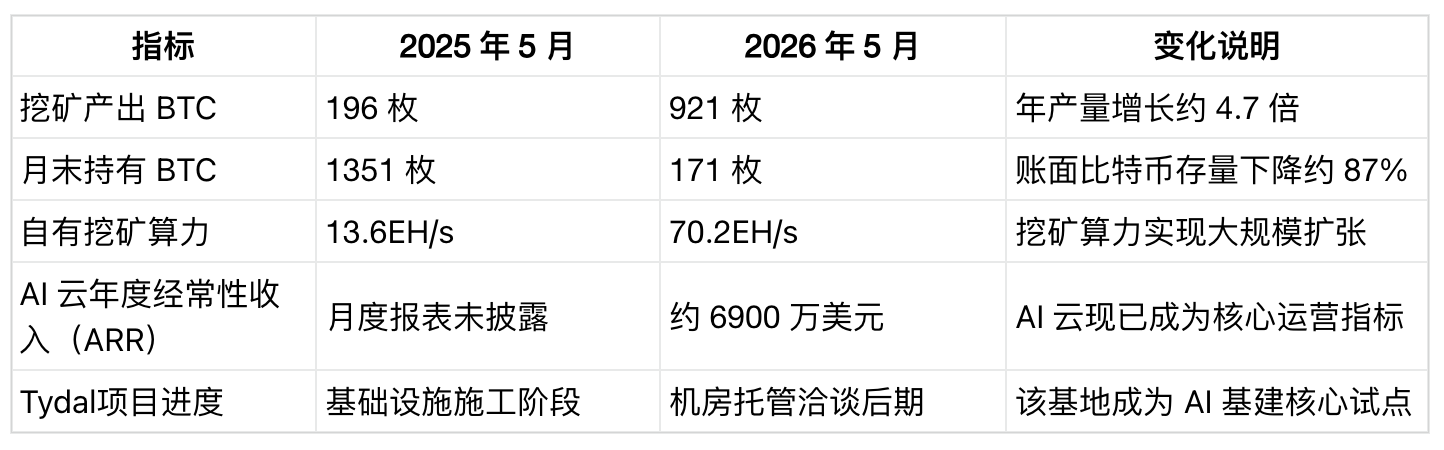
Using rough estimates based on bitcoin's price range of approximately $62700 to $62900 on June 19, the total value of Bitdeer's mining output in May was about $57.9 million, while the market value of bitcoin held at the end of the month was merely $10.7 million.
This is just an estimate based on spot prices and not the company's official financial disclosure, but it clearly reflects the scale gap. The mining output for the month is considerable, yet the retained bitcoin scale on the books is severely mismatched with the overall business operating scale.
The monthly holdings reflect static data at a single point in time, and cannot fully portray the complete cash flow dynamics; it does not precisely account for how much of the bitcoins mined that month were sold, pledged, retained, or repurposed. Nevertheless, this data suffices to show that the expansion of computing power and the increase in mining output have not translated into the company's bitcoin treasury reserves.
For bitcoin mining companies transitioning to AI infrastructure, this data difference changes the investment logic: the new AI income must either help the company retain more bitcoins or be used for capital-intensive infrastructure expansion.
The financial report for the first quarter of 2026 further corroborates the trend of the May data. In the first quarter, Bitdeer produced 2033 BTC, compared to only 350 bitcoins in the same period of 2025; the bitcoin holdings at the end of the quarter were only 31 bitcoins, down from 1156 bitcoins a year earlier. The company also disclosed it realized $206.8 million from disposing of digital assets.
As mining scale expands, Bitdeer's mining revenue has significantly increased, while the bitcoin holdings on the balance sheet continue to decline, indicating that the company is continually converting mined bitcoins into funds required for operations and expansion.
The company had a net cash outflow of $346.9 million in operating activities in the first quarter; capital expenditures amounted to $93.7 million for data center infrastructure, GPU procurement, taxes, and mining machine room deployment; the total liabilities of the company reached $1.9 billion. Total revenue for the first quarter was $188.9 million, and adjusted EBITDA was $14.4 million, with cash, cash equivalents, and restricted cash totaling $297.7 million.
The company is advancing a large-scale capital investment plan, where bitcoin reserves, debt financing, and infrastructure investments are interlinked to form a unified development strategy.
Can AI business cash flow alleviate the pressure to sell coins?
Data from Bitdeer's AI cloud business is the core argument supporting the market's optimistic expectations. In May, the company disclosed that AI cloud's annual recurring revenue stabilized at $69 million, with a GPU utilization rate of 90%, having deployed 4248 GPUs, and secured additional leases for 3305 GPUs; at the same time, it launched two sets of NVIDIA GB300 NVL72 computing clusters, and the model studio has adapted to NVIDIA's Nemotron 3 large models.
The income from AI cloud had achieved rapid growth before May. Monthly data for March showed annual revenue of approximately $43 million, which climbed to $69 million in April and maintained that level in May, transitioning from high-speed growth to stable operation, testing the sustainability of the business.
The annual recurring revenue is merely a projected annual metric. The income confirmed by the company from AI cloud in the first quarter was only $3.7 million. There is a significant gap between the two: annualized income represents potential future revenue space, while confirmed income is the actual cash flow accounted for in the profit and loss statement. The $69 million annualized revenue appears to reduce the company's reliance on selling bitcoins, but cash flow still needs to cover electricity costs, interests, capital expenditures, and the costs associated with the volatility of the mining industry cycle.
Bitdeer's monthly data also raises industry controversies regarding the transformation of the entire mining sector to the AI track. Previous reports from CryptoSlate noted that although most AI computing facilities have yet to be implemented, Wall Street is still willing to give higher valuations to bitcoin mining companies layout in AI and high-performance computing (HPC). Bitdeer's May operation report brings the industry's doubts down to a single enterprise: when the scale of the AI business has reached a level that can be disclosed independently, why is the company's bitcoin treasury reserve still so meager, and how should it be interpreted?
For bitcoin mining companies, the benefits of deploying AI cloud and data center hosting are apparent: long-term computing power leasing contracts can smooth cash flows, reduce the need to sell bitcoins during downturns, and also leverage their own power resources beyond simple mining pricing systems to generate additional value.
However, the transformation path also presents challenges: building AI infrastructure requires significant capital, stable customers, mature delivery capabilities, and sufficient time. During the transformation period, the bitcoin treasury serves more as liquidity reserves rather than long-term value assets.
The Tydal project: Hidden landing risks
The Tydal data center is the most intuitive physical project of Bitdeer's business model transformation. In March, the company revealed that its Tydal data center subsidiary had partnered with a third-party organization to transform the site into an AI computing center of 180 megawatts, mainly hosting NVIDIA's Vera Rubin equipment, with the project expected to complete by December 2026.
In May, the latest news indicated that the Tydal base has entered deep discussions with potential hosting clients, making this project a core evidence of the company: power stations originally serving bitcoin mining can be transformed to take on client computing power leasing, generating long-term contract revenue, and no longer relying solely on bitcoin mining revenue.
Bitcoin mining business exposes Bitdeer to risks related to computing power pricing, mining difficulty, fees, energy costs, mining machine performance, and bitcoin prices. In contrast, AI data center hosting introduces new risks including client qualification, delivery deadlines, GPU supply, construction cycles, electricity allocation, contract terms, and financing costs. The overall risk volatility may decrease, but the sources of risk shift.
Hence, Bitdeer's May operation report cannot be deemed an impressive report card; it resembles an ongoing operational stress test. CryptoSlate previously reported in February on Bitdeer's large-scale reduction of bitcoin reserves, which clarified the core market question: even if mining companies continue to produce bitcoins, they will still sell tokens to support operational expansion.
At this stage, Bitdeer's mining capacity continues to expand, with a slight recovery in bitcoin holdings after the low point in March, AI annual income stabilizing at $69 million, and AI data center hosting business continuing to advance. However, the critical gap remains unfilled: AI annual income cannot consistently translate into continued cash flow, and mining output has not solidified into the company's bitcoin reserves.
If the profitability chain can be successfully established in the future, AI business will become a cushion against routine coin-selling operations; if the chain cannot take shape, the transformation merely alters the form of risk: book bitcoins continue to decrease, while the company heavily relies on computing power leasing business, while also bearing pressures from power facility operations, client development, and the capital markets.
This is precisely the core question that Bitdeer's May operational data leaves for the market: while mining 921 bitcoins that month certainly deserves attention, the mere 171 bitcoins left at the end of the month is the number that warrants deeper contemplation.
免责声明:本文章仅代表作者个人观点,不代表本平台的立场和观点。本文章仅供信息分享,不构成对任何人的任何投资建议。用户与作者之间的任何争议,与本平台无关。如网页中刊载的文章或图片涉及侵权,请提供相关的权利证明和身份证明发送邮件到support@aicoin.com,本平台相关工作人员将会进行核查。


