Author: Chloe, ChainCatcher
On July 1, 2026, the transition period for the EU's Markets in Crypto-Assets Regulation (MiCA) officially ends, and institutions that obtained licenses will receive an "EU passport" allowing them to operate throughout the single market; those that did not obtain a license must exit. Binance, having failed to secure a license, notified users on June 26 that it would cease operations in the EU market.
Binance officially stated, "We are not leaving Europe," indicating that assets are secure and available at any time; they just plan to reapply in France. However, in practice, it is essentially a business suspension: starting July 1, new registrations, deposits, spot orders, and financial products such as Earn, staking, and Launchpool for EU residents will cease, leaving only withdrawals available.
Binance has faced a significant setback in front of MiCA; how will the remaining competitors carve up Binance's existing EU users? Looking back over the past three years, as the benefits of regulatory arbitrage gradually diminish, what has this giant, which thrived on regulatory gaps, managed to rectify, and what remains unaddressed?
The Battle for Binance's Users
In the past, exchanges competed for users by silently adjusting fees and quietly listing new tokens. This time, it's different; following Binance's setback, competitors quickly launched their subsidy wars: Coinbase CEO Armstrong offered a 5% transfer bonus, OKX's Xu Mingxing raised it to 8%, and the key selling point was all "We have a MiCA license." Even second-tier players like SwissBorg jumped in, offering a 3% deposit bonus for funds transferred from non-MiCA platforms.
In response to such a battle for users, CZ posted on X stating that the EU has sliced "the best liquidity in the world," hoping for a turnaround in the future.

The reason competitors are so eager to capture users is due to MiCA's high elimination rate: of over 3,000 crypto institutions operating in Europe, only about 210 had obtained full authorization by July 1, resulting in an approval rate of approximately 7%. Licenses are highly concentrated in a few jurisdictions, with Germany leading with 56 licenses, followed by the Netherlands with 26, France with 21, and Malta, Cyprus, and Ireland with around a dozen each.
OKX's European CEO Erald Ghoos estimates that about 80% of exchanges will not survive MiCA; as of a few days ago, around 60% of European users remained on non-MiCA platforms. In other words, Binance's exit does not leave behind scattered retail users but a whole batch of high-value users forced to move, yet with almost nowhere to go.
From market share data, Binance's bleeding actually began even before MiCA. According to Coingecko's 2025 Annual Report, Binance retained a 39.2% market share, leading the transaction volume among the top ten centralized exchanges, generating $7.3 trillion in transaction volume for the year, although the year-on-year growth rate was -0.5%. By the end of 2025, it became even more evident, as Binance's spot market share in December was still 38.3%, while the transaction volume plummeted by 40.6% from $609 billion in November to $361.8 billion.
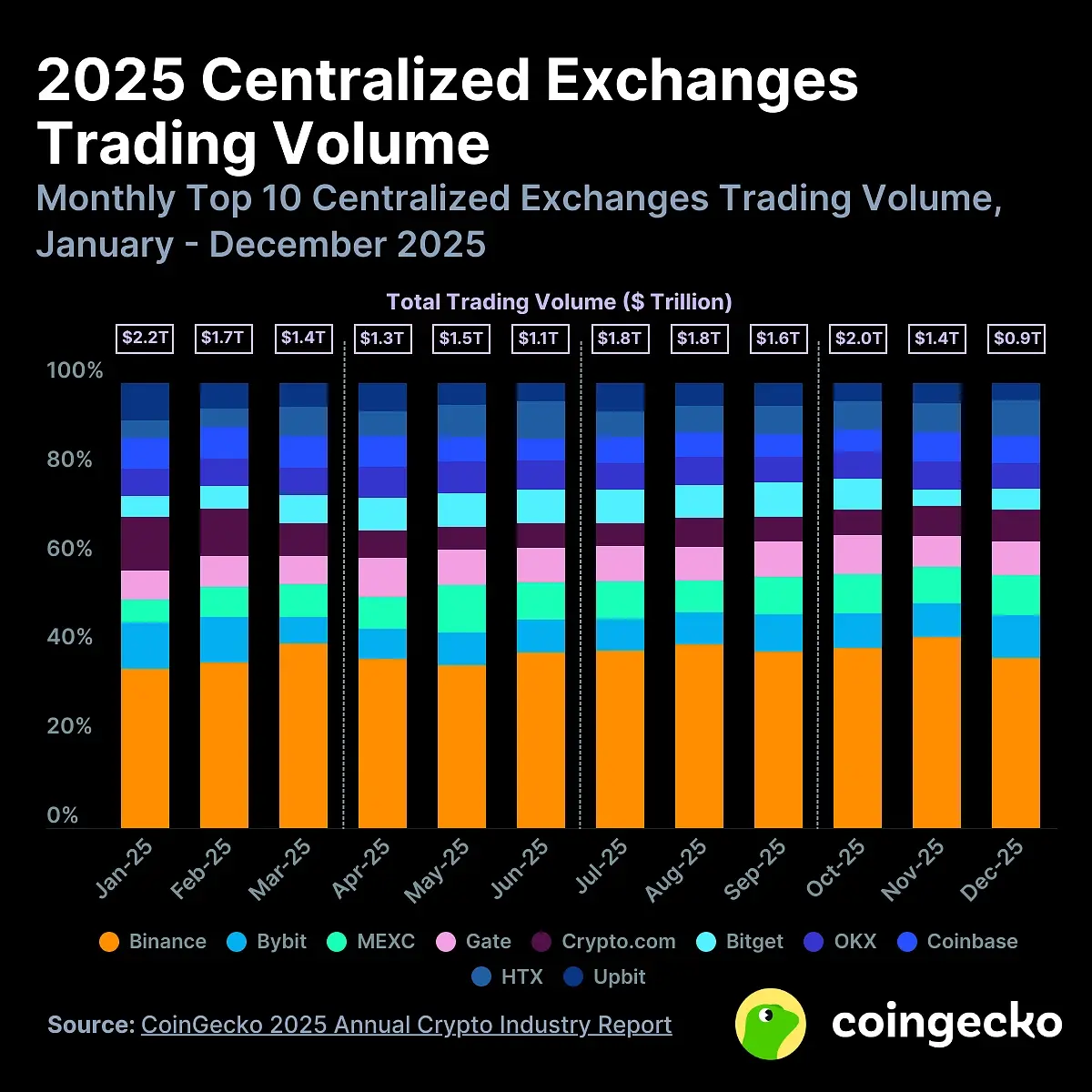
By early 2026, this trend fluctuated more widely: according to CoinDesk data, Binance's market share dropped to 22.0% in February, the lowest since October 2020, while OKX's derivatives market share climbed to 18.3%. However, according to CoinMarketCap data, by April 2026, Binance saw some recovery in related data, with its derivatives market share rebounding to 36.25%.
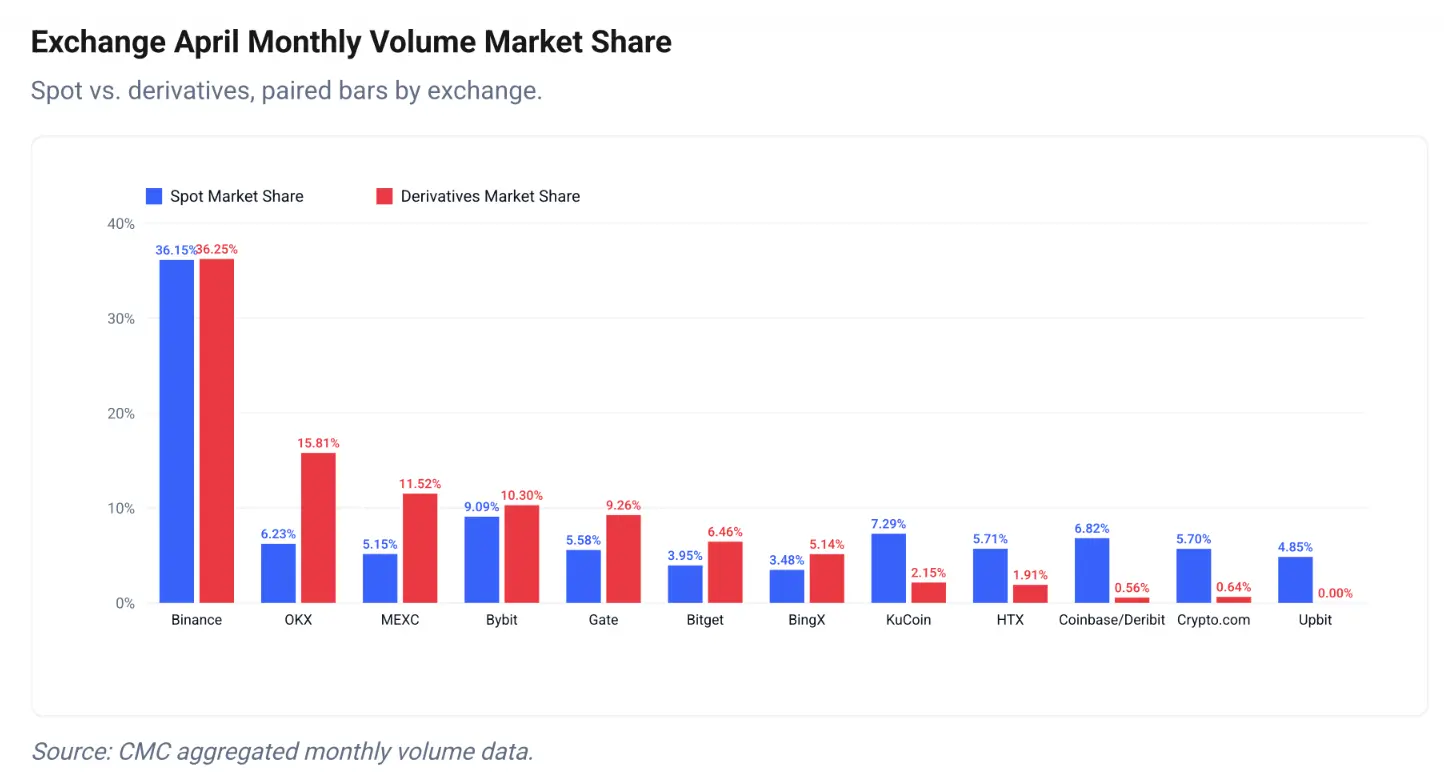
Faced with the high volatility of the market, the EU's decisive action effectively hands the existing chips directly to competitors, and the real problem is that once users complete identity verification and deposits elsewhere, even if Binance improves its features and lowers fees in the future, they may not return.
Review 1: The Largest Fine in History
To understand why Binance encounters obstacles in the EU, we must first revisit its first critical juncture.
On November 21, 2023, Binance reached a record settlement with the United States for a massive corporate anti-money laundering penalty totaling over $4.3 billion. The Financial Crimes Enforcement Network (FinCEN) imposed a civil fine of $3.4 billion, the highest ever issued by the agency, along with a five-year monitoring period. The Office of Foreign Assets Control (OFAC) issued a fine of approximately $968 million. Founder Zhao Changpeng pled guilty, paid a $50 million fine, and stepped down, additionally incurring a penalty of $100 million after discounts applied from the Commodity Futures Trading Commission (CFTC) fine of $150 million, while the former compliance officer Samuel Lim was fined $1.5 million.
The penalty was so severe because the core issue was not that Binance lacked a compliance department but that it had one and had never submitted any Suspicious Activity Reports (SARs) to FinCEN. Over 100,000 suspicious transactions went unreported, involving terrorism, ransomware, child sexual exploitation content, and various frauds, until May 2022, when it began collecting KYC data. Regarding sanctions, OFAC identified 1,667,153 transactions suspected of violating sanctions between August 2017 and October 2022. During this period, Binance collected approximately $1.35 billion in trading fees from U.S. users alone.
Review 2: A Real Monetary Shift
However, Binance indeed initiated a costly compliance pivot beginning at the end of 2023.
The first step was a change in CEO, with CZ stepping down and being succeeded by Richard Teng, who has over twenty years of experience in finance and regulation and previously worked for the Abu Dhabi Global Market and the Monetary Authority of Singapore. Subsequently, Binance expanded its full-time compliance team by 34%, aiming to reach 645 members by the end of 2024; including contractual employees, the compliance-related staff exceeded 1,000 people. Compliance expenditures increased by 36% starting in 2023, and it began recruiting from traditional finance and governmental institutions, including Todd McElduff from PayPal and Morgan Stanley, and Tigran Gambaryan, a former financial crime specialist with the IRS.
By early 2026, Binance had over 580 dedicated compliance staff, with an additional 970 compliance-related personnel scattered across customer service, technology, and product departments, totaling over 1,500 people; in just 2025, Binance responded to over 71,000 law enforcement requests, assisting in the seizure of over $130 million in illegal funds.
The second step was a change of battlefield. After facing heavy penalties from the U.S., Binance shifted its focus to regions with clear regulations, adopting a strategy of "first securing licenses, then operating." It announced plans to expand its licensed jurisdictions worldwide to more than 20 by 2025, having already secured licenses in Australia, India, Indonesia, Japan, New Zealand, and Thailand, and even acquired control of South Korea's Gopax for another license. Its subsidiary became the first exchange to obtain a complete VASP license from Dubai VARA as early as 2024. Binance established regional headquarters in Dubai, Paris, and Singapore, gradually dismantling its previously ambiguous "global no-entity" structure into regulated legal entities.
Review 3: Politically "Unbound" in the U.S., Yet Hitting a Hard Wall in the EU
Looking solely at the U.S. situation, Binance’s compliance adjustments appear to have successfully freed it from constraints. The SEC withdrew its civil lawsuit against Binance in May; on October 23, 2025, Trump directly pardoned CZ, who had actually already completed a four-month prison term and was released in September 2024. However, this pardon comes with a dispute over interests: Binance had custody of Trump's family's crypto project World Liberty Financial, which was a key driver of USD1's growth, and earlier this year accepted a $2 billion investment from the UAE through USD1, although Binance and CZ denied any business relationship.
Internal data reviewed by the Financial Times revealed that despite the settlement, Binance still had $144 million in suspicious transactions, including a Venezuelan resident's account that processed $93 million between 2021 and 2025, with the account still operating despite system alerts. For regulators, such data would be a key basis for decision-making. Regulatory bodies in Greece, Ireland, and Latvia expressed concern over Binance's past legal issues and corporate structure. However, Binance insists it has been "constructively cooperating" with regulators for 18 months; it has secured passes from Asia and the Middle East but has notably failed to obtain a license from the EU despite 18 months of goodwill, a 1,500-person team, and billions of dollars in investment.
What Truly Changes is Not a License
So how should we view Binance's failure this time? Its compliance investments over the past three years are real, but the historical burdens that cannot be washed away are also undeniable. It is worth tracking not whether it can regain France's license after the deadline, but whether this company can produce product strength, governance ability, and trust foundation commensurate with its scale when the benefits of regulatory arbitrage have returned to zero.
According to CryptoQuant data, Binance maintained a 32% market share dominating cryptocurrency spot trading volume in 2026; however, whether updates to MiCA (Markets in Crypto-Assets Regulation) will shake its leading position remains to be seen.
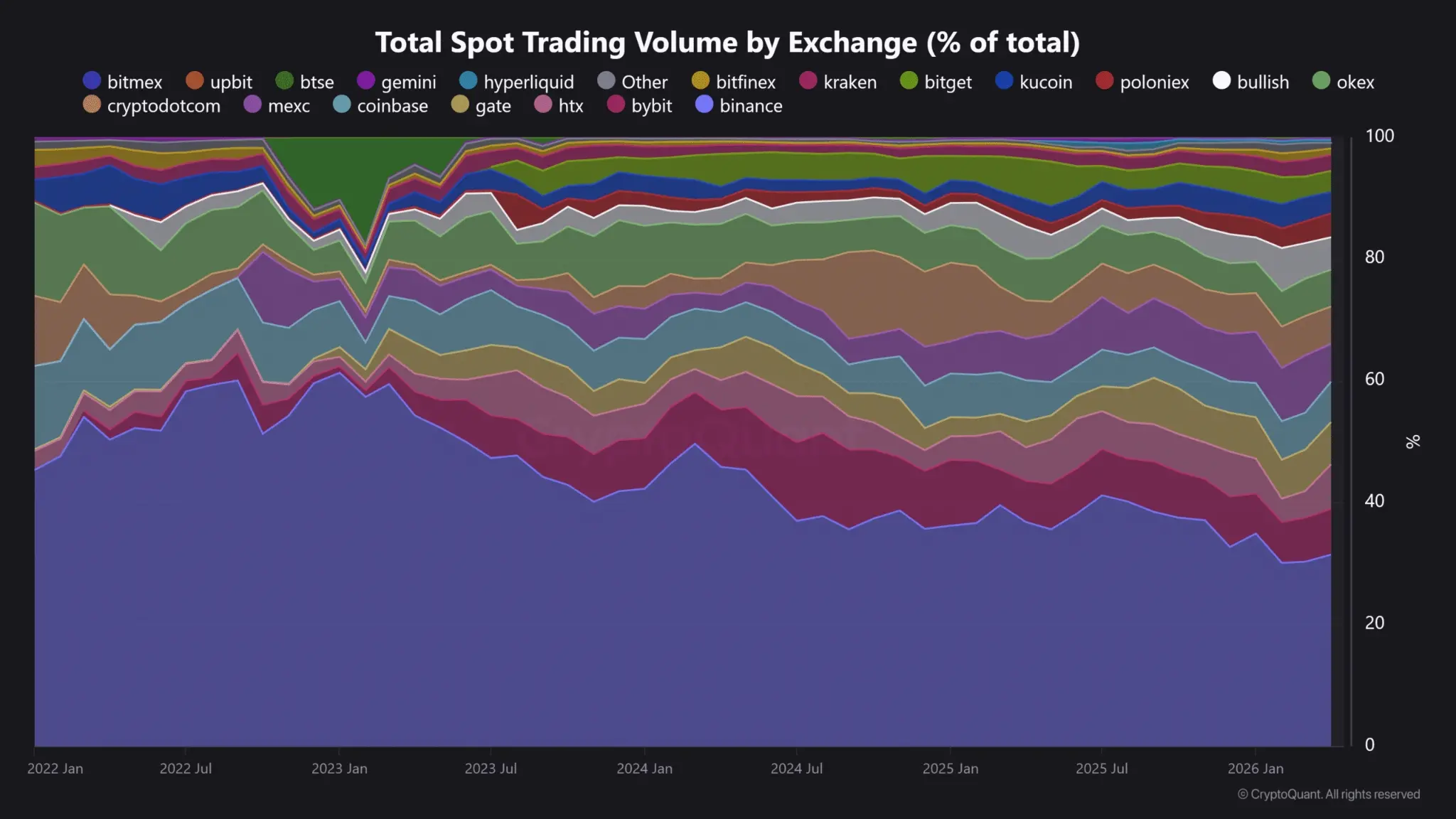
MiCA reshuffles the European crypto market landscape; it is not just an isolated disaster for any single exchange but an engine for redistributing capital: users, fees, and attention are flowing to those who can quickly align rules and products. For Binance, the EU's door may eventually reopen, but by the time it returns, the capital and users in the market will no longer resemble what they were when it left.
免责声明:本文章仅代表作者个人观点,不代表本平台的立场和观点。本文章仅供信息分享,不构成对任何人的任何投资建议。用户与作者之间的任何争议,与本平台无关。如网页中刊载的文章或图片涉及侵权,请提供相关的权利证明和身份证明发送邮件到support@aicoin.com,本平台相关工作人员将会进行核查。


