Author: Chloe, ChainCatcher
The on-chain narrative of Solana is spreading from meme coins to tokenized trading cards. In the past, Pump.fun was almost representative of Solana's consumer-side revenue applications; however, after entering the second quarter of 2026, Pump.fun's quarterly revenue began to slow down, while Collector Crypt presented a stronger recent growth curve.
DefiLlama data shows that Pump.fun's first quarter revenue was $108.3 million, and in the second quarter it has dropped to $69.2 million, a decrease of 36.1% compared to the previous quarter. During the same period, Collector Crypt's revenue curve is clearly on the rise.
Collector Crypt's first quarter revenue was $12.3 million, and in the second quarter it has risen to $25.8 million, growing by 108.8%; its revenue in the recent week reached $5.1 million, which accounts for about 38% of its total revenue of nearly $13.5 million over the past 30 days. This set of data indicates that while Pump.fun still has a larger scale, Collector Crypt is achieving stronger short-term growth momentum.
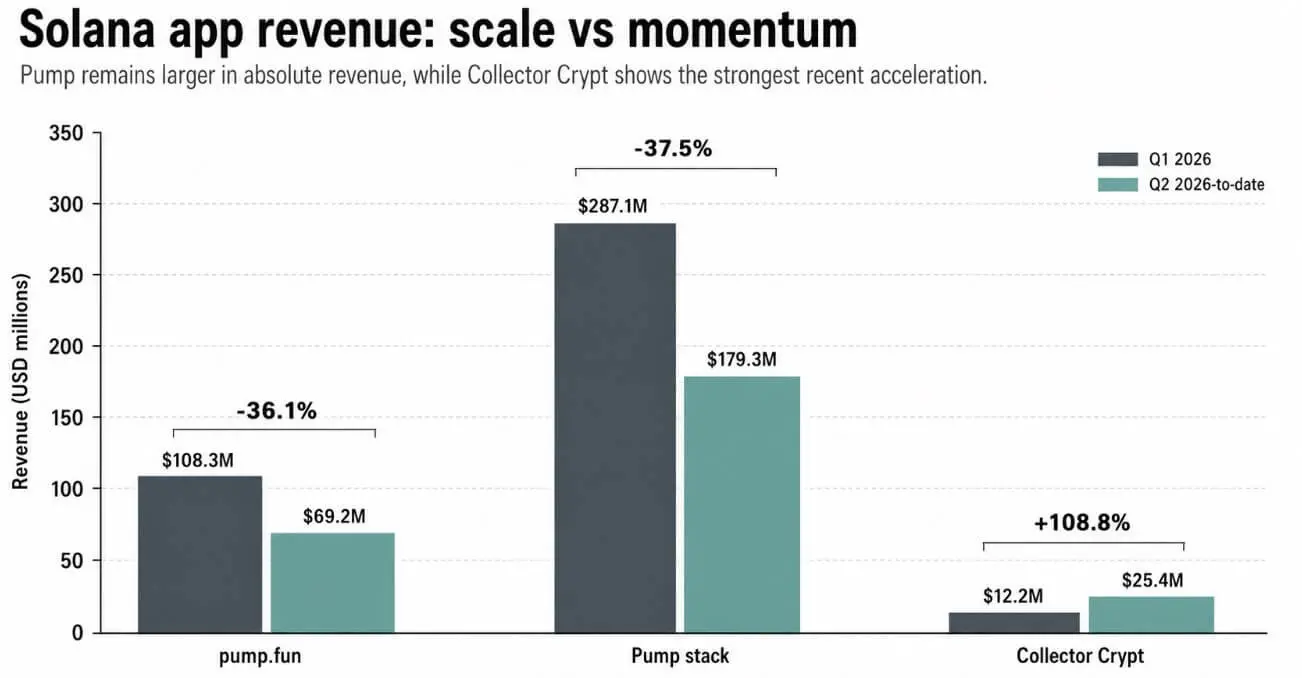
From the data summary, it may not be that Pump.fun is losing scaled growth, but rather that the sources of Solana's consumption fees are starting to diversify. The meme coin track is still vast, but tokenized trading cards, random card packs, physical redemptions, and on-chain secondary markets are becoming another consumption scenario that can genuinely charge fees, complete transactions, and retain users.
Is Collector Crypt's profit source stable?
Collector Crypt's core operating model involves custodying physical graded trading cards and minting corresponding NFTs on Solana. After users purchase a random card pack, they receive a digital card linked to the real physical card; they can then choose to hold the NFT, sell it on-chain, sell it back to the platform, or redeem the physical card.
Collector Crypt's revenue primarily comes from random card pack sales, secondary market transaction fees, and royalties; when calculating revenue, it also deducts the buyback costs incurred from users selling cards back to the platform. Additionally, Collector Crypt purchases trading cards in bulk, obtaining inventory at a discount of about 5% to 15%; if users do not want to hold the cards after unpacking, they can sell them back to the platform at prices about 7% to 15% below market value.
This allows Collector Crypt to retain about 4% to 5% of operating profit margins. According to estimates, taking a $1,000 card pack as an example, Collector Crypt's overall profit margin is about 5.14%; after deducting incentive costs such as user rewards, the net profit margin is about 4.44%.
This model has garnered attention because it does not just sell on-chain images, but connects on-chain transactions with real-world collectibles. Collector Crypt broke through $1 billion in cumulative transaction volume in May 2026; the platform opened over 215,000 tokenized collectible card packs in a single week, and over 30% of users have redeemed physical cards.
Solana's revenue ranking has not fully reversed
However, Collector Crypt has not yet truly replaced Pump.fun in total revenue. From 2026 to the present, Pump.fun's revenue has been about $177.5 million, the total income of the Pump ecosystem is approximately $466.5 million; in contrast, Collector Crypt's revenue for 2026 has been about $38.1 million. In cumulative revenue, Pump.fun exceeds $1 billion, the overall Pump ecosystem is about $1.18 billion, while Collector Crypt is approximately $58.4 million.
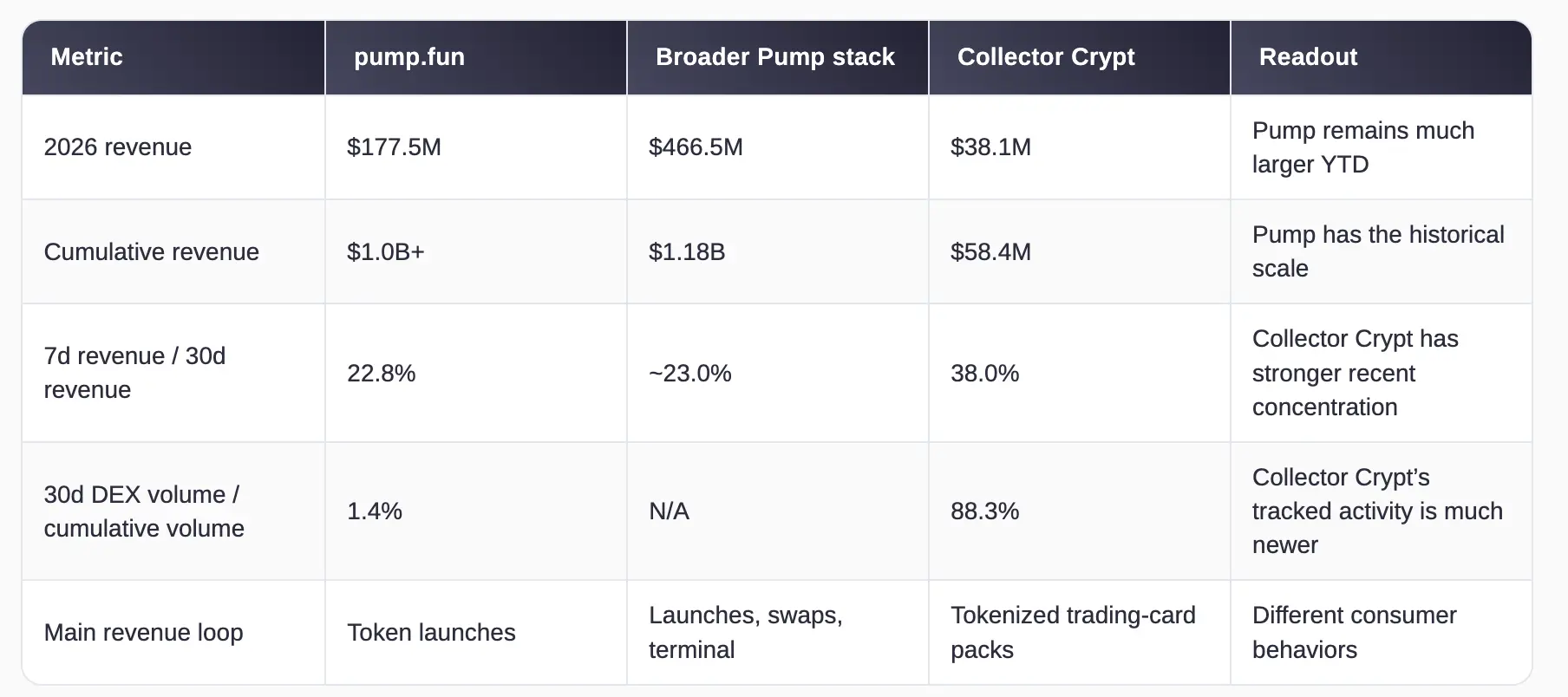
Therefore, the so-called "income throne change" is more accurately described as a change in recent income momentum and daily income rankings, rather than a comprehensive reversal of historical cumulative scale.
Pump.fun's model relies on a speculative token issuance cycle: users continuously issue new tokens, trade on the early price curve, and subsequently, some tokens enter the open market, generating fees at each stage. Collector Crypt's model represents another consumption cycle: users purchase random card packs, obtain on-chain proof of corresponding physical collectibles, and then engage in on-chain transactions, instant sales back, or physical redemptions. Both can generate fees, trading volume, and market attention, but the reason for attracting users is different.
Pump.fun leans towards attention, volatility, and early meme coin chips; Collector Crypt leans towards collecting, scarcity, gamified experiences, and anchoring to real assets. This is also where the focus of discussions around Solana consumer applications has shifted: income no longer solely comes from meme coin issuance, but can gradually spread to more consumption scenarios closer to real assets.
Conclusion
In the end, whether Collector Crypt's revenue is sustainable depends first on whether the demand for random card packs can be maintained. If the demand for packs remains strong, Collector Crypt's 30-day revenue might continue to approach that of Pump.fun; if the demand for random card packs cools, the recent phenomenon of Collector Crypt's revenue being highly concentrated could turn from a growth signal to a risk.
Additionally, Collector Crypt's second growth variable is whether it can expand from Pokémon cards to sports cards and other collectibles. Data indicates that Pokémon cards currently dominate Collector Crypt's monthly trading volume; however, in physical card exhibitions, sports cards and Pokémon cards roughly split the sales evenly, while on-chain sports cards currently account for only 3% to 4% of Collector Crypt's $88 million monthly trading volume.
The third variable for Collector Crypt is regulatory pressure. If multiple regulatory jurisdictions begin to scrutinize the random card pack mechanism with a "blind box regulatory framework," it may slow down Collector Crypt's growth.
Therefore, under unchanged macro conditions, Pump.fun will still be a larger revenue engine, while Collector Crypt will continue to appear at the top of the Solana application revenue leaderboard. In this situation, Solana's consumer application revenue will no longer rely solely on meme coin issuance, but will gradually expand to more consumption scenarios.
The key change for Solana is not that Pump.fun has been completely replaced, but that the structure of consumer income has broadened. Pump.fun has proven that meme coin issuance can become a highly profitable consumer application on Solana; Collector Crypt has demonstrated that tokenized physical collectibles can also yield real income, real transactions, and real user behaviors.
免责声明:本文章仅代表作者个人观点,不代表本平台的立场和观点。本文章仅供信息分享,不构成对任何人的任何投资建议。用户与作者之间的任何争议,与本平台无关。如网页中刊载的文章或图片涉及侵权,请提供相关的权利证明和身份证明发送邮件到support@aicoin.com,本平台相关工作人员将会进行核查。


