How should the boundaries of control be defined when centralized brokers build permissionless infrastructure?
Written by: Gino Matos
Translated by: Saoirse, Foresight News
Robinhood officially launched the Robinhood Chain mainnet this month. This chain is built on top of Arbitrum, belonging to the permissionless Layer2, focusing on tokenized stocks, real-world assets (RWA), DeFi lending, and native AI financial scenarios.
Within just a week of its launch, the hottest retail trading activity on the entire chain was driven by CASHCAT. This meme coin derives its name from the brand name "CashCat," which Robinhood abandoned in its early years, reaching a market capitalization of nearly 150 million dollars and a 24-hour trading volume exceeding 159 million dollars.
CASHCAT did not go through the internal listing process of the Robinhood app, but instead relied on the Uniswap V3 liquidity pool, along with third-party issuance and routing infrastructures like Noxa.fun and Pump.fun to gain liquidity, market display pages, and market attention.
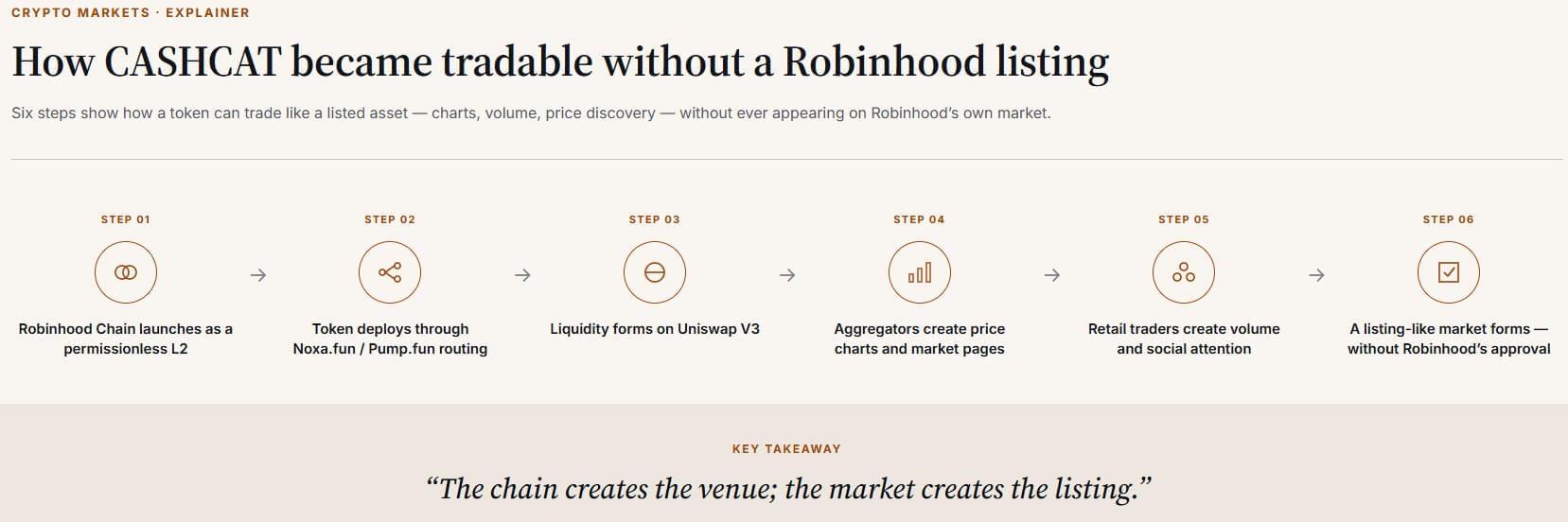
An illustrated diagram outlines six key stages, clearly showing how CASHCAT achieved trading, accumulated liquidity, and transaction volume on the Robinhood Chain without official listing approval.
The "Listing" Behind the Lack of Official Approval
Upon its launch, the Robinhood Chain connected with partners like Uniswap and integrated users of Robinhood's own on-chain wallets. This open architecture, originally designed for tokenized securities and RWA collateral assets, also provides access channels for all tokens deployed on the chain to external decentralized exchange liquidity and market aggregation pages—even if the tokens have not undergone Robinhood app-level review, they can achieve trading conditions similar to an official listing.
Vlad Tenev (Co-founder and CEO of Robinhood) and Baiju Bhatt (Co-founder and Chief Creative Officer of Robinhood) initially named the company CashCat before settling on the name Robinhood; this name was inspired by Baiju's love for cats. This company backstory led an anonymous developer to find a narrative source for creating the meme coin.
User Adam_tehc's Dune-made data dashboard shows that among the top 25 meme coins by market capitalization on the Robinhood Chain, CASHCAT occupies nearly 79% of the total market cap and 74% of the trading volume; the second-largest coin, Dog In Hood, is only one-sixteenth of its size.
The same dashboard shows that on-chain trading activity has rapidly climbed: on July 7, the average daily transactions on the chain were around 1.2 million, soaring to nearly 2.8 million on July 8, with a single-day increase of 133%. During the same period, the number of tokens issued via Noxa.fun grew from 1,858 to 6,675, an increase of 259%.
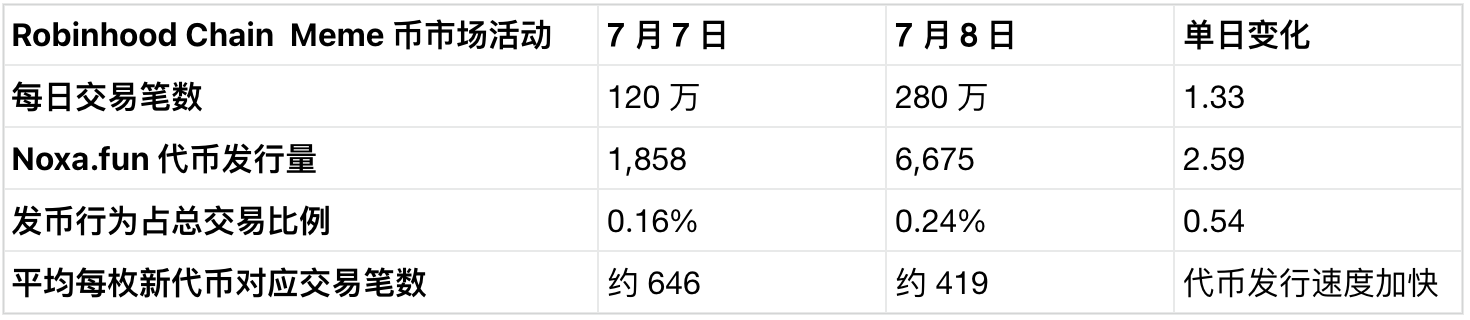
As of July 8, the issuance growth rate of new tokens had already outpaced the overall trading volume growth rate. Transactions related to tokens issued by Noxa.fun accounted for only 0.155% of total transactions on July 7, rising to 0.238% the next day. The ongoing rapid token issuance means that many new projects are competing for market attention, making it difficult to concentrate liquidity on nurturing quality tokens, and instead easily causing the dispersion of funds.
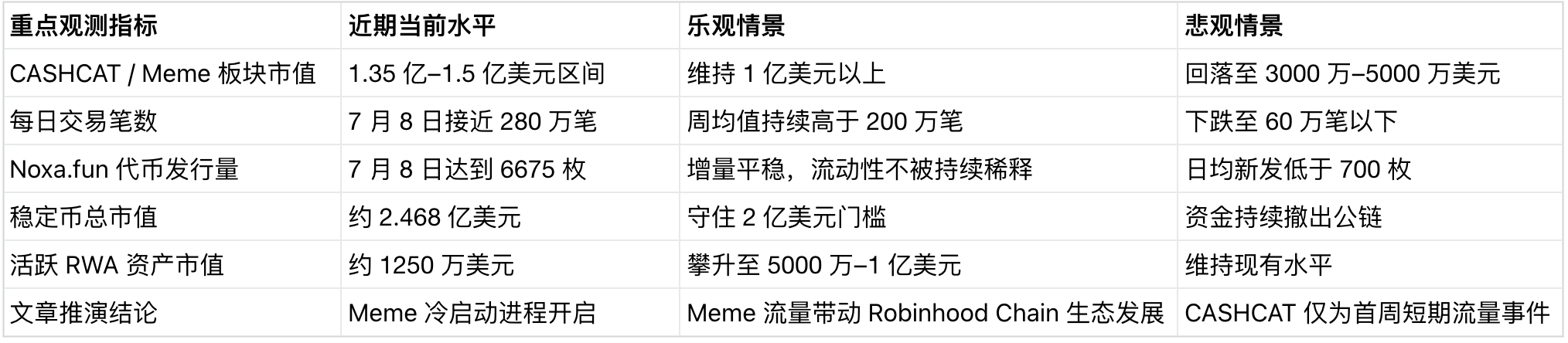
DefiLlama data shows that the total locked value on the chain is approximately 107.8 million dollars; the total market capitalization of stablecoins is close to 246.8 million dollars, while the market cap of the RWA sector currently stands at only 12.5 million dollars.
CASHCAT has an extremely high trading volume-to-market cap ratio, with significant intraday capital turnover characteristics, leaning more towards high-frequency speculative trading rather than long-term asset holding.
Risks Hidden Beneath the Sudden Surge
Vlad Tenev stated in a CNBC interview on July 2 that the future of the crypto industry belongs to real-world assets (RWA). Just a few days later, he published that Robinhood Chain aims to create the best RWA public chain, while also noting that this chain "performs exceptionally in carrying meme coins."
This statement reflects the essence of permissionless infrastructure: once Robinhood opens public chain permissions to all developers, the market will autonomously select popular assets. CASHCAT was born from Robinhood's early history and even involves its founders in a meme narrative that the company cannot control.
Currently, there are many mimic tokens and fake official social accounts circulating in the market; CASHCAT's liquidity is concentrated on a single decentralized trading pair, making it prone to slippage and violent price movements.
An academic research report from 2026 counted a total of 34,988 meme coins across Ethereum, BNB Chain, Solana, and Base, revealing that 1,801 of them (5.15%) lost all trading liquidity within 24 hours of going live.
Although CASHCAT currently dwarfs these fleeting tokens in size, the same set of permissionless channels that supports it also accommodates thousands of projects that are highly likely to quickly drop to zero.
Two Development Scenarios in the Next 60 Days
Optimistic Scenario
CASHCAT could keep the total market capitalization of the entire meme sector above 100 million dollars, with weekly on-chain transactions stable above 2 million, stablecoin total market cap holding above 200 million dollars, and the RWA sector's market cap gradually moving towards the 50 million to 100 million dollar range.
If the market evolves along this path, the liquidity brought by memes will become a key point for Robinhood Chain's cold start, accumulating wallet users and stablecoin funding for Robinhood's RWA narrative that commenced on July 1.
Pessimistic Scenario
CASHCAT's market cap may fall back to the range of 30 million to 50 million dollars, daily transaction count drop below 600,000, Noxa.fun's average daily token issuance decline to below 700, and the RWA sector's market cap stagnate at its current level.
In this scenario, CASHCAT would merely represent a short-term traffic pulse from the public chain's launch; after the hype fades, Robinhood Chain's RWA vision will need to start anew to attract users.
Citi's 2026 tokenized asset research report indicates that the current global market size for tokenized assets is about 17 billion dollars; under baseline scenarios, its size may reach 5.5 trillion dollars by 2030, with tokenized stocks and U.S. Treasury bonds becoming early mainstream applications. The report estimates that if 10% of U.S. retail investors transition to on-chain solutions by 2030, the demand from the tokenized U.S. stock sector alone could generate 2.6 trillion dollars.
Robinhood's revenue from crypto operations in Q1 2026 fell 47% year-on-year to 134 million dollars; during the same period, the company's total net revenue grew by 15% year-on-year, reaching 1.07 billion dollars, with platform assets under custody amounting to 307 billion dollars.
This layer two chain can accommodate trading demands outside the platform's official listing, effectively opening up a second growth curve for Robinhood’s crypto business, where ecosystem development is no longer entirely tied to the survival of a single meme coin.
However, the RWA vision of Robinhood Chain highly depends on institutional adoption over several years; as Citi predicts, asset tokenization is a long-term effort spanning a decade.
The CASHCAT incident has already substantiated a fact: once permissionless infrastructure is officially launched, regardless of platform approval, the market can autonomously incubate popular assets worth over 100 million dollars.
免责声明:本文章仅代表作者个人观点,不代表本平台的立场和观点。本文章仅供信息分享,不构成对任何人的任何投资建议。用户与作者之间的任何争议,与本平台无关。如网页中刊载的文章或图片涉及侵权,请提供相关的权利证明和身份证明发送邮件到support@aicoin.com,本平台相关工作人员将会进行核查。


