On the night of the Federal Reserve's monetary policy meeting in July, a "quantitative shadow war" for pricing power.
Written by: Gino Matos
Translated by: Saoirse, Foresight News
From July 28 to 29, the Federal Reserve will hold a meeting to finalize a new round of interest rate decisions. Traders will leverage bonds, foreign exchange, cryptocurrencies, and event contracts directly tied to central bank decision outcomes to bet on the price movements resulting from the decisions.
On July 21, Reuters conducted a survey of 104 economists, all of whom expect the Federal Reserve to maintain the interest rate range at 3.50%–3.75%. The probability of betting on this outcome in the Kalshi July contract reached 87%, with a trading volume of approximately $29.7 million, while the market still needs counterparts to quote the remaining 13% possibility.
Currently, these counterparts include market makers, quantitative institutions, asset management proprietary teams, and AI agents. These programs monitor prices around the clock, compare similar contracts across platforms, and continuously update the probabilities of events occurring.
Various institutions are testing event contracts, and brokers are continuously introducing liquidity providers. Proprietary asset management institutions are beginning to treat settled contracts as a gauge for screening traders—whether traders are human or algorithms, those who can price uncertainty more accurately than the market average will be given priority attention.
The combination of multiple forces can thicken the order book and accelerate price discovery, but trading advantages will also concentrate among the institutions with the fastest infrastructure.
The combined monthly trading volume of the two major platforms, Kalshi and Polymarket, reached a peak of $13.7 billion in June, and July's trading volume has already surpassed $11 billion. Data proves that the trading scale of prediction markets has reached a level comparable to professional institutions.
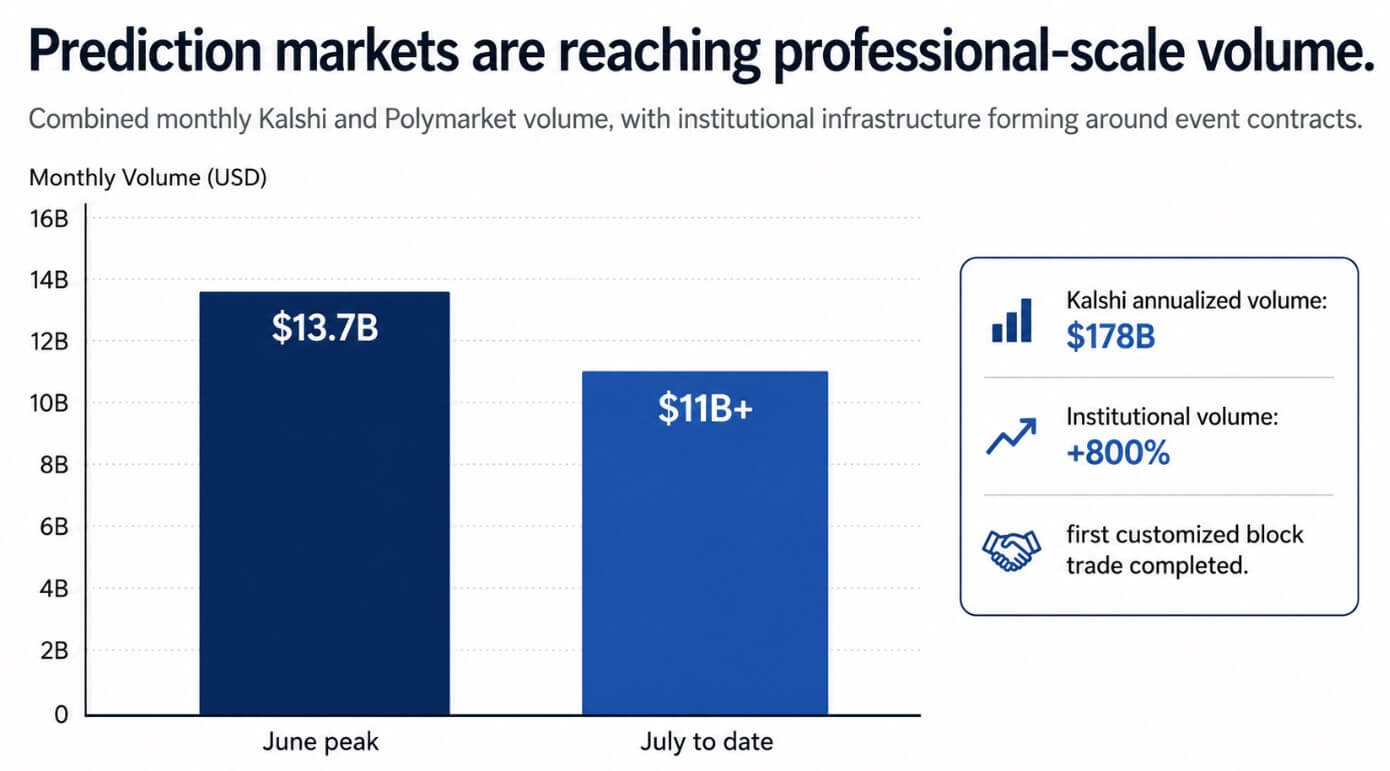
The chart shows that Kalshi and Polymarket's monthly trading volume peaked at $13.7 billion in June, with Kalshi's annualized trading volume reaching $178 billion.
Kalshi stated that within six months, the platform's annualized trading volume has more than doubled to $178 billion, with institutional trading volume increasing by as much as 800%, and the platform completed its first customized block trade.
Clear Street, Marex, and Jump Trading are all building access channels in line with this growth trend: Clear Street helps institutional clients connect with Kalshi; Marex bridges both Kalshi and Polymarket; Jump Trading assists institutions in directly participating in event market trades. In addition, AQR, Susquehanna, and OKX have issued recruitment information for specialized trading positions in prediction markets.
Corporate finance departments are also experimenting with these contracts to hedge against tariff risks and exposures brought by regulatory policies. However, the premise for such hedging demand to be valid is that the market has counterparts capable of continuously and significantly taking on reverse position quotes.
To build a well-functioning market, suppliers need to be willing to quote both ways, compare similar contracts across platforms, and immediately correct pricing when significant deviations occur.
Measuring Trading Advantages
Louis Régis, founder of the on-chain proprietary trading firm Propr and former quantitative trader at Credit Suisse, suggests that compared to traditional financial markets, event contract selection criteria for traders are more stringent. These contracts clearly reflect the trader's judgment ability while having clearly defined and controllable risk boundaries.
A contract ultimately anchors to a clear result settlement, allowing fund contributors to intuitively assess whether traders can consistently provide probability pricing superior to market consensus. Relying on event contracts to identify trading capability is far more pure than merely looking at directional trading profit and loss records—ordinary profits and losses can easily be influenced by market trends, margin fluctuations, and other factors.
Foresight Arena's baseline calculations show that to confirm a stable trading advantage of 2 percentage points with reasonable statistical confidence, approximately 350 completed binary prediction contracts are needed; to verify a 1 percentage point advantage, the required sample size is about four times that of the former.
Merely relying on a few Federal Reserve decision or election-related contracts to achieve short-term profits may simply mean that favorable trading targets were selected, that there were coincidences in position correlation, or that mere luck was involved, rather than indicative of long-term capability.
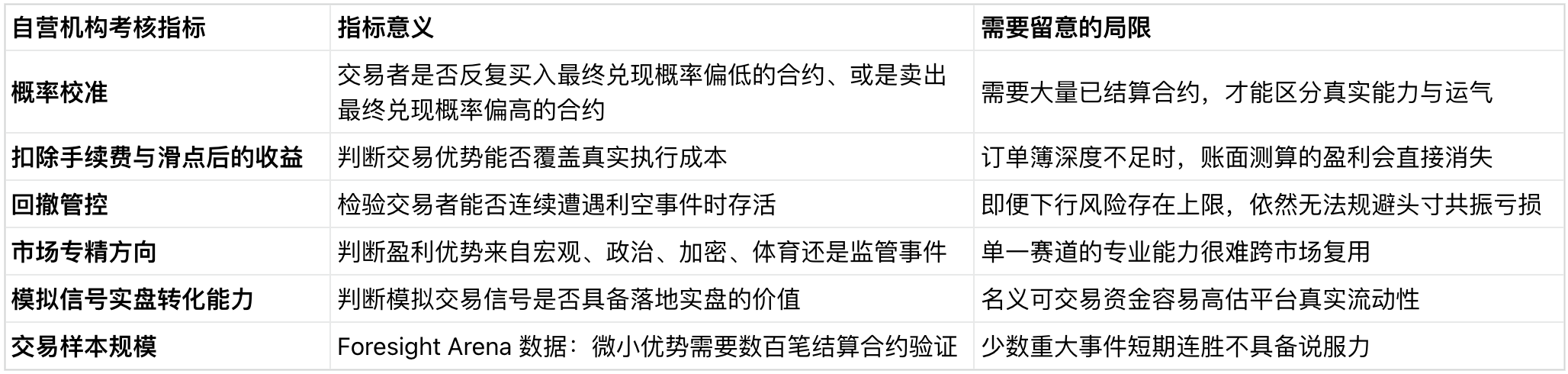
Propr plans to extend this evaluation system to Polymarket. Traders and AI agents who pass the assessment can receive a maximum trading limit of $100,000 per account, with a total limit of $300,000 across multiple accounts, and a profit-sharing ratio of up to 80%.
The company views each trade as an effective signal, with part of the signals replicated onto the live trading platform as positions in Book A, while the rest operate internally in simulation, categorized under Book B. Regardless of the method, traders receive profit and loss calculations based on the same standards.
Currently, Propr allocates only about 5% of trading signals to the real trading market, while the remaining signals are kept internal for simulation. Louis Régis stated that this approach aims to accumulate sufficient data and reliably manage the proprietary funds. Regardless of whether in Book A or Book B, profits are ultimately settled on-chain in USDC.
Execution-Level Challenges
Louis Régis believes that prediction markets are inherently compatible with AI agents: each contract's structure is standardized, prices are observable in real-time, and settlements are completed according to fixed rules.
Agents can continually monitor the market and update pricing every minute. Louis Régis stated that the combination of a standardized market environment with continuous re-pricing capability can theoretically form a solid trading advantage.
Prediction Arena is conducting benchmark tests: six cutting-edge AI models are assigned $10,000 each, trading autonomously on Kalshi and Polymarket from January 12 to March 9. The results show that the models experienced losses ranging from 16% to 30.8% on Kalshi; on Polymarket, the average loss was smaller, yet still recorded negative returns, with an average drawdown of 1.1%. Additionally, one research paper pointed out that to convert prediction accuracy into stable profits, a reasonable betting strategy must be paired with ample liquidity to support the strategy.
Prediction markets can serve as an excellent testing ground to assess whether AI trading models can transform predictive viewpoints into profitable trades.
Future Market Evolution Prospects
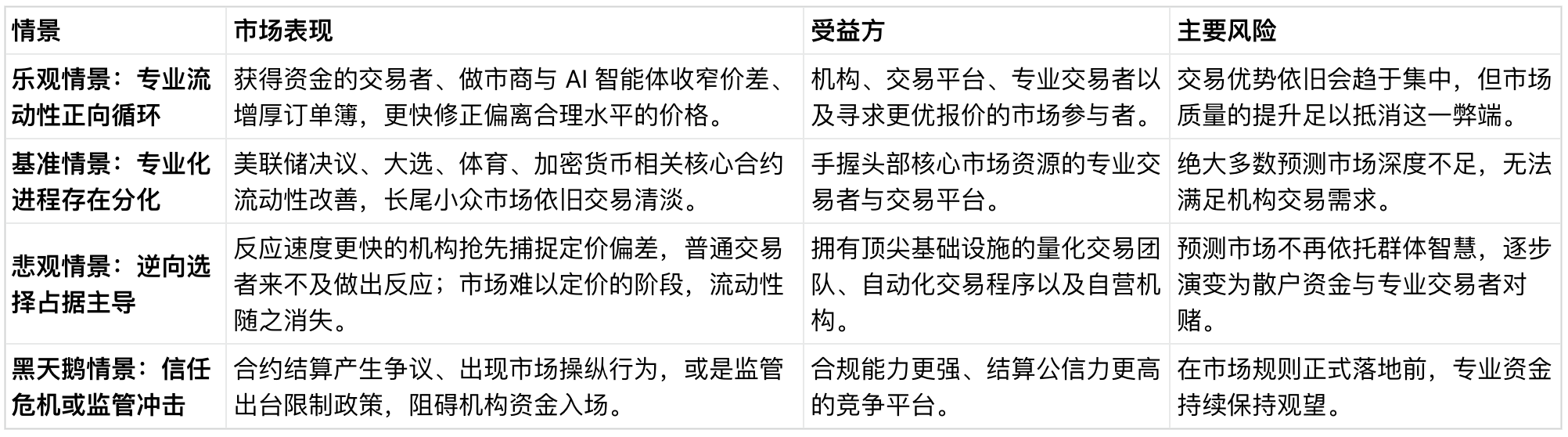
In an optimistic scenario, traders, market makers, and AI agents receiving financial support will bring ample real trading capital, narrow bid-ask spreads, enhance the order book, and bridge the price levels between Kalshi and Polymarket.
A research paper from January 2026 analyzed similar contracts on the Polymarket, Kalshi, PredictIt, and Robinhood platforms. The study found that when liquidity and trading activity are high, Polymarket often dominates price discovery, and large one-sided order flows will determine which platform adjusts the price first. More real trading capital entering the market is expected to further expand the leading advantages of top platforms across more contracts and shrink the price differentials between major platforms.
In a pessimistic scenario, trading advantages will concentrate in the hands of a few institutions with top-tier infrastructure. Ordinary retail traders will continue to lose to counterparts with more informed information; when the market struggles to price events, liquidity will quickly dwindle.
Louis Régis said: "I am confident about the direction of development, but cannot predict the final scale." Even if a proprietary institution expands rapidly, compared to a market with monthly trading volumes already in the hundreds of billions, the trading volume a single institution can provide remains very limited.
The market has already pre-bet on the expectation that the Federal Reserve will maintain interest rates unchanged on July 28 to 29, and before the official statement is released, mainstream expectations have essentially been set. The real competition exists in the tail intervals, which are the probability intervals that deviate from this consensus; when CPI, GDP, and non-farm employment data are released, all contracts will experience a concentrated repricing window.
The U.S. Bureau of Economic Analysis will release the preliminary GDP estimate on July 30, and the July employment report will be published on August 7. Each round of data release will see the same competition: those who can anticipate data surprises the fastest or correct outdated pricing the quickest will seize the trading order flows.
Being able to consistently and accurately price these types of data market movements is key for a trader or a model to gain support from proprietary trading funds.
免责声明:本文章仅代表作者个人观点,不代表本平台的立场和观点。本文章仅供信息分享,不构成对任何人的任何投资建议。用户与作者之间的任何争议,与本平台无关。如网页中刊载的文章或图片涉及侵权,请提供相关的权利证明和身份证明发送邮件到support@aicoin.com,本平台相关工作人员将会进行核查。


