
Authors: Joe Schmidt, Julian Marx, a16z
Translation: Omnitools
The well-known client you are desperately chasing may be causing you to lose the whole market.
Many startups with excellent AI products spend months chasing their first Fortune 100 client: their funding is quickly depleted, and the core team is trapped in deals that are slow to convert. Founders pursue these clients not necessarily because of the high contract amounts, but because they believe that as long as a well-known brand appears in their sales materials, subsequent transactions will be easier.
As a result, they invest almost all their energy in these companies, even willing to offer significant discounts or even pay customers to use their products. Whether revenue can cover costs is not important; securing that name itself is the goal. Meanwhile, those who truly need the product and are willing to pay full price may have never heard of this company.
This choice is not without reason. AI is still a new technology, and founders often believe that they must first educate the market, so they tacitly adopt a "lighthouse client" strategy: acquire a few leading clients, build social proof, and reassure buyers hesitant to make wrong decisions.
However, for many AI companies, this intuition may be quite the opposite. Their buyers already understand the problem and are not worried that a purchasing mistake will ruin their careers; they just need to confirm whether the deal makes financial sense. For every additional week that startups spend chasing well-known clients, competitors gain another week signing deals in a broader market. For these companies, a more appropriate strategy might be "market capture": relying on a clear return on investment to win clients, acting quickly, and expanding the number of contracts without being overly reliant on client reputation.
When it comes to selling AI products to enterprises, there are roughly two market entry strategies: lighthouse clients and market capture. The difference between the two does not lie in product quality or team strength but in what you are selling and to whom you are selling it.
Lighthouse Clients: Proving a New Category with Leading Clients
When AI makes previously impossible tasks feasible, the company is essentially creating a new category. These products have no precedent within the client organization, there are no existing products to substitute, and buyers lack a readily applicable cognitive framework. You are not replacing Salesforce; you are inventing an entirely new way of working, which means buyers need to take a step that carries risks.
In such a market, social proof is extremely important. Startups need to find "lighthouse clients": the adoption behaviors of these clients not only represent an order but also prove to the entire industry that this category genuinely exists and that this company is worth betting on.
Harvey is a typical case. It provides AI services for legal professionals. Today, legal AI is like a mature category, but a few years ago there were hardly any players in the market and almost no clients. In the past, law firms purchased research tools like Thomson Reuters and Legal Analytics to find information, which then got handed to paralegals for interpretation and processing; Harvey takes on tasks such as drafting, research, and due diligence across thousands of documents.
The legal profession inherently emphasizes risk avoidance, so no law firm was willing to be the first to try it. It wasn't until Allen & Overy signed on at the end of 2022 and Paul Weiss followed in early 2023 that other peers began to pay serious attention. Today, Harvey's recurring annual revenue reaches hundreds of millions of dollars, with a valuation of $11 billion, but before this, it first needed these two leading law firms to prove to the entire industry that using AI to complete parts of legal work is feasible.
Hebbia adopted a similar strategy in the financial services field. It builds an AI intelligence platform for teams that spend over 60 hours a week handling high-risk data room materials. In a transaction environment that values confidentiality and reputation, no fund was willing to take the risk first either. Hebbia first secured major global private equity firms, hedge funds, and consulting companies, and then expanded to more than 40% of the top asset management firms by assets under management, including KKR and BlackRock. Like Harvey, the market only began to follow once well-known institutions took the first step.
Securing lighthouse clients often relies on small teams, founders' personal involvement, and high-intensity service. In suitable markets, this strategy can yield large orders: early annual contract amounts reach at least six figures, often even seven figures. Due to the need for concept validation, custom development, and convincing buyers worried about high-cost mistakes, the sales cycle can last 3 to 6 months or even longer.
The team that signs the order is often the same team that delivers the product. This approach is costly and difficult to scale, but it is inherently designed to establish a new category. For early buyers, being the first to adopt may bring excessive returns. Therefore, excellent lighthouse sales need to make clients feel that this risk is more about gaining an advantage early rather than bearing the risk of making mistakes.
Market Capture: Expanding Coverage with Economic Logic and Speed
If buyers already understand the problem, and a purchasing mistake won’t cost decision-makers their jobs, the rules of the game change completely.
These buyers know exactly what you are selling, and the sales pitch can be very direct: "I can replace the existing solution at a lower cost or deliver better outcomes." You do not need to get a technology executive from some star company to endorse your product. Just laying the current costs of the customer service head on the table and telling them, "We can cut this expenditure in half," is enough to earn a meeting.
Social proof can still speed up transactions, but the market does not need to be convinced that this problem exists. In such markets, sacrificing speed is often fatal, as startups are not only competing against other startups but also against traditional vendors who are adding AI capabilities to existing products.
For example, Zendesk added AI assistants while Decagon used agents to replace most customer service functions; there are fundamental product differences. But Zendesk already has clients. The more AI capabilities it adds each quarter, whether developed in-house or acquired, the harder it becomes for startups to pull customers away from it. Therefore, speed itself becomes the core of competition. As a16z partner Alex Rampell notes, companies must secure distribution and customer coverage before traditional vendors catch up with innovation.
Stuut provides a case of accounts receivable automation, covering collection, payment, cash write-off, and dispute handling. Enterprise resource planning suites like SAP and Oracle have long included accounts receivable modules, and companies like HighRadius have been selling related single-point solutions since the early 2000s, yet enterprise teams still waste a huge amount of time chasing invoices.
Stuut has delivered very clear results: clients improved cash flow by 40%, reduced manual tasks by 70%, and shortened the average payment cycle by 37%. The company chose to broadly target clients early on, prioritizing the mid-to-low-end enterprise market rather than chasing Fortune 100 brands. Now, it serves manufacturers, distributors, and logistics companies in states like Michigan, Ohio, and Texas. Traditional solutions often require 6 to 18 months for deployment, while Stuut can go live in a week.
Decagon adopted a similar approach in the customer support realm. Before developing the product, the founder interviewed around 100 clients within a month, then emphasized quick deployment and immediate ROI as selling points. Within 18 months, the company’s annual recurring revenue grew from zero to eight figures. In 2025 alone, Decagon signed over 100 new enterprise clients across travel, finance, healthcare, and retail; in less than 6 months, its valuation tripled to $4.5 billion.
Market capture sales are driven by demonstrations and typically require larger teams. Products must be standardized enough for clients to quickly onboard and rapidly see value. Implementation work should be handled by frontline teams adept at delivery, rather than re-exploring needs with each client. Since scale itself is the very strategy, the unit economic model must support a large volume of clients.
How to Determine Which Strategy You Belong To
Enterprise sales are fundamentally a trade-off between risk and return. Behind every transaction, there is a person who needs to sign off on the purchasing decision. They want the product they approve to work correctly and hope to keep this job next year.
Buyers are not abstractly evaluating the product; they are assessing: how much personal risk this purchase will bring them and what evidence is needed to make that risk bearable.
Thus, startups can assess which strategy to choose using two questions.
First, how much risk does the signing buyer have to undertake?
The cost of different mistakes varies significantly. In customer support or accounts receivable automation, an erroneous reply or an incorrect invoice can annoy clients but can usually be corrected. Decision-makers might experience a poorly performing quarter, but it may not end their careers.
The buyer’s risk exposure is primarily influenced by three factors:
- Whether the industry is strictly regulated such that a vendor's errors translate into compliance liabilities for the buyer;
- Whether the product is replacing the enterprise's core record system or merely serving as an additional tool;
- Whether the product output directly faces external clients, such as formally submitted documents or directly sent answers, rather than internal drafts that still require review.
In the legal and financial services sectors, these three factors are often simultaneously high. A fabricated piece of data can lead to incorrect asset pricing or even cause an entire transaction to fail. For these buyers, ROI calculations may not be the primary focus; they need to manage personal risks that discounts cannot offset.
Second, can social proof spread in the market?
In some markets, the spread of reputation is highly efficient; in others, it is not.
Financial and legal institutions closely monitor their peers and easily identify industry standing. Securing two leading institutions can potentially influence the entire market because early adopters have already completed a risk assessment for latecomers.
However, in the fragmented mid-sized enterprise accounts receivable market, a financial officer in one area may not care whether a well-known brand is using your product, or might never even encounter that information. There is a lack of close observation among buyers, and every sale must demonstrate value from scratch, where the benefits of a famous client’s name are more limited.
In other words, concentrated markets that emphasize industry standing can convey social proof; highly fragmented markets require sellers to recalculate the economic logic in each transaction.
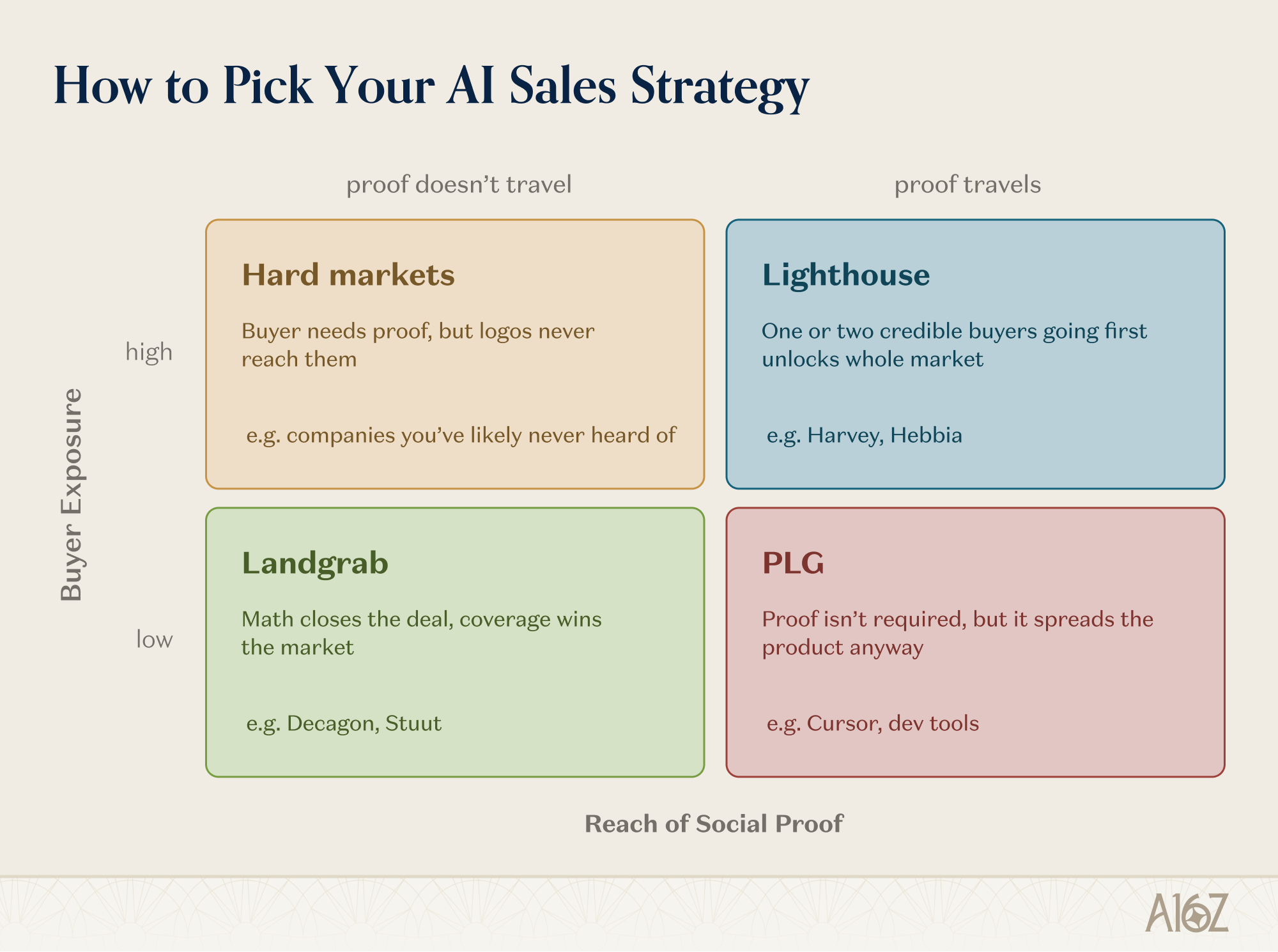
By putting the two questions together, you can get a strategy map:
- High buyer risk and fast dissemination of social proof belong to the lighthouse client market. A few trusted buyers adopting first can open up the entire market, as seen in legal work and financial research.
- Errors are easily corrected and social proof dissemination is weak, belonging to market capture. Clear economic logic drives transaction completion, and broader client coverage wins the market, represented by customer support and accounts receivable automation.
- Social proof spreads quickly, but buyers do not rely on it; products may disseminate organically through users. For instance, development tools can circulate among engineers, forming categories from the bottom up, at which point a large sales team may not need to be established initially.
- Buyers need proof, but the influence of leading clients does not reach other buyers; this is the most challenging market. Companies trapped in this quadrant often remain unseen by the outside world.
Some superficial rules can also aid in judgment: small and medium-sized enterprises tend to prefer market capture and are risk-averse; auxiliary tools typically sell faster than products replacing core record systems. However, tracing these rules back will ultimately bring you back to the two variables of "buyer risk" and "can proof be disseminated."
Markets do not always fit neatly into clear categories. In ambiguous cases, existing budgets and rough investment return estimates can still be observed. However, these signals only confirm a company is in market capture if buyer risk has already become manageable. Buyers may have budgets and understand economic logic, yet they may still insist on waiting for a credible institution to adopt first. When risk and economic logic point in different directions, risk should take priority.
Sales cycles can also serve as quick checks. If a deal lasts over 60 days, if the team requires significant customization to validate the concept, if buyers first ask "Is it safe?" rather than "How much does it cost?", it indicates they need social proof, and the company should adopt a lighthouse client strategy.
Currently, the more common mistake is the opposite: assuming all buyers need to be educated and all need endorsements from leading clients because AI technology is new. But if the worst outcome for buyers is just an incorrectly priced invoice that can be rectified later, they are not managing career risk. At this point, showing up with a list of well-known clients amounts to answering a question they've never asked.
Common Traps for the Two Strategies
Four Traps of the Lighthouse Client Strategy
First, being held hostage by well-known clients. All startups compete for the same leading brands, ultimately engaging in brutal competition over about 500 large clients. Big clients are aware of the startups' urgent needs and continually demand concessions. Lighthouse clients are merely a means to open the market, not the destination. After securing a few trusted brands, the company needs to quickly move into a broader market, as the vast majority of revenue still comes from lesser-known enterprises.
Second, having only fame without returns. Wrong clients may refuse to cooperate in developing replicable software, gradually turning startups into consulting firms; they may also refuse to pay continuously, making the business model unsustainable; or the contract amounts may be too low, rendering the unit economic model ineffective. The worst situation is that the company serves a well-known brand but learns no replicable experience, and the income is insufficient to cover the investment, ultimately just earning a vanity metric.
Third, falling into the pilot hell. Large companies love pilot projects, with a concept validation lasting 6 months that never turns into a formal contract, enough to drain the best talents from the startup. The solution is to set clear deadlines and milestones for the pilot, and include terms in the contract that it will automatically convert to formal cooperation upon meeting conditions.
Fourth, illuminating only one ship. The team overly responds to the customization needs of a particular lighthouse client, resulting in a product that is only suitable for that client and has no value for others. The company indeed secured a lighthouse client, but other ships in the market are not moving forward along that beam of light.
Three Traps of the Market Capture Strategy
First, dying from indigestion. When a product could nearly be sold to anyone, real discipline is learning to say no. Some customers are difficult to onboard, hard to produce results, yet the contract amounts are low. Without a strict client screening and transaction approval mechanism, a company might wake up one day with 200 clients, 50 of whom are in the red.
Second, capturing a market you cannot maintain. If a company expands its sales coverage before its product is mature, it risks creating large numbers of dissatisfied customers. Fifty dissatisfied customers mean loss of renewal, while 500 dissatisfied customers can lead to a reputation crisis.
Third, mistaking a local market for the entire market. Running through every bus stop in a large city does not equal truly capturing the market. A bigger opportunity is finding a way to present clear investment returns to 50,000 companies outside traditional relational networks.
Optimal Order: Transitioning from Lighthouse Clients to Market Capture
The best companies do not remain in one model forever but consciously transition from lighthouse clients to market capture: first securing benchmark clients in one vertical industry, dominating that vertical, and then seeking adjacent industries with similar characteristics.
Affirm’s development path exemplifies this. Its early breakthrough came from the mattress brand Casper. After securing one mattress company, Affirm continued to pursue nearly all mattress companies, followed by entering the fitness equipment sector, then expanding into products that appear similar to fitness equipment but actually belong to different categories.
While mattresses and Peloton exercise bikes seem unrelated, they are both high-priced items that consumers wish to pay for in installments. Affirm saw this earlier than the market.
As lighthouse clients define and validate new categories, that category will ultimately become a recognized market. However, companies must first earn the right to transition from being a lighthouse to scaling up. Spreading out before the category is established will deplete both cash and credibility.
A clear signal for transition is when buyers start approaching with allocated budgets, requesting product demos, rather than repeatedly asking "Who is already using it?" When this situation arises, it indicates that the lighthouse clients have completed their mission, and the time for market capture has arrived.
Conclusion
Every AI founder believes they are inventing the future, and they may indeed be doing so. But buyers do not purchase the abstract concept of "the future"; they buy proof or an economic logic that makes sense.
If buyers need proof, go secure that leading client who can provide the proof; if what buyers need is economic logic, present the return on investment to them as quickly as possible, closing the deal before competitors or traditional vendors.
Founders who choose the wrong strategy may not fail due to product errors or picking the wrong option from a strategic checklist. They are more likely to fail from never having truly asked: which game are they actually participating in.
In such a rapidly changing market, a company may have only one chance to answer this question.
免责声明:本文章仅代表作者个人观点,不代表本平台的立场和观点。本文章仅供信息分享,不构成对任何人的任何投资建议。用户与作者之间的任何争议,与本平台无关。如网页中刊载的文章或图片涉及侵权,请提供相关的权利证明和身份证明发送邮件到support@aicoin.com,本平台相关工作人员将会进行核查。


