$29 billion non-stablecoin distributed assets' four major landing scenarios and three major cutting-edge breakthroughs.
Written by: Starbase Accelerator
Report Content Overview
On August 11, 2026, The Block Research released the report "RWAs as Collateral: The New Primitive." The report focuses on the paradigm shift of tokenized real-world assets (RWA) as collateral in DeFi, indicating that under the total market value of $730 billion in RWA, $29 billion of non-stablecoin distributed assets are reshaping on-chain capital efficiency at a growth rate of 246%, marking a new phase where collateral transitions from "non-interest bearing custody" to "continuous income generation." The report unfolds from the following dimensions:
- Market panorama and asset classification: Clarifying the essential differences between representative assets and distributed assets, positioning the core value of non-stablecoin distributed assets in the composability of DeFi.
- Collateral economics reconstruction: Using tokenized government bonds and credit products as examples, illustrating how "interest-bearing collateral" can compress borrowing costs to the level of interest spreads, redefining capital structure.
- Four major demand-side functions: Systematically sorting the current integration paths and typical cases of RWA in lending, margin, reserves, and yield strategies.
- Institutional infrastructure evolution: Analyzing how isolated markets, prime broker models, and yield distribution channels lower the threshold for RWA entry, promoting the formation of on-chain institutional-level services.
- Cutting-edge scenario outlook: Forecasting three imminent breakthroughs in tokenized stock collateral, receivables financing, and wage advances, and their long-term impact on on-chain market structure.
RWA Market Panorama: From "Stablecoin Appendage" to "Independent Asset Class"
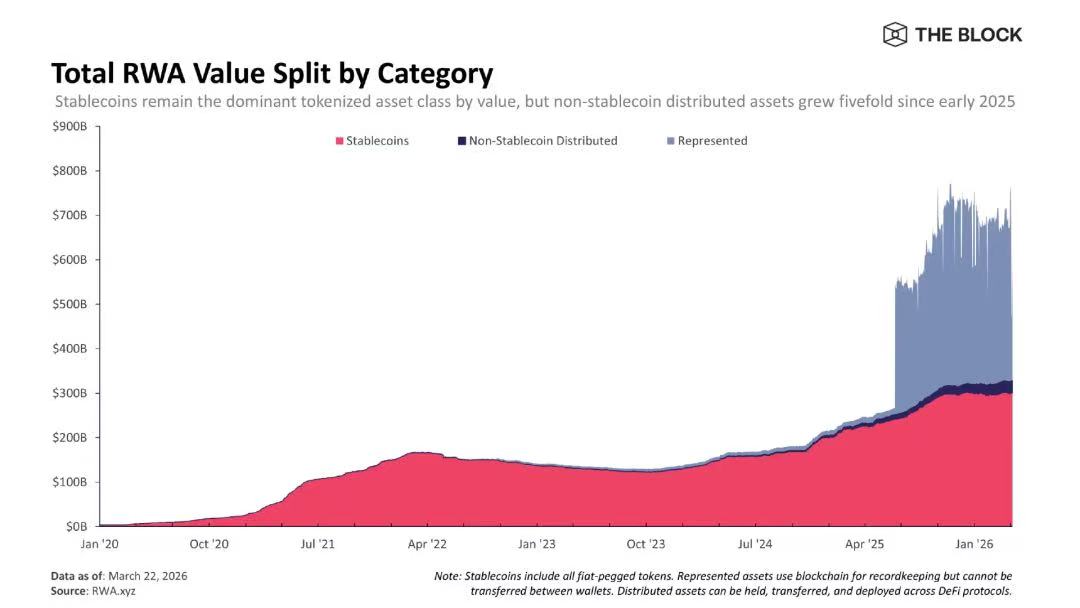
As of March 2026, the total value of the tokenized real-world assets (RWA) market has surpassed $730 billion, growing 197% over the past twelve months. However, within this headline number, stablecoins account for over 90% of distributed assets; what really deserves the attention of DeFi practitioners is a subset beneath it—the non-stablecoin distributed assets, with a scale of approximately $29 billion and a growth rate of 246%, outpacing the overall RWA market.
The so-called "distributed assets" refer to tokenized assets that can be directly held, transferred, and composed in on-chain wallets, including government bonds, private credit, commodities, stocks, and real estate. In contrast, "representative assets" refer to those with on-chain ownership records that cannot be freely circulated, essentially just electronic ledgers. The composability of DeFi only recognizes distributed assets, and the $29 billion scale is transitioning from "experimental products" to "infrastructure."
Paradigm Shift: Collateral from "Non-Interest Bearing Custody" to "Continuous Income Generation"
The collateral logic in traditional DeFi lending is quite simple: you lock ETH or WBTC in a contract, borrow stablecoins, and during the lock-up period, the collateral does not generate returns (or the returns are unrelated to the lending scene). RWA collateral completely rewrites this equation.
Take tokenized government bond funds as an example: suppose an institution holds $10 million worth of AAA-rated CLO tokens with an annual yield of 6.5% and needs $5 million in stablecoins to circulate for six months. The traditional approach would be to sell half of the position, incur a 1% discount and 20% capital gains tax, with an actual cost of about $90,000. However, in the RWA collateral lending scenario, the institution can use the entire $10 million as collateral to borrow $5 million USDC at a rate of 5.5%. The collateral generates continuous income over the full position for six months, yielding $162,000, completely covering the $137,000 interest cost, resulting in a net profit of $25,000 with no tax liabilities.
This is not about "optimization," it is a redefinition of capital structure—collateral itself has become a revenue engine, and borrowing costs are compressed to the level of "interest spreads."
Four Major Demand-Side Functions: Current Integration Map of RWA Collateral
Currently, the integration of non-stablecoin distributed RWA focuses on four functional scenarios:
1. Lending: From Standardized Pools to Isolated Markets
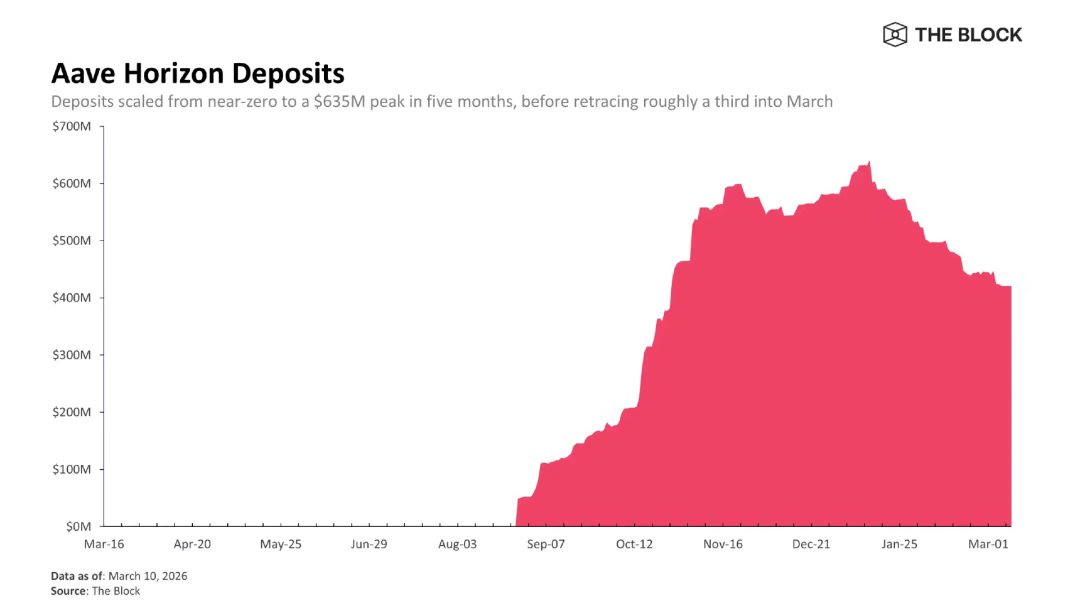
Aave Horizon represents permissioned RWA lending, where qualified entities deposit tokenized government bonds and credit products as collateral to borrow stablecoins. Its design logic is "institution-grade assets + institution-grade counterparties," isolating risk through KYC thresholds. However, RWA assets are extremely heterogeneous—different issuers have vastly differing redemption mechanisms, liquidity, and legal structures, making it challenging to frame using a single risk parameter.
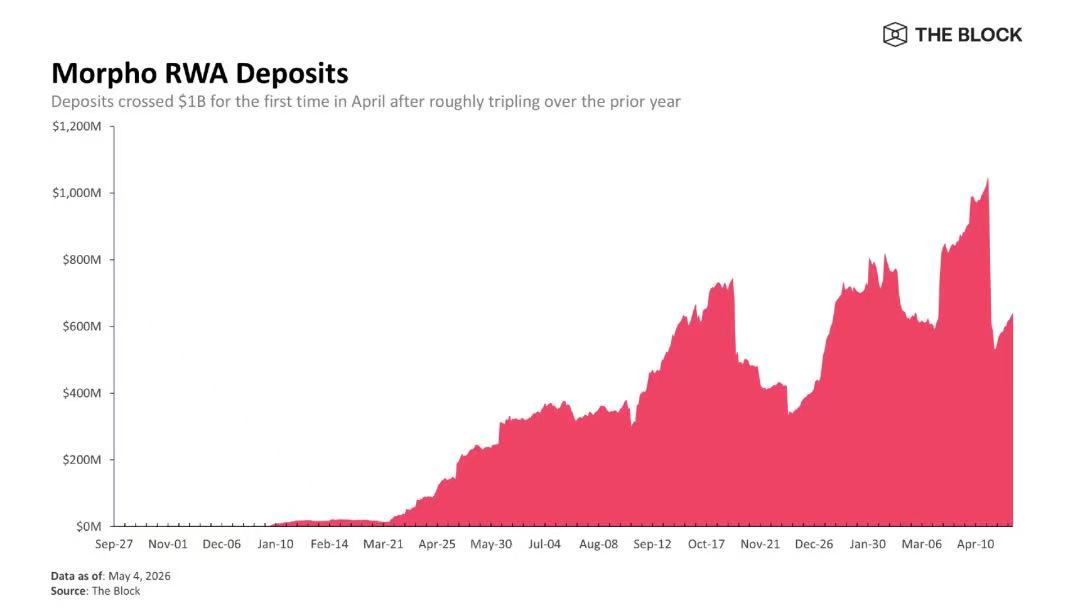
The isolated markets design of Morpho provides another solution: independent curators can create exclusive lending pools for specific tokens, customizing LTV, liquidation thresholds, and interest rate curves, without waiting for lengthy governance votes. This "long-tail model" allows single originators in invoice pools and regional private credit strategies to obtain on-chain liquidity. As of March 2026, Morpho's RWA exposure increased from approximately $34 million to $875 million in one year, marking a growth of about 2478%, indicating an explosion in demand for customized RWA lending.
2. Margin: Generating Government Bond Yield from "Idle Funds"
Derivatives platforms have begun accepting yield-generating RWA tokens as margin, allowing traders not to choose between "earning government bond yields" and "opening leveraged positions."
BNDL, a tokenized government bond fund under BlackRock (with a size of about $2.9 billion), is accepted as cross-collateral for futures and options by mainstream derivatives platforms such as Deribit and Crypto.com. Institutional trading counterparties use BNDL as margin while still earning the underlying government bond yields. Ondo Perps goes further by offering perpetual contracts for tokenized US stocks, ETFs, and commodities, with a leverage of up to 20 times and natively accepting yield tokens like USDY and OUSG as margin—the margin continues to generate income while supporting directional bets.
FalconX and Hidden Road have extended this logic to the prime brokerage scene: a single RWA collateral pool supports activities across multiple exchanges and multiple counterparties, with collateral earning interest throughout. This is beginning to replicate the PB model of traditional finance.
3. Reserves: "Packaging" RWA Yields into Tokens Themselves
More on-chain assets are embedding yield directly into token design by holding tokenized RWA as reserves.
Sky (formerly MakerDAO) is the largest example: its stablecoin USDS reserves contain over $2 billion in tokenized government bonds and institutional credit, with RWA yields accounting for the bulk of protocol revenue, directly subsidizing sUSDS holders. Similarly, stablecoins like Ethena's USDtb, Frax's frxUSD, and Usual's USD0 use tokenized short-term credit assets as their main reserves, enabling holders to indirectly earn government bond yields through "stablecoin packaging."
More native attempts include Liquid Yield Tokens, where certain on-chain funds dynamically combine US government bonds, investment-grade commercial paper, and DeFi lending positions, providing a 6%-10% annualized yield over seven days without pegging net asset value to the dollar, and can be used as permission-free packaging tools to cover underlying authorized assets. This type of product is pushing the concept of "on-chain money market funds" toward retail users.
4. Yield: Splitting, Recirculation, and Distribution
Pendle is the primary venue for RWA yield trading, splitting into PT (Principal Token) and YT (Yield Token), allowing holders to trade future rights to income separately. For RWA, this means retail investors can underwrite institutional credit funds or corporate preferred stock at fixed rates without crossing the qualified investor threshold.
Leveraged recursive vaults provide another layer of amplification: using RWA tokens as collateral, stablecoins are recursively borrowed and reinvested into the same asset, amplifying the baseline return of 8%-9% to approximately 16% with financing costs of 3%-4%. Apollo ACRED recursive vault is a mature example, and the same template is being promoted to more tokenized credit assets.
A more user-friendly form is "yield distribution channels"—users deposit USDC in exchanges or fintech apps, and the platform automatically directs the funds into underlying RWA vaults, allowing users to earn daily compounded yields with immediate redemption. The blockchain layer is entirely abstracted, hiding wallets, signatures, and gas fees. More than $80 million in deposits have flowed through this architecture, indicating that RWA yields are transitioning from "DeFi native tools" to "ordinary users' savings accounts."
Cutting-edge Outlook: Three Imminent Scenarios
Based on the existing infrastructure extensions, the following three directions are most likely to break through first:
1. Tokenized Stocks as Collateral
Users holding tokenized SPY or individual stocks can use their investment portfolios as collateral to borrow stablecoins for consumption or reinvestment, completely deferring capital gains taxes. This effectively democratizes "securities-backed loans for high net worth private banking clients" into a low-threshold on-chain scenario. Regulation remains the biggest obstacle, but once compliant channels open up, the scale will far exceed the current RWA lending market.
2. Receivables Financing
Entering the on-chain operating capital by tokenizing invoices, bills of lading, and warehouse receipts as collateral compresses the 60-90 day cash conversion cycle into instant access. For small and medium-sized enterprises in emerging markets, this means they can access global stablecoin liquidity pools without establishing bilateral relationships with banking agents. Current pilot projects have financed tens of millions of dollars in receivables, but the improvement of cross-border legal frameworks is a prerequisite for scaling.
3. Wage Advances and Receivables Financing
Borrowing against future wages approaches interest rates akin to home equity lines of credit rather than payday loans. As the scale of wage payments in stablecoins expands, smart contracts can automatically deduct repayments when wages settle, anchoring default risk to employer credit rather than individual FICO scores. This presents a potential market with an annual income exceeding $20 billion, and on-chain implementation could significantly reduce operating costs.
Conclusion
RWA as collateral in DeFi is transitioning from the "concept verification" stage to the "scale implementation" stage. The $29 billion non-stablecoin distributed assets are expanding at a growth rate of 246%; their core value lies not in "moving traditional assets on-chain," but in reconstructing the fundamental economics of collateral—collateral is no longer a sunk cost that is locked up, but rather a living asset that generates continuous income. The four major scenarios of lending, margin, reserves, and yield have formed a preliminary closed loop, while the three directions of stock collateral, receivables financing, and wage advances are most likely to take over as the next wave of growth engines. For any infrastructure provider or application layer project participating in the RWA space, the current key task is not "which chain to choose," but how to translate the credit quality of off-chain assets into on-chain risk parameters without loss within a compliant framework.
免责声明:本文章仅代表作者个人观点,不代表本平台的立场和观点。本文章仅供信息分享,不构成对任何人的任何投资建议。用户与作者之间的任何争议,与本平台无关。如网页中刊载的文章或图片涉及侵权,请提供相关的权利证明和身份证明发送邮件到support@aicoin.com,本平台相关工作人员将会进行核查。


