The market may have overestimated the probability of interest rate hikes. Nomura Securities pointed out that the recent cooling of inflation gives the Federal Reserve "breathing room to wait"; combined with the historical law that has never seen a "hawkish turn" in the second half of an election year since 1990, under the dual constraints of economic data and the political cycle, the Federal Reserve will most likely remain inactive before the midterm elections.
Written by: Xu Chao
The latest minutes from the Federal Reserve's July meeting, which lean hawkish, indicate that the interest rate hike camp consists of more than just three members, and the turmoil in the bond market has further sparked speculation of a "passive hike"—will the Federal Reserve break the 40-year historical norm and turn hawkish against the tide in the second half of an election year?
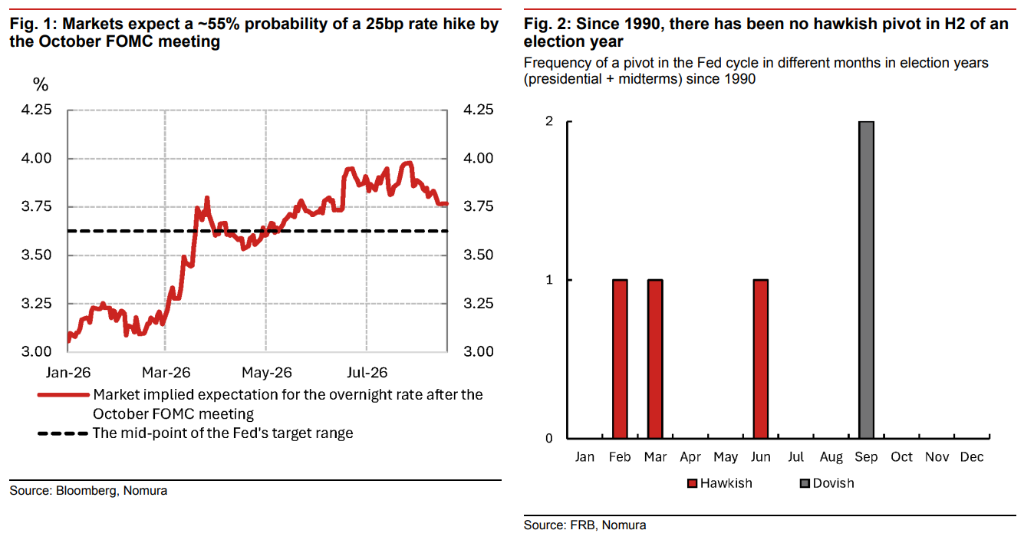
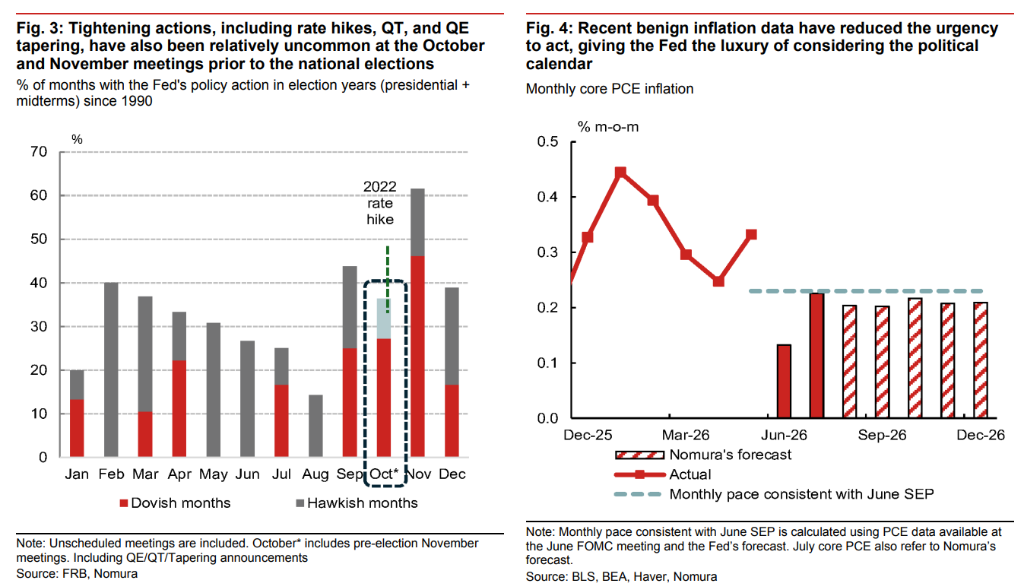
Current market pricing shows that the probability of the Federal Reserve raising interest rates by 25 basis points before the October 2026 FOMC meeting is about 55%, reflecting concerns over high inflation and the market’s worries regarding the Fed's credibility in combating inflation after the July meeting. However, according to Nomura Securities' latest research report, recent inflation data has clearly cooled—June's core PCE increased only by 0.132% month-on-month, and July's CPI and PPI data also point to another moderate reading—objectively granting the Federal Reserve the "luxury of waiting". Nomura maintains its baseline forecast of the Federal Reserve remaining inactive.
Nomura's report also points out that the election calendar marginally provides additional support for the "wait and see" judgment. Since 1990, the Federal Reserve has never turned hawkish in the second half of an election year (i.e., shifting from a rate-cutting cycle to a rate-hiking cycle). Combined with the current cooling inflation momentum and weakening employment and consumption data, Nomura believes that the likelihood of the Federal Reserve maintaining its rate unchanged before and after the midterm elections is increasing, and the market's current pricing for interest rate hikes is overstated.
Historical Norm: Never Turned Hawkish in the Second Half of Election Years
Nomura Securities economists Aichi Amemiya, Ruchir Sharma, and Jeremy Schwartz analyzed the policy behavior of the Federal Reserve before and after elections since 1990 in their research report dated August 19.
Data shows that since 1990, whether in presidential election years or midterm election years, the Federal Reserve has never initiated a policy shift in the second half of an election year—specifically, transitioning from easing to tightening. The frequency of the Fed implementing interest rate hikes, tapering (QT), or reducing quantitative easing (QE Tapering) before the national elections in October and November has also been notably low.
Nomura specifically points out that the current situation is fundamentally different from past interest rate hike cycles. The interest rate hike in November 2022 occurred six days before the midterm elections, but by that time the tightening cycle had already begun and there was a broad consensus among FOMC members to continue hiking rates. The current situation, however, is completely different—if the Federal Reserve were to raise interest rates now, it would be restarting hikes after two years of continuous cuts, truly meaning a "hawkish turn," which has no historical precedent.
Historical Echo: Election Factors in the Meeting Minutes
Nomura cited multiple historical FOMC meeting records that provide direct evidence that policymakers have explicitly considered the timing of elections.
The FOMC meeting in November 2016 was held six days before the presidential election. Then-New York Federal Reserve President Dudley believed that raising rates at a time "one week away from the election" would convey a sense of urgency not aligned with economic data; Philadelphia Fed President Harker explicitly stated, "Given the timing of this meeting, we might want to wait until December." The committee ultimately decided to remain inactive and raised rates in December.
The case from September 1994 provides the closest reference to the current situation regarding midterm elections. Although multiple officials advocated for a rate hike at that meeting, the committee ultimately chose to keep rates unchanged. Boston Fed President Minehan clearly pointed out that the timing for further hikes involves both "economic factors" and "political factors." A week after the elections, the committee promptly raised rates by 75 basis points.
The FOMC meeting on September 24, 2002, is also quite instructive. At that time, the next regular meeting was scheduled for November 6, the day after the midterm elections. Then-Fed Chairman Greenspan stated that the Fed was not considering political factors, but he also acknowledged that there would be public associations, concluding with, "If the meeting were the day before the election, we would be in trouble." The Fed ultimately waited until November 6 to announce a 50 basis points cut.
Data Provides the Federal Reserve the "Luxury of Waiting"
The minutes from the July FOMC meeting indicated rare hawkish signals: not only did three voting members formally support a rate hike, but the record also showed that several attendees leaned toward a 25 basis points increase. "New Fed Communications" Nick Timiraos interpreted this as interest rate hikes gaining "broader support." Meanwhile, the turmoil in the global bond market has introduced new pressure variables—Goldman Sachs' trading head in Europe, Privorotsky, bluntly stated that the significant pressure on bond supply might force the Fed to "raise rates even when data weakens to anchor long-term rates."
Despite rising doubts about whether "historical norms will still hold," Nomura believes that the current inflation and employment data provides the Federal Reserve with an objective basis to remain on hold without damaging its credibility.
Regarding inflation, the month-on-month growth rate of the core PCE in June fell to 0.132%, showing a marked slowdown; the July CPI and PPI data point to a moderate reading of approximately 0.226% for the month-on-month core PCE. Nomura points out that, according to recent statements from Federal Reserve officials, a monthly growth rate of 0.1% to 0.2% for the core PCE is viewed as a positive sign toward the 2% target. Although gasoline and food prices are volatile, long-term inflation expectations remain generally stable.
In terms of employment and consumption, the July non-farm payroll report shows the labor market stabilizing rather than overheating again, alleviating concerns about wage-driven inflation; the July retail sales data also indicate that consumer spending, after robust growth in the second quarter, has started to return to normal levels.
Nomura anticipates that as the impact of tariffs gradually wanes, wage growth slows, and residual seasonal price factors turn negative in the second half of the year, inflation momentum will continue to weaken. Moreover, adjustments to the calculation methods of certain PCE components are expected to occur by the end of the year, which is anticipated to marginally lower the year-on-year reading of the core PCE on a technical basis.
Waiting Itself Will Strengthen the Logic of "Staying Put"
Nomura's core judgment is: the longer the Federal Reserve waits to act, the more confident it becomes in the continued decline of inflation, and ultimately, the lower the necessity for taking tightening actions.
The firm believes that the year-on-year growth rate of the core PCE may have already peaked. Considering the trends in economic data and the midterm election calendar, the Federal Reserve will likely maintain rates unchanged for about the next four months. If inflation and economic data evolve as expected, this round of "pause" may extend into an indefinite hold, at which point the current tightening expectations priced in by the market may be completely digested.
Nomura emphasizes that the core basis for its Fed forecast is the inflation outlook rather than the election cycle. However, the historical norms of election years marginally corroborate the firm's "wait and see" judgment and may slightly reduce the probability of the Federal Reserve taking action in the upcoming meetings.
免责声明:本文章仅代表作者个人观点,不代表本平台的立场和观点。本文章仅供信息分享,不构成对任何人的任何投资建议。用户与作者之间的任何争议,与本平台无关。如网页中刊载的文章或图片涉及侵权,请提供相关的权利证明和身份证明发送邮件到support@aicoin.com,本平台相关工作人员将会进行核查。


