The South Korea CBDC has entered the real trading phase, but there is still no legislative foundation for the Korean won stablecoin.
Written by: Ryan Yoon, Tiger Research
Translated by: AididiaoJP, Foresight News
Summary
- The central bank digital currency (CBDC) led by the Bank of Korea has entered the real trading test phase of the "Han River Project," but there is still no legislative basis for the Korean won stablecoin.
- The related amendments to the STO have been passed, but the scope of allowable issuable assets and licensing details are left to a presidential order. The actual market shift depends not on the passage of the bill but on when these details are implemented.
- A public-private consultation mechanism has reached a consensus on the roadmap for the tokenization of stocks, bonds, and money market funds. The focus is not on finding new fragmented investment targets but on bringing already validated standardized securities onto the chain.
- Korea's Hana Bank acquired a stake in Dunamu (6.55%, 1.0033 trillion won, about $733 million) and plans to take 97.15% equity in Korbit (141.4 billion won, about $10.3 million) in the future, not just for transaction fee income but to position infrastructure for STO, RWA, and stablecoins.
- Overseas tokenization pilots usually take 6 months to 1 year, while Korean financial institutions' budgets will be finalized by early December. Now is the time to act, rather than waiting for regulatory details.
The Global Cryptocurrency Market is Fragmenting, Where Does South Korea Stand?
On the surface, the crypto ecosystem has no borders. In reality, once regulatory frameworks in various countries take shape, borders become clearer.
The EU has implemented MiCA, the US is advancing the GENIUS Act and the CLARITY Act, while in Asia, Singapore, Hong Kong, and Japan have also set their own tones. Major economies are incorporating the market into their systems with clear policies, but the policies differ from one another, and the global market is being segmented regionally.
South Korea is also building its environment within this trend. Domestic investment demand and public attention are high, but the regulatory pace is lagging behind major economies.
Current Status of the South Korean Crypto Market
In the first half of 2026, regulations once led the market to believe that crypto would soon be fully incorporated into the formal financial system—STO related legislation had also passed. However, a series of statements suppressing the market, including tax discussions, have disrupted the ecosystem.
Results of the Bank of Korea "Han River Project" Phase One (March 29, 2026)
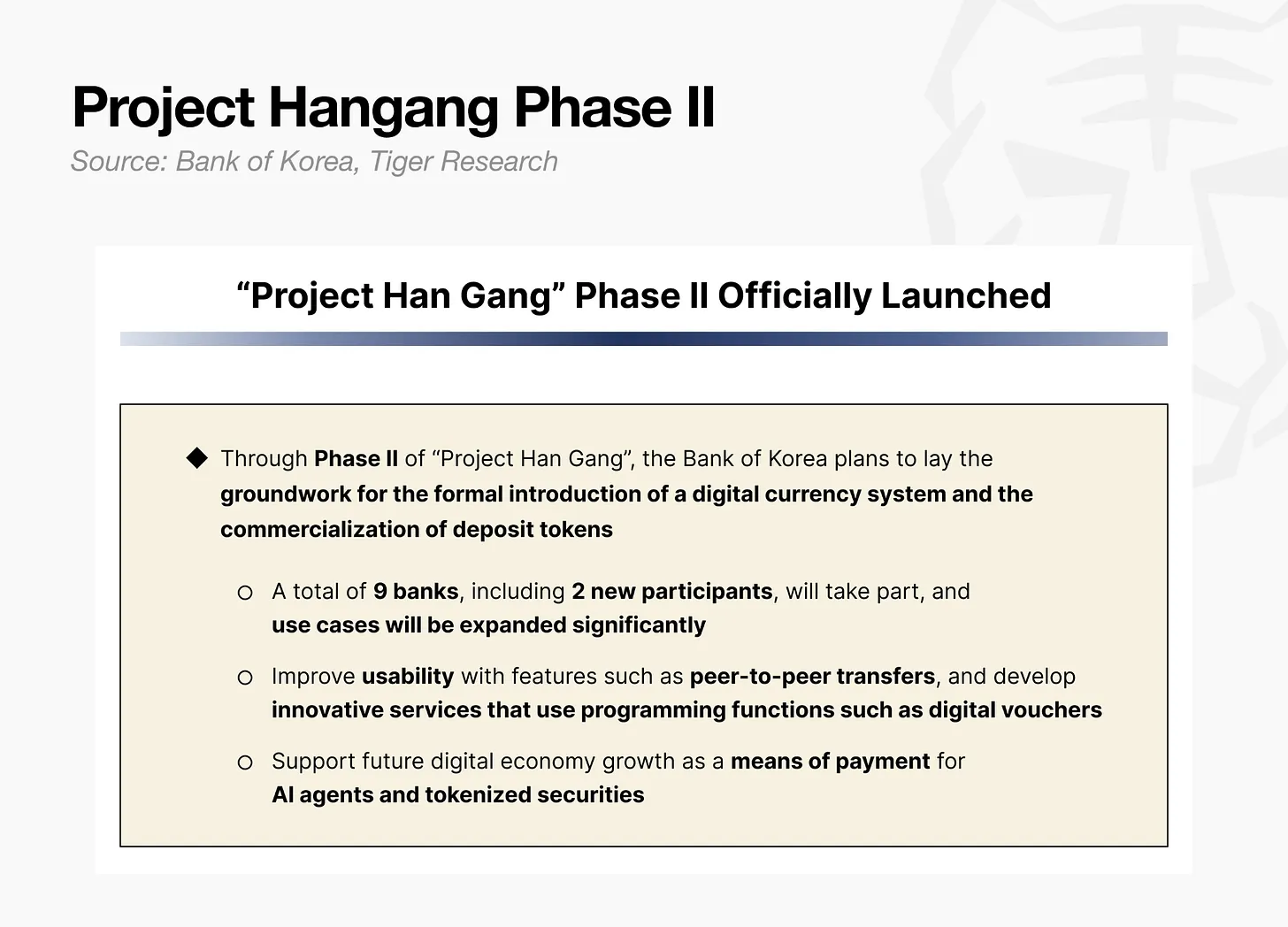
On December 18, 2025, the Bank of Korea released the report of the first phase of the CBDC pilot based on deposit tokens and officially announced the launch of the second phase on March 29, 2026.
The second phase is no longer just a technical validation but tests fund disbursement under real conditions, including electric vehicle subsidies and public expenditure accounts. The number of participating banks has expanded to 9, and the pilot has added peer-to-peer transfers, biometric authentication, and automatic deposit conversion. Real trading may start as early as September, but no specific testing deadline has been set. The absence of a set deadline indicates that they want the service to be operational continuously rather than just a one-off demonstration.
The Han River Project has pushed the CBDC forward significantly, while the Korean won stablecoin is still far from being grounded.
The Han River Project is making progress, but the second phase of the "Fundamental Law of Digital Assets," which should institutionalize the Korean won stablecoin, has been delayed by about a year. This is due to disagreements between the Bank of Korea and the Financial Services Commission: the Bank of Korea advocates for a bank consortium to hold at least 51%, while the Financial Services Commission believes this would stifle innovation and opposes the requirement.
Various policy alternatives have been proposed since then, but legislative discussions have completely stalled after the June local elections, with no clear progress so far. In July, the government and the Financial Services Commission announced plans to resume in the second half of the year and strive for legislation by the end of the year, but the process has been delayed again—Democratic Party lawmaker and member of the National Assembly's Administration Committee Park Min-kyu stated that a task force will be reorganized after the party conference in August, with plans to propose the bill in September.
The CBDC led by the Bank of Korea has entered real verification and provided visible outcomes, but there is still no legislative foundation for the Korean won stablecoin, and its future remains uncertain. One should be cautious about being overly optimistic about this segment, as it is a long-term project that will take considerable time to finalize.
The STO-related Bill Passed in National Assembly (January 15, 2026)
On January 15, 2026, the amendments to the "Electronic Registration of Stocks and Bonds" (Electronic Securities Act) and the "Financial Investment Services and Capital Markets Act" (Capital Markets Act) were passed in the National Assembly's plenary session. After the Financial Services Commission published the "Securities Token Issuance and Circulation Regulatory Framework Restructuring Plan" in February 2023, a three-year regulatory sandbox was implemented, which has now concluded.
The amendments are built on three pillars: recognizing the legal status of distributed ledgers, introducing a system for issuer account management organizations, and refining the circulation roadmap for investment contract securities.
• Legal recognition of distributed ledgers: Previously, the legal forms of securities registration were limited to physical certificates and electronic securities, now expanded to blockchain-based distributed ledgers.
• Introduction of issuer account management organizations: Qualified issuers can register and manage securities directly with the Korea Securities Depository without needing financial intermediaries.
• More specific circulation roadmap for investment contract securities: Provides legal basis for brokerage transactions by securities companies, improving the previously fragmented secondary trading environment and liquidity of fragmented investment assets.
The amendments were published on February 3, 2026, and will be fully effective on February 4, 2027, after a one-year grace period. It is still premature to expect an immediate market boost from the legislative basis alone—key practical requirements, such as the specific scope of allowable issuable assets, are delegated to presidential orders and regulatory provisions, with detailed guidelines yet to be published.
To finalize these guidelines, a public-private partnership Token Securities Committee was established on March 4, 2026, and is discussing the specifics. The Financial Services Commission originally planned to announce secondary regulations and guidelines around July 2026, but as of July 31, it remains in closed-door consultations with the legal and financial sectors, delaying the timeline. By the end of August, the working level expected announcements to be made between September and November.
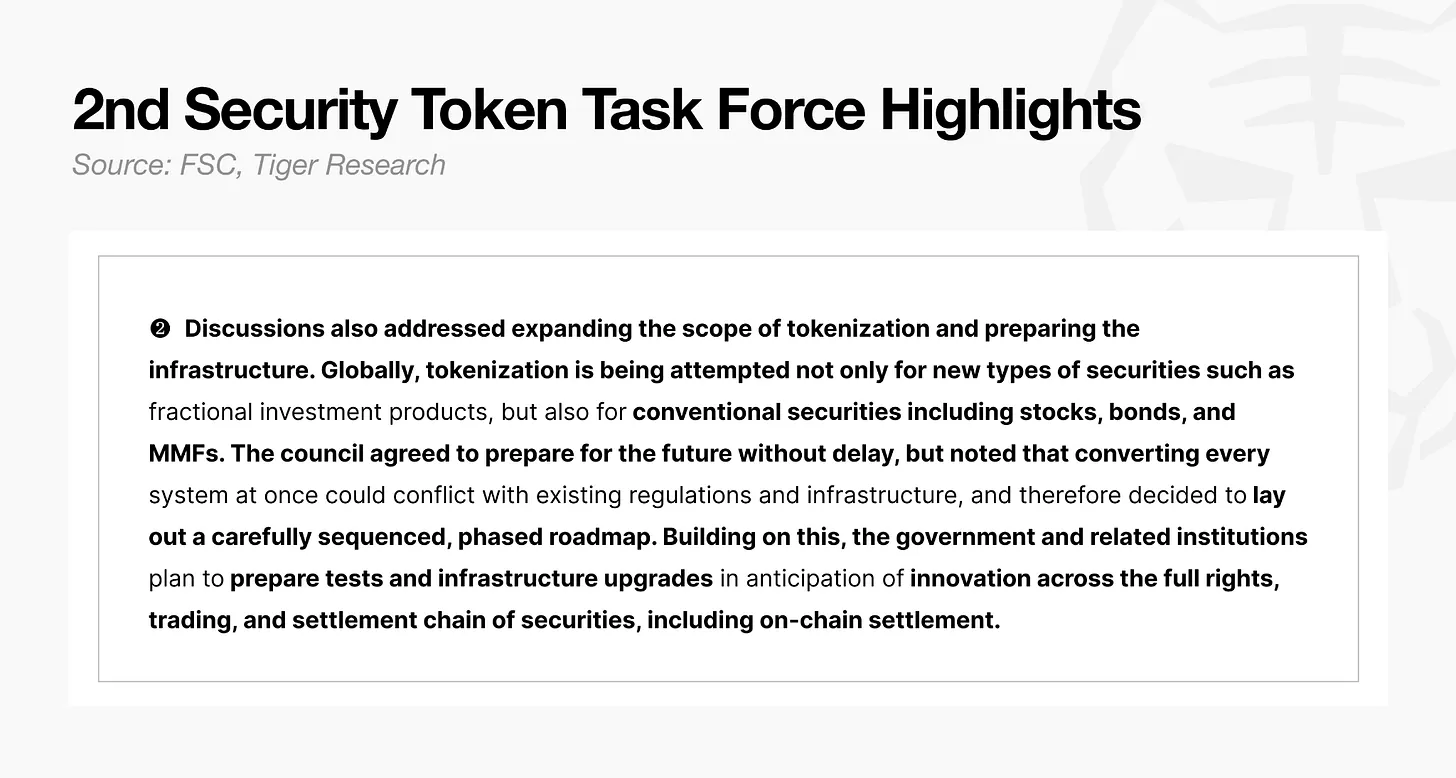
A positive signal in the committee discussions is the inclusion of standardized securities like stocks. In the second meeting on May 15, the parties reached a consensus on a phased roadmap: tokens will be created for existing standardized securities such as stocks, bonds, and money market funds, and on-chain settlement infrastructure will be built. This indicates that the market is expected to expand beyond previously restricted fragmented investments.
Rather than continuing to seek new assets like existing fragmented investment operators, it may be more beneficial to distribute standardized securities that have already been validated, as the potential market space could be larger. Domestic institutions should carefully examine specific precedents and establish diverse global partnerships early on, to secure their position when the market becomes genuinely mature.
The Revised "Specific Financial Information Act" Takes Effect (August 20, 2026)
The revised "Specific Financial Transaction Information Report and Utilization Act," commonly referred to as the "Specific Financial Information Act" (Law No. 21358), was published on February 19, 2026, and took effect on August 20. Not all provisions apply simultaneously from that day. The tightening of VASP registration reviews will be implemented starting August 20; the enforcement of travel rules and trading rules with overseas service providers and personal wallets will apply about six months after the publication of the enforcement order, around February 2027.
• Tightened VASP registration review: Increases review of major shareholders, improves financial soundness and credit requirements, and raises the entry threshold (effective August 20).
• Strengthened travel rules: The original threshold for triggering information sharing of 1 million won (about $730) is eliminated, expanding to all transactions (effective around February 2027).
• Tightened rules for overseas service providers and personal wallets: Limits the scope of allowed transactions based on risk levels (effective around February 2027).
The core change in VASP registration review is the expanded definition of "major shareholders." Now, detailed scrutiny is required for the largest shareholders, shareholders who have appointed a majority of CEOs and directors, as well as, in cases where the shareholder is a corporate entity, the largest shareholder and representatives' financial soundness and credit.
Strengthened travel rules target split transactions to avoid reporting. Transfers already reported between VASPs will have the information sharing threshold expanded from 1 million won and above to include all transactions, and the receiving party is also obligated to acquire this information.
Overseas transactions have also been pulled from the regulatory blind spot. Rather than a blanket ban, there are three tiered risk limits: transfers to low-risk overseas exchanges do not require both parties to have the same name; transfers to other overseas exchanges and personal wallets only allow the sender and receiver to be the same person, meaning the wallet must belong to the user themselves; and all transactions with high-risk overseas exchanges are prohibited. For overseas transactions of 10 million won (about $7,300) or more, already reported VASPs must build and operate suspicious transaction monitoring systems.
Virtual Asset Taxation No Longer Delayed (August 3, 2026)
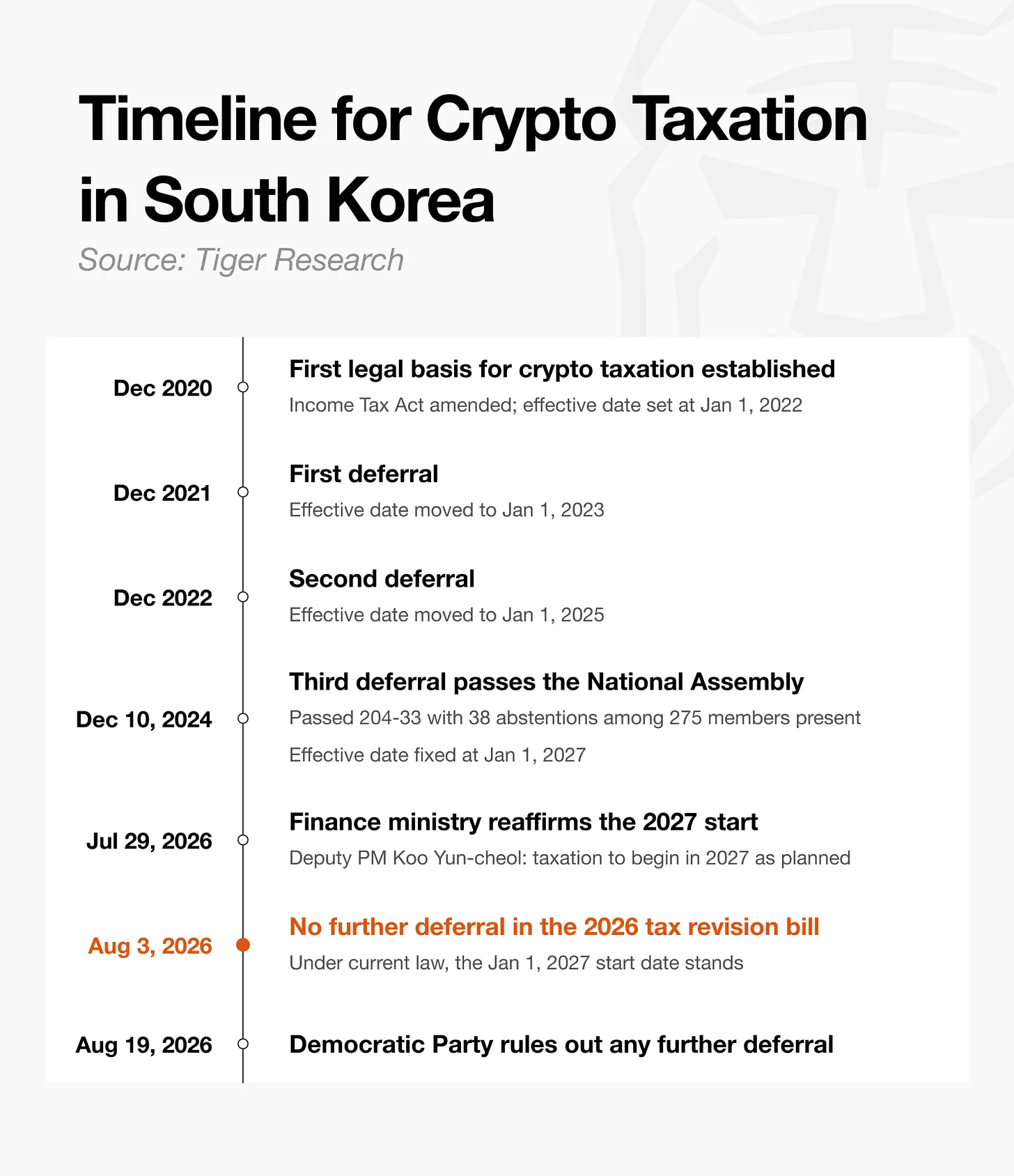
The effective date for virtual asset taxation has been set as January 1, 2027, due to the amendments to the Income Tax Act in December 2024. The government's tax reform proposal in August 2026 did not introduce additional delay clauses, and it will proceed as scheduled under current law. The proposal for delay or repeal of related bills submitted by the People Power Party is still under review.
Additionally, a petition submitted through the National Assembly's public petition system pointed out insufficient taxation infrastructure, capital outflows, and declining profits at exchanges leading to reduced corporate taxes, but the National Assembly and the government continue to have differing positions on this.
Exchange Equity Investment Heating Up
Traditional financial institutions and large capital groups investing in virtual asset exchanges are not just doing so for returns, but to secure positions in the digital financial market ahead of time. Regulatory scrutiny on VASPs makes direct entry challenging, and equity investment has become a pathway that reduces regulatory risk while immediately connecting to large-scale users and liquidity.
- Dunamu (parent company of Upbit): Hana Bank acquired 6.55% equity (1.0033 trillion won, about $733 million, decision made on May 15, 2026), becoming the first commercial bank to hold a significant stake. On August 18, BitGo’s VASP registration in Korea was approved, forming a dual structure of "Upbit equity + BitGo custody." Hanwha Investment Securities increased its stake to 9.84%, becoming the third-largest shareholder; the Samsung group—Samsung Securities (2%), Samsung SDS (1%), Samsung Card (1%) collectively acquired 4% (612.8 billion won, about $448 million), with roles defined in securities tokens, infrastructure, and payments.
- Korbit (Acquisition completed): Future Asset Consulting secured 97.15% equity (141.4 billion won, about $10.3 million). Since the acquirer is a non-financial related company, the approval from the Fair Trade Commission was also interpreted as not constituting a direct investment by a financial company.
- Coinone (Major shareholder change approved on July 22, 2026): Korea Investment & Securities and OKX Ventures each acquired 20% equity (each about 80 billion won, about $5.8 million). The equity structure has been adjusted to CEO Choi Myung-hoon at 30.36%, Com2uS Holdings at 24.54%, and Korea Investment & Securities and OKX Ventures each at 20%, marking a case of a securities company directly holding shares.
- Bithumb (Still pending): Negotiations with Kiwoom Securities broke down substantively over valuation and operational control on August 5, and discussions with Kakao are also dragging. The multi-layered governance structure and the second-largest shareholder Vidente actually holding over 32% makes it difficult to sell existing shares.
Exchange equity investments continue. From a structural perspective, investors view exchanges as the next generation of financial infrastructure—functions of STO, RWA, and stablecoins will converge here—and are positioning themselves in advance of the opening of corporate accounts and more comprehensive participation from institutional investors.
What to Watch in the Future of the South Korean Crypto Market
As mentioned, South Korea is in a transitional phase of establishing its regulatory framework, while barriers suppressing industry growth still exist. The market direction will heavily depend on changes in corporate governance of major virtual asset service providers and legislative advancements concentrated in the fourth quarter, making these turning points worth monitoring.
Close of Trading Season (September to December)
The stock exchange swap between Dunamu and Naver Financial is likely to be the first deal to come to fruition.
The Fair Trade Commission's review of corporate combinations has been postponed; the completion date for the stock swap has already been pushed back twice, first from June to September, then to December 31. The shareholder meeting is set to be moved to November 19. Naver Financial has set a goal to be listed within five years post-merger, with clauses allowing for extensions if this timeline cannot be met.
Bithumb has outlined a three-phase roadmap: seeking new investment since early August, submitting a pre-review for listing in 2027, and completing an IPO in 2028. However, with the negotiations with Kiwoom Securities having broken down substantively and discussions with Kakao still stagnating, the first step of the roadmap—this round of financing—has faced risk of lagging behind.
VASP re-registration is also squeezed towards the year's end. Preliminary materials will start being submitted at the end of October, and the official application deadline is November 20, followed by substantive reviews by the Financial Intelligence Analysis Institute. Additionally, after the amended Foreign Exchange Transaction Act comes into effect in early December, virtual asset transfer businesses must register, marking another critical compliance juncture.
Legislative Turning Point (National Assembly September Regular Session)
The government draft of the "Fundamental Law of Digital Assets" is likely to take shape in the September regular session, to be proposed in the form of a member's bill. The most sensitive issues are: whether to require private stablecoin issuers to have at least 51% ownership by banks, and whether to restrict the equity ratios of major shareholders of exchanges to improve corporate governance.
Meanwhile, authorities view the amendments to the capital markets law and regulation of single stock leveraged ETFs as urgent priorities, raising concerns that the legislative momentum for the "Fundamental Law of Digital Assets" may be weaker than expected.
Whether this bill can pass is directly related to whether the Korean won stablecoin can be institutionalized, making it a variable that could most likely reshape the market landscape.
Finalization of STO Secondary Regulations
The implementation order and guidelines for setting STO market specifics have missed the original July target and are still being delayed as of the end of August. They are expected to be announced in the second half of the year, but no specific date has been set.
Once finalized, the guidelines will clarify which underlying assets can issue security tokens, the requirements for over-the-counter exchange licenses, and limits on investor transactions. The Korea Securities Depository has initiated system construction based on a goal for implementation by 2027. Ongoing delays in the secondary regulations are causing concerns that gaps may emerge between issuance and circulation, leaving a period of silence.
How Enterprises Should Enter the South Korean Market
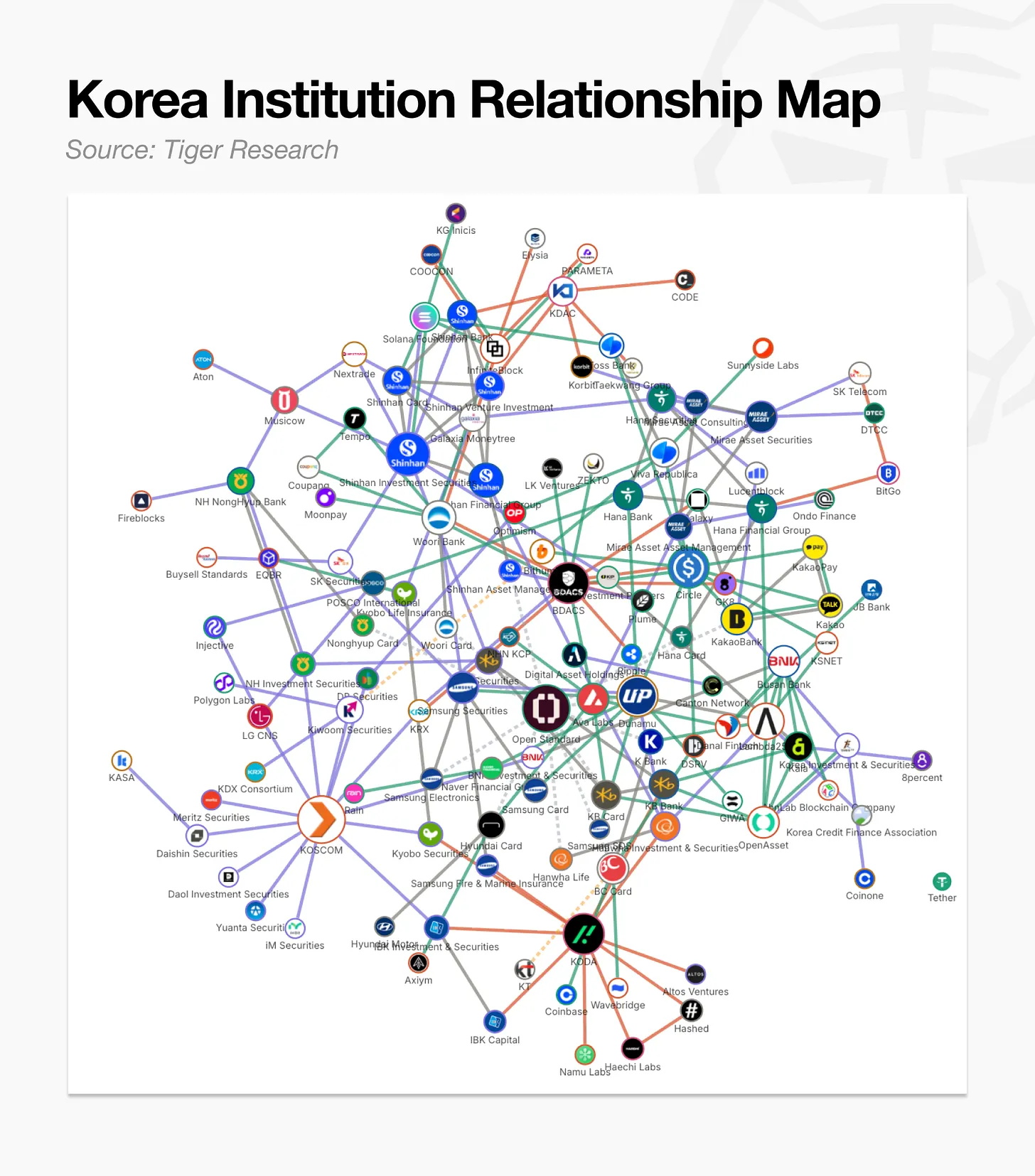
The relationship map of domestic institutions drawn by Tiger Research shows that major institutions are still expanding cooperation comprehensively, attempting to genuinely build up the business value chain.
Traditional financial institutions are leading the way in establishing specific business precedents; domestic and international Web3 projects are increasingly concentrating resources on securing strategic partnerships with institutions rather than retail users.
This shift is partly due to the current slowdown in retail liquidity, and partly a more long-term judgment: genuine value must be created within the formal financial system before retail demand can potentially be reignited.
Domestic institutions: Acting first is more important than anything else.
Traditional financial institutions continue to engage in large-scale equity investments, but the current regulatory framework limits the space for establishing true business models in Korea. Institutions either wait for the secondary regulations for STO to be in place or are confined within the regulatory sandbox to conduct limited testing. A more effective alternative path is to begin operations in overseas jurisdictions where regulations are already complete.
Passively waiting for regulatory clarity makes it difficult to maintain a market position; the sandbox is also essentially trapped within a narrow range of fragmented investments and is hard to extend into standardized securities. Therefore, even if domestic institutions find it challenging at the moment, they should prioritize building operational capabilities centered on overseas bases.
Hong Kong has integrated security tokens into existing financial regulatory frameworks, allowing secondary circulation through licensed exchanges, creating a unified environment for issuance and trading. Singapore has high regulatory transparency, but its entry threshold is also quite high. The US, on the other hand, allows for pathbreaking issuance via exemption clauses when using specific platforms.
Domestic financial institutions with existing overseas networks should focus on the potential of their current bases rather than spending time developing new jurisdictions. Rather than getting caught up in extensive legal interpretations, a more strategic approach is to quickly engage with leading local platforms to verify feasibility.
This window is particularly crucial right now.
Overseas tokenization projects usually take 6 months to over a year from preliminary analysis to issuance and circulation. Given the timeline for the implementation of Korea's STO regulations and electronic securities law set for February 2027, now is the right time to carry out overseas pilots and establish connections with the domestic market. Waiting for domestic regulations to be fully in place will waste over a year. Institutions should confirm specific lists and roadmaps and act now.
Web3 Projects: Likewise Applicable, Act Now
The first hurdle to collaborating with South Korean financial institutions is not technical capability but the qualification of the signing entity. Even for concept verification, the project must first pass information security reviews and vendor registration; applicants without a South Korean legal entity are often directly rejected. When unable to establish a local entity, the project requires a strategic structure that allows a trusted South Korean partner to act as the signing entity and move forward.
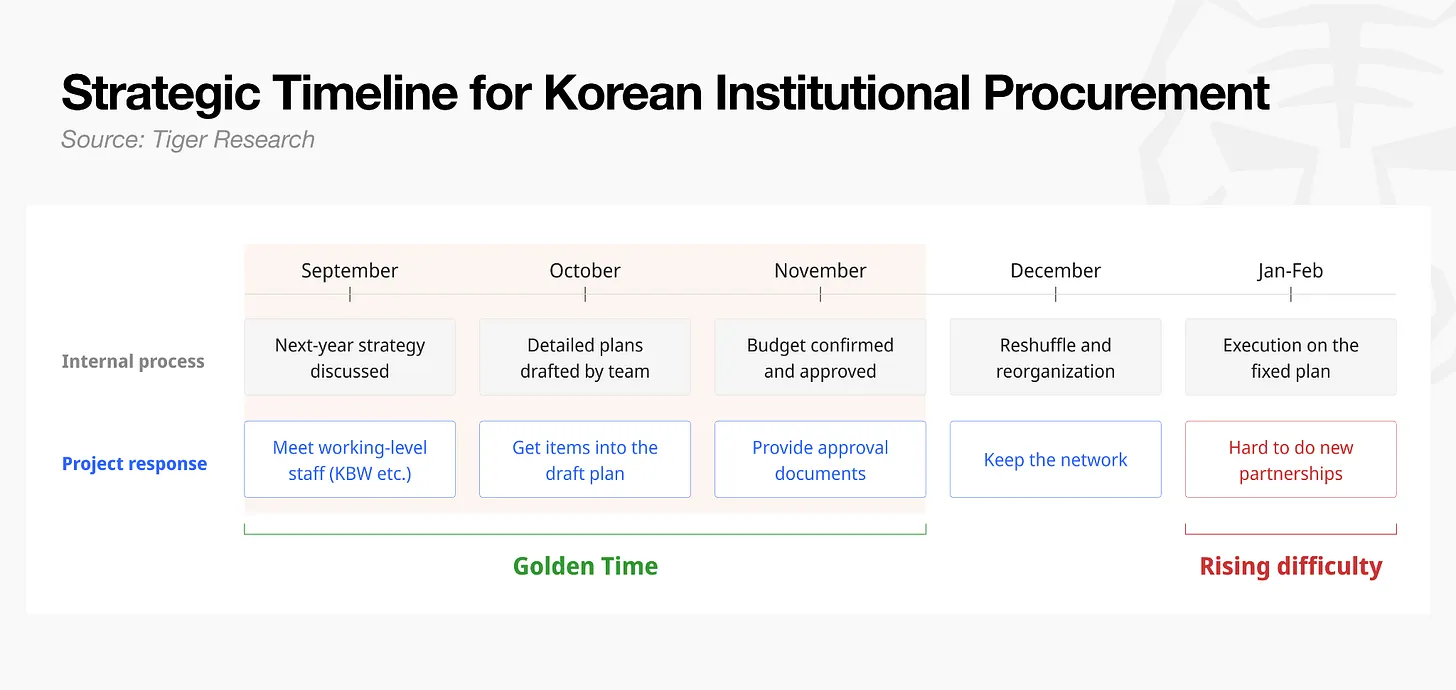
Another key variable is the unique budgeting cycle of South Korean financial institutions. Most institutions start drafting strategies for the following year in October, finalizing budget allocations by early December. Once the budget is officially executed in January, available resources can quickly be depleted, significantly reducing the momentum for advancing new projects. Projects intending to do business with these institutions should regard the current period as a proposal window—missing it will markedly decrease the likelihood of the project moving forward.
Retail strategies must also be comprehensively adjusted. The current market slowdown stems from broader global downturns, making it hard for retail marketing to yield the same effects as in the past. The narrative now needs to focus on real achievements rather than merely publicity. Institutional endorsements have accumulated to the extent that a simple memorandum of understanding cannot move the market; obtaining substantial achievement references has become a more vital strategy.
Many foundations are also drastically cutting retail budgets. However, AI has reduced costs, and unless projects are ready to completely abandon retail outreach, a better approach is to spend retail expenses more effectively rather than applying a one-size-fits-all cut.
A Window to Observe Market Changes
The rapid changes in South Korea's virtual asset market and the push toward institutional inclusion are expected to become clearer and more specific around the Korean Blockchain Week (KBW2026) to be held in September 2026. KBW2026 is anticipated to be not just a venue for technical, academic exchanges, or social events but will serve as a place for substantive discussions shifting between traditional finance and the Web3 ecosystem.
The focus of this year's event is expected to pivot away from retail marketing to multi-party strategic discussions among financial institutions, policymakers, and major virtual asset service providers: how to build business models within the formal financial system and in accordance with regulatory guidance, and create genuine use cases.
Domestic and international enterprises and research institutions should closely analyze the policy recommendations and inter-institutional cooperation roadmaps presented at KBW2026 and position themselves early in the soon-to-be fully formed institutional virtual asset market.
免责声明:本文章仅代表作者个人观点,不代表本平台的立场和观点。本文章仅供信息分享,不构成对任何人的任何投资建议。用户与作者之间的任何争议,与本平台无关。如网页中刊载的文章或图片涉及侵权,请提供相关的权利证明和身份证明发送邮件到support@aicoin.com,本平台相关工作人员将会进行核查。


