Author: Jae, PANews
On September 8, a spectacular price divergence unfolded on BNB Chain.
The first 4Stock product BNC4 launched by Four.meme once soared to 35 dollars but has now fallen back to around 6 dollars. Meanwhile, the underlying stock CEA Industries (code: BNC), listed on NASDAQ, has hovered around 5 dollars, with on-chain prices at one point being seven times that of the corresponding US stock.
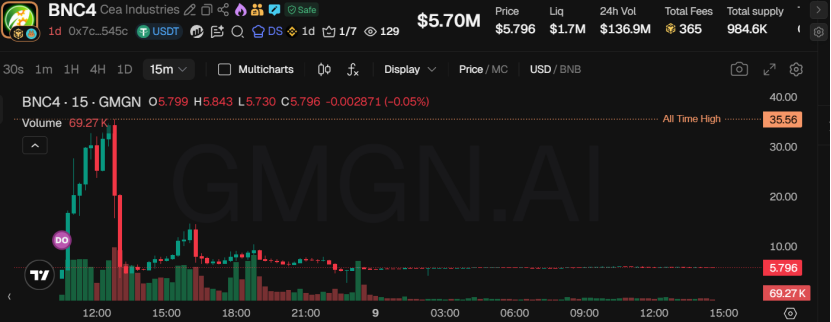
Despite being based on the same underlying assets, two markets have drawn completely different price curves. An experiment around "early on-chain stocks + Meme trading ecology" ignited speculative enthusiasm on the chain beyond expectations.
4Stock: The "early on-chain" experiment racing ahead of bStocks
The popularity of BNC4 stems from 4Stock's differentiated positioning at the product level. It is not a copy of bStocks; Four.meme targeted the time difference of "stock narrative heat, absence of on-chain assets" to create a more flexible lightweight version of stock on-chain.
According to Four.meme's design, each 4Stock is backed 1:1 by the corresponding underlying stock asset. Users can trade directly on-chain and also use it as the underlying asset for "stock Meme" issuance and trading of derivative Meme assets. When the corresponding bStocks are officially launched in the future, 4Stock can be converted into standard bStocks on the platform at a 1:1 ratio.
The main value of this mechanism is to address the pain point of "supply lag" in the on-chain stock ecology: When a stock's trends and narratives have already fermented in traditional markets or social media, the corresponding compliant on-chain asset often has not yet been launched.
4Stock effectively breaks down “asset on-chain” and “trading ecology” into two steps: as long as the individual stock is hot, in theory, 4Stock can be quickly generated, and then the trading and Meme ecology can be built around it without waiting for the complete bStocks product to finish the process.
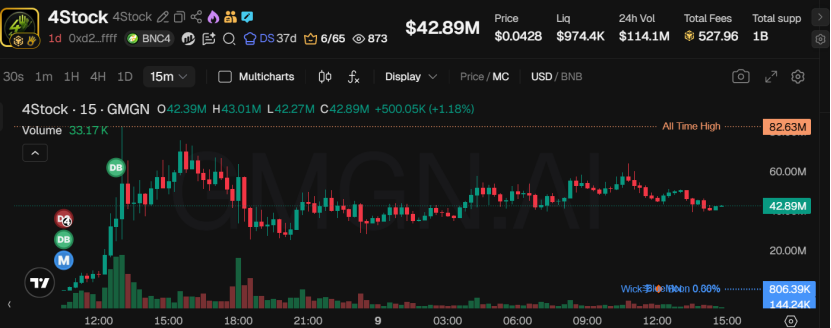
Yesterday, the market cap of the eponymous Meme coin of 4Stock exceeded 82 million dollars, setting a new historical high. Currently, its market cap has declined to approximately 43 million dollars, with a trading volume exceeding 114 million dollars in the past 24 hours.
Same "stock", different price: 7 times premium gives rise to a 230,000 dollars arbitrage feast
BNC4 is the first experimental product of this mechanism. CEA Industries (BNC) has long transformed into a listed DAT (digital asset treasury) heavily invested in BNB. According to its financial report, the company holds 515,544 BNB, with a fair value of approximately 317 million dollars, and digital assets make up 94.6% of total assets.
For crypto investors, BNC4 is not just a "US stock token"; it also encompasses three narratives: BNB trends, DAT, and the on-chain stock.
However, the 1:1 asset backing did not bring about 1:1 price anchorage. The misalignment of trading hours between the US stock market and the on-chain market, coupled with the magnifying effect of low liquidity, jointly pushed BNC4 to soar to seven times the price of the underlying stock at the same time.
The huge price difference not only created arbitrage opportunities but also exposed early problems with this mechanism.
Crypto KOL 0xShawn publicly disclosed his arbitrage path: he first deposited USDC to a designated address of Four.meme to submit a minting application, and the platform used the funds to purchase the underlying BNC stock, then minted BNC4 at a 1:1 ratio; at that time, the trading price of BNC4 on-chain had reached over 7 times the after-hours price of the underlying stock, and after obtaining the tokens, he sold them directly on-chain at a high price, ultimately realizing about 230,000 dollars in arbitrage profit.
This case once again proves that 1:1 asset reserves ≠ 1:1 secondary market price. The time difference between minting, trading, and redeeming, along with the differences in liquidity and investor expectations between the two markets, inevitably creates price discrepancy. Although arbitrageurs will exist to dampen the premium and push prices toward the underlying assets, during the early stages, minting applications need to be processed in the order funds arrive, and new BNC4 cannot enter the market quickly, leading to sustained or even expanded premiums due to the arbitrage supply lagging behind speculative demand.
Four.meme subsequently also warned of risks: BNC4 might trade at a premium, and newly minted tokens entering the market might impact prices.
Repurchase and destruction flywheel: feeding the Meme ecology with product income
Facing the rapidly warming trends and community enthusiasm, Four.meme introduced the next ecological stimulation plan, which is a daily repurchase and destruction mechanism for BNC4.
According to the rules, between September 9 and December 9, all product income generated by BNC4 each day will be used for repurchasing and destroying the most actively traded community Meme coin of the day. Selected projects need to have BNC as pool assets, at least 3,000 holders, and a market cap of no less than 500,000 dollars; whoever ranks first in daily trading volume will qualify for the repurchase, and 100% of the tokens obtained through repurchase will be destroyed.
This design essentially constructs a flywheel: BNC4 trading generates fees → fees repurchase top Meme tokens → destruction drives Meme trends → more users participate in trading → further increase in demand for BNC4.
Four.meme's goal is to use BNC4 as the underlying asset to activate the entire stock Meme ecology, allowing trading fees to benefit the community and create positive feedback.
However, the other side of the coin is equally apparent: to compete for daily repurchase qualifications, project parties may actively inflate trading volume, leading to potential further amplification of short-term speculative trading, and even liquidity mismatches. Although the official categorically lists volume inflation and abnormal trades as exclusion conditions, the actual execution effect still needs to be verified by the market.
Reverse transmission: On-chain revelry feeding back into US stocks
An even more interesting phenomenon is that the fervor on-chain has been transmitted back to the US stock market. On September 8, the closing price of BNC rose by 50.43%, closing at 5.25 dollars.
Even more exaggerated is the change in transaction volume: in the past 24 hours, BNC's trading volume approached 285 million dollars, equivalent to about 197 times its usual daily trading volume. It can be said that the trading of the underlying stock has clearly been driven by the BNC4 trend.
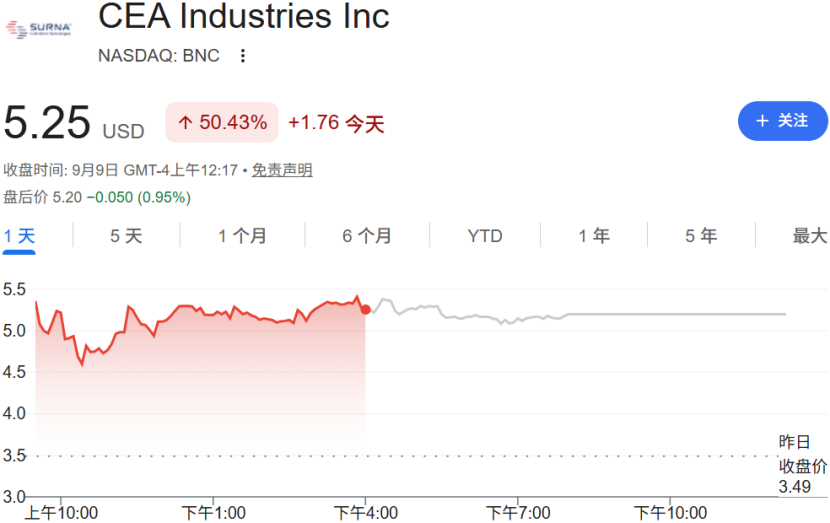
This has formed a special "two-way rush": the stock prices in the traditional market provide a basic valuation anchor for on-chain assets; meanwhile, the trading enthusiasm and community discussions around on-chain assets have conversely increased the market attention on the underlying stocks, attracting funds to buy in and pushing up stock prices.
For small market cap DATs like BNC, this effect is further amplified. Its stock price is no longer limited to financial metrics, but rather the combination of three pricing logics: operational governance fundamentals + BNB asset net value + valuation premium of the "BNB ecology". Each instance of speculation on-chain can potentially fuel the valuation of the underlying stock.
The on-chain revelry of BNC4 resembles a pressure test for the "early on-chain stocks + Meme trading ecology".
Its value lies in exploring a more lightweight and community-oriented way to put assets on-chain. However, the 7 times premium also starkly reveals the speculative nature of the on-chain market: when liquidity is insufficient, narratives precede, and arbitrage mechanisms are inefficient, prices will significantly decouple from the underlying assets.
What truly deserves attention is whether, as the arbitrage mechanism and minting-redeeming mechanism gradually normalize, 4Stock can transform the funds attracted by emotions into long-term on-chain stock liquidity.
Every participant should also realize: the early on-chain stocking only alleviates the issue of transaction convenience but does not solve the problems of price discovery, liquidity, and regulatory compliance. When the speculative frenzy recedes, we will see if the new play is swimming naked.
免责声明:本文章仅代表作者个人观点,不代表本平台的立场和观点。本文章仅供信息分享,不构成对任何人的任何投资建议。用户与作者之间的任何争议,与本平台无关。如网页中刊载的文章或图片涉及侵权,请提供相关的权利证明和身份证明发送邮件到support@aicoin.com,本平台相关工作人员将会进行核查。


