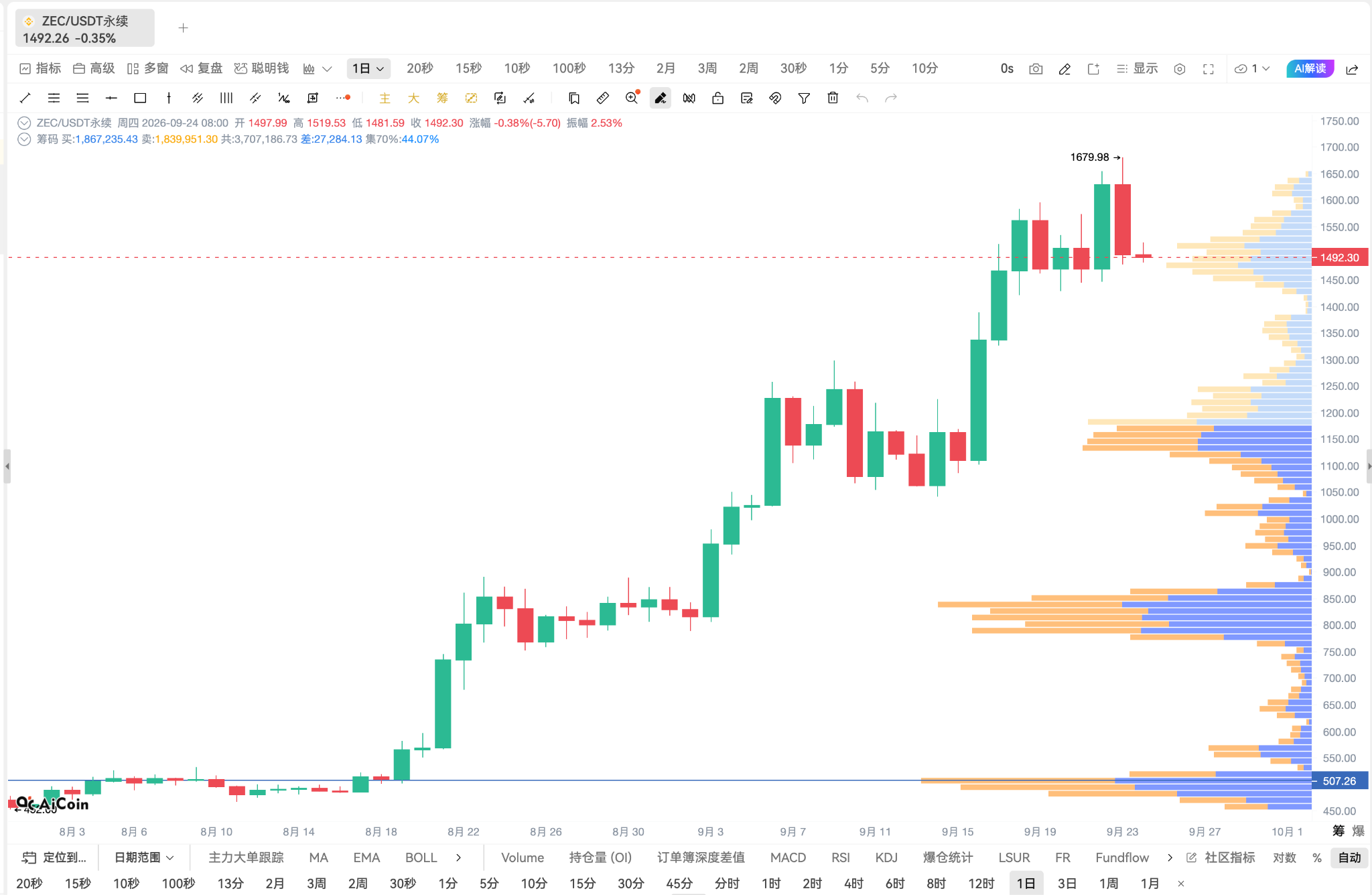
On September 23, ZEC briefly surpassed $1,600, returning to the historical high range of 2016. AiCoin data shows that ZEC has reached a peak of about $1,679.83 this year, with a current market capitalization of approximately $25 billion, now close to the top ten in cryptocurrency market values.

Meanwhile, on September 23, 21Shares launched the first Zcash exchange-traded product (ETP) in Europe, listed on Euronext Paris and Amsterdam; previously, the Grayscale-backed ZCSH had started trading on NYSE Arca on August 25, and announced asset growth exceeding $500 million in early September. The market cap of the privacy coin sector has expanded from about $7 billion a year ago to around $36 billion—$38 billion. The long-dormant “privacy narrative” is becoming the market focus again.
Why have privacy coins suddenly gained popularity again?
Privacy coins are essentially cryptocurrencies that restore the "cash attributes" on public ledgers: hiding the sender, receiver, and amount, making transactions not easily linked to real identities, while ensuring token fungibility. Bitcoin and Ethereum are pseudonymous rather than anonymous—once an address is linked to an identity, the entire history becomes permanently exposed. Privacy coins use cryptography to sever this link, preventing external observers from establishing a complete flow of funds.
The core of privacy coins is not merely "anonymity." Behind this lies an increasingly real question:
As on-chain analysis, KYC, and AI data analysis capabilities grow stronger, is the public ledger still suitable as a true "digital cash"?
This has become one of the important narratives for the recent renewed funding interest in the privacy sector.
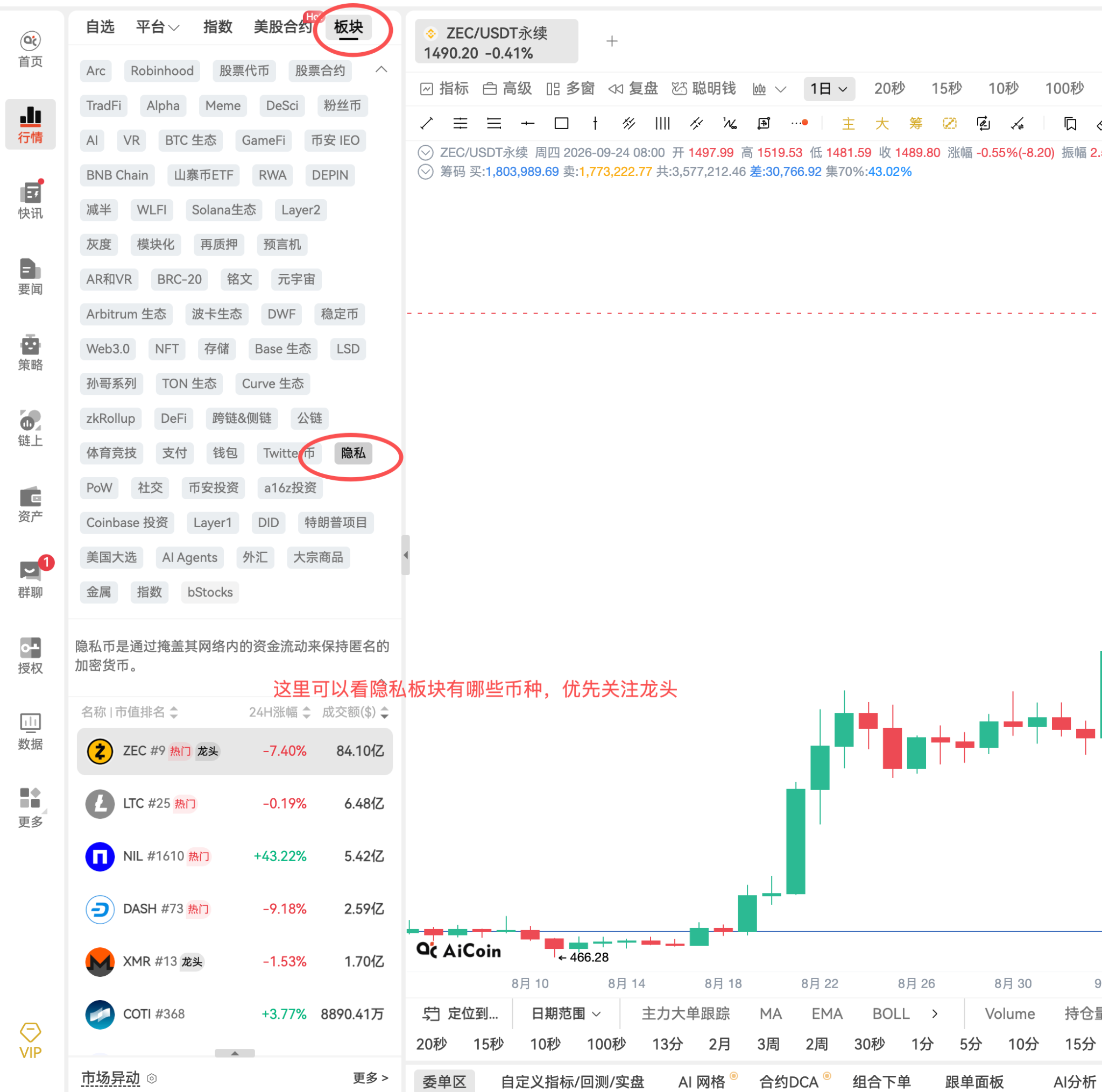
According to publicly compiled data, the market capitalization of privacy coins has increased from about $7.1 billion a year ago to roughly $33.6 billion; the privacy coin category has further reached around $36.5 billion. ZEC and XMR occupy most of this market cap.
1. What Privacy Coins Do
Common technical approaches vary:
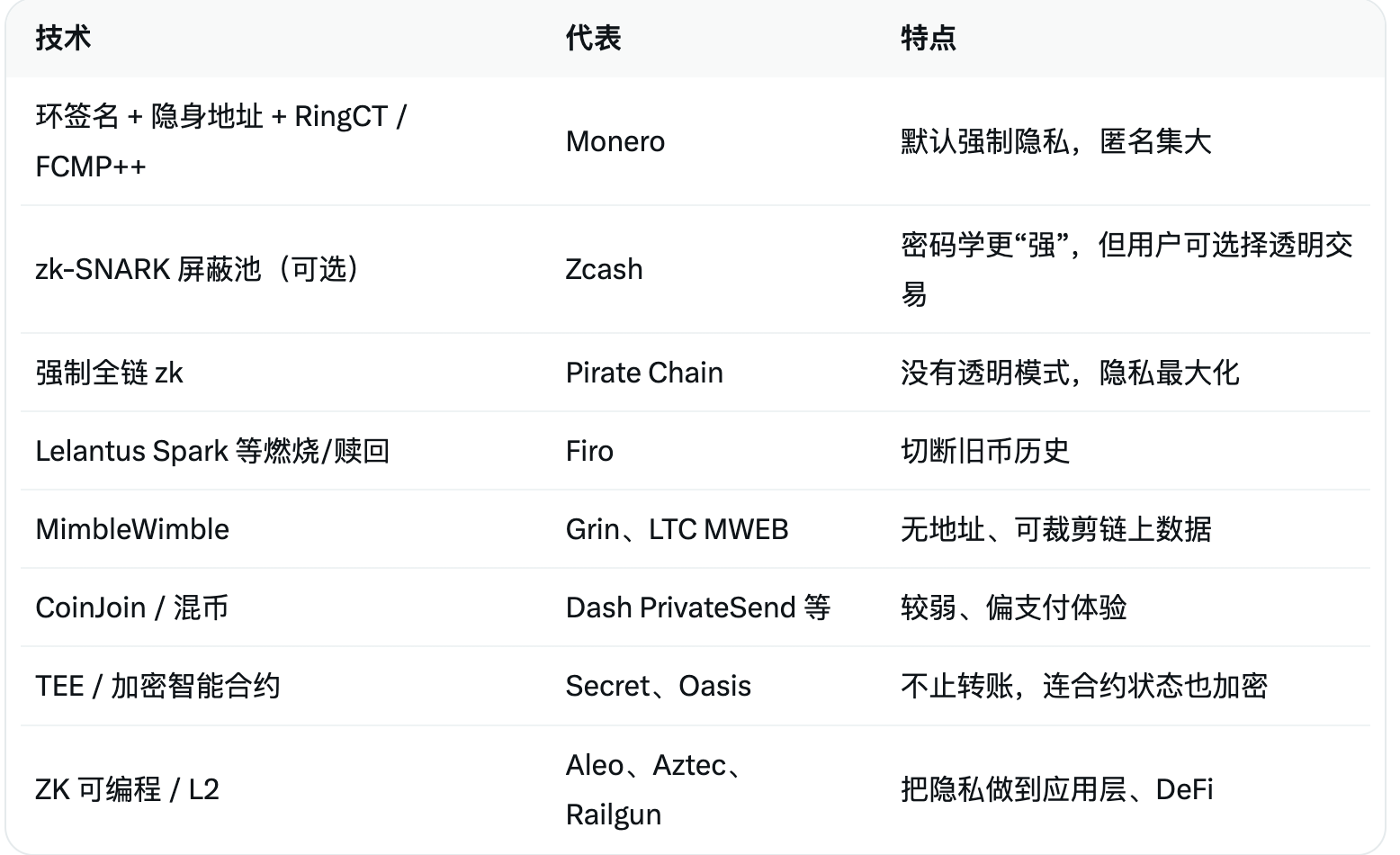
The key divergence is simple: mandatory privacy (Monero approach) vs optional privacy + selective disclosure (Zcash approach). The former has a more complete anonymity set and better fungibility; the latter is easier to list on exchanges, conduct compliance audits, and be accepted by institutions.
Zcash (ZEC) has chosen “optional privacy.”
The largest dedicated privacy coin by current market cap. Optional shielded transactions (zk-SNARKs, Ironwood and other new pools), supporting view key selective disclosure. Grayscale's Zcash product launched on NYSE Arca (ZCSH) in August 2026, which is one of the clearest catalysts for this market cycle. The exchange admission is significantly better than Monero. The proportion of shielded supply has increased in recent years (approximately 29% volume, with higher activity proportion). Fixed at 21 million coins, narratively closer to “BTC with privacy.”
Users can choose transparent transactions or enter shielded pools, hiding transaction details through zero-knowledge proofs while utilizing mechanisms like Viewing Keys for selective disclosure. This means ZEC does not simply pursue “invisibility” but seeks a balance between privacy, verifiability, and regulatory needs.
Monero (XMR), on the other hand, is closer to “default privacy.”
Still the benchmark for “default privacy + real-world use.” Every transaction enforces the concealment of three elements; by 2026 FCMP++, the anonymity set expands from fixed ring members to all unspent outputs on the chain. It remains a key player in darknet, peer-to-peer cash, and no-KYC transfers. The trade-off is significant delisting from mainstream CEXs, poorer compliance pathways, and often weaker price elasticity than ZEC's “institutionally purchasable” version. Its market cap is around $10 billion.
It strengthens transaction privacy at the protocol level, with the core goal of making it as difficult as possible for external observers to associate transactions. Thus, the two correspond to two distinct product philosophies:
ZEC: Privacy + selective disclosure + traditional financial entry
XMR: Default privacy + digital cash + stronger transaction untraceability
This also explains why funding this time is notably more willing to revolve around ZEC.
2. Real Change: Privacy is Transitioning from “Coin Circle Narrative” to Financial Infrastructure
In the past, when the market discussed privacy coins, it often referred to anonymous payments, mixing coins, and regulatory risks. But now, the logic is changing.
First, institutions require privacy on-chain.
If funds, trading strategies, or even customer capital flows are fully disclosed on-chain, it effectively equals actively exposing their financial information. Therefore, what institutions truly need is not necessarily “completely un-auditable,” but possibly:
Not visible to others, but I can prove it to you.
This precisely illustrates the value of ZEC's “optional privacy + selective disclosure” approach.
Second, AI is amplifying the privacy issues brought by on-chain transparency.
Previously, on-chain transactions of an address might only have been public data; now, with the addition of AI to on-chain analysis tools, addresses, transactions, fund flows, and behavioral patterns can be correlated on a larger scale.
Thus, “financial privacy” is transitioning from an ideological issue within the crypto industry to a more general data privacy issue.
Third, privacy is spreading to DeFi and the application layer.
In the future, privacy does not necessarily mean “a new Monero.”
Projects like Aleo, Aztec, Railgun, and Secret are exploring privacy DeFi, private balances, private orders, and encrypted smart contracts.
In other words, the privacy landscape is evolving from:
“Hiding a transaction”
Gradually moving towards:
“Hiding entire financial behaviors.”
3. However, this market cycle should not focus solely on ZEC’s rise
The current concentration in the privacy sector remains very high. Current data shows that ZEC's market cap is about $25.6 billion and XMR is about $10.3 billion, together accounting for a large portion of the privacy coin sector's market cap. Therefore, the so-called “explosion in the privacy sector” is largely driven by ZEC's lead.
Meanwhile, regulation, exchange admission, privacy technology upgrades, and liquidity are all still unavoidable issues in this arena. It is especially important to note:
The emergence of ETFs/ETPs does not mean that privacy assets have escaped regulatory risks; similarly, that ZEC can access traditional financial market entry does not imply that the entire privacy coin landscape will receive the same treatment.
Thus, what the current market is truly trading may not simply be the “resurgence of anonymous coins,” but rather:
Will financial privacy become part of the next stage of crypto infrastructure?
ZEC has risen from a low point in 2024 to over $1,600, with prices re-entering the historical high range of 2016.
This time, it no longer faces the same cryptocurrency market as in 2016.
As on-chain monitoring increases and AI becomes better at “understanding” public data, privacy may be transitioning from a niche attribute to a financial necessity.
How to Validate Data? APIs May Be More Important Than Stories
For rapidly rotating sectors, looking at prices alone is often insufficient.
What is truly worth tracking is whether price, transaction volume, fund flow, market depth, and relevant on-chain data change in sync.
If you need to integrate privacy coin market dynamics into your monitoring system, you can access real-time market data and related data through the AiCoin OpenData API to build your own data dashboards, market monitoring, and strategy systems.
Start experiencing for free:
https://www.aicoin.com/zh-Hans/opendata
Markets tell stories, and data is responsible for validating those stories.
This article is for market information organization and industry analysis, and does not constitute investment advice.
免责声明:本文章仅代表作者个人观点,不代表本平台的立场和观点。本文章仅供信息分享,不构成对任何人的任何投资建议。用户与作者之间的任何争议,与本平台无关。如网页中刊载的文章或图片涉及侵权,请提供相关的权利证明和身份证明发送邮件到support@aicoin.com,本平台相关工作人员将会进行核查。