Author: Yuan Xinyue | Editor: Wang Jing | Produced by: Zimu Bang
Reprint: Deep Tide TechFlow
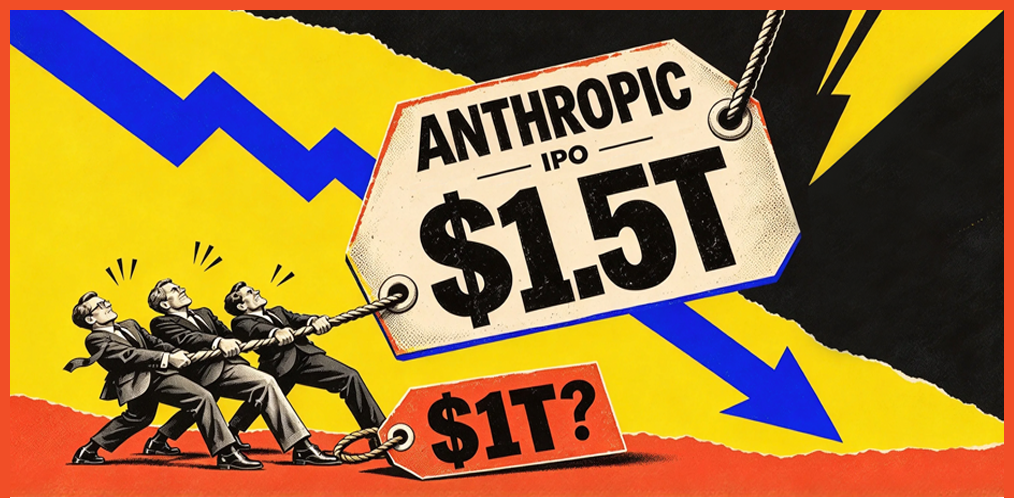
Deep Tide Introduction: In early November, the sharp sell-off of tech stocks in the US and tightening policies on data center infrastructure regulation are pushing the frenzy surrounding AI assets toward a harsh reality check. As a benchmark event originally expected to create a record in global capital market financing, Anthropic's IPO process is not only related to the valuation of a cutting-edge model manufacturer but also serves as a core barometer for observing how the secondary market prices the real commercial returns of frontier AI companies. The expectation has dropped from $2 trillion down to the $1.1 trillion range, with massive compute debts and personnel upheavals coexisting. The twists and turns of this enormous IPO reflect a capital shift from purely storytelling narratives to a brutal examination of balance sheets and real business closures.
On November 5, the "Blue Wave" swept Wall Street, with all three major US stock indices plummeting, and stocks related to AI, semiconductors, and data centers were sold off en masse.
The following day, tech stocks rebounded somewhat, with the Nasdaq rising by 1.09% and the Philadelphia Semiconductor Index recovering about 4.2%, but the Nasdaq still saw a cumulative decline of approximately 3.4% for the week.
Anthropic, which has yet to go public, finds itself at the eye of the AI storm, facing the same stringent scrutiny without real-time stock price fluctuations.
According to foreign media reports, on the prediction market Kalshi, traders believe that the probability of Anthropic completing its IPO within the year has dropped from nearly 90% before the US midterm elections to below 60%. Some potential investors even question whether Anthropic can achieve the valuation expectation of $1.5 trillion.
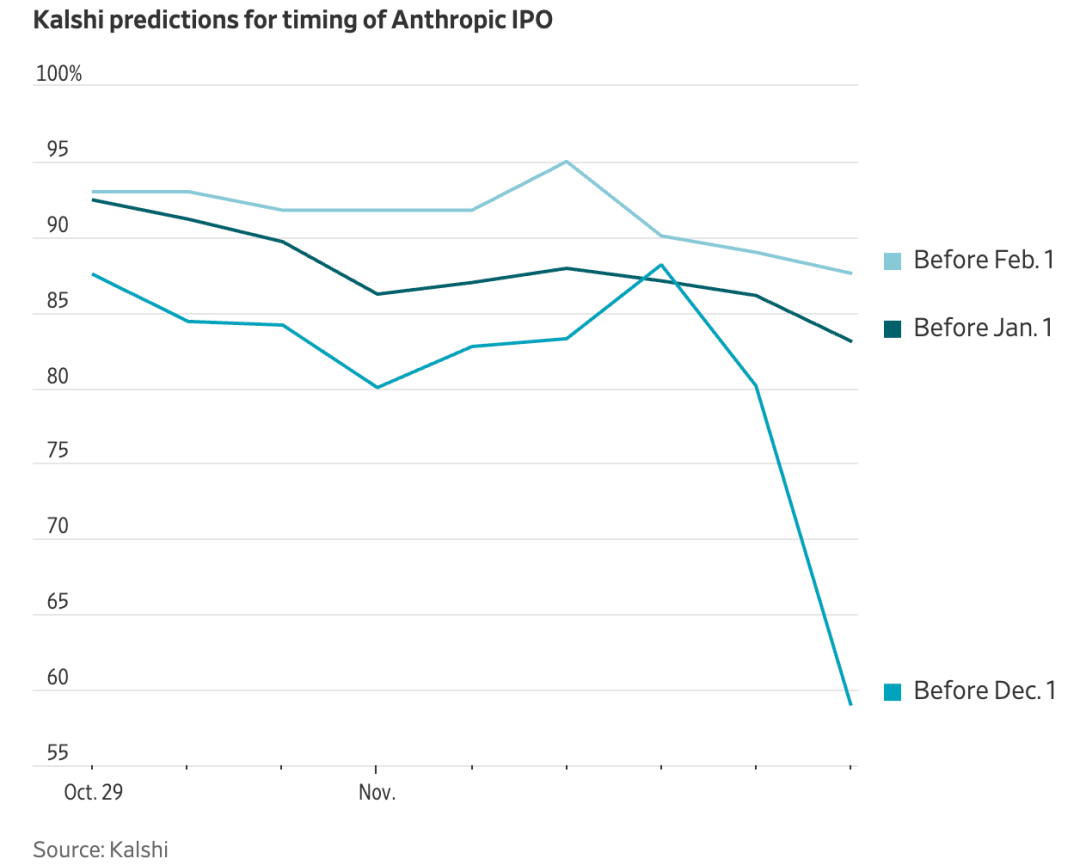
Image: Probability trend on Kalshi prediction market regarding the timing of Anthropic's IPO
When it rains, it pours; Anthropic has been experiencing consecutive personnel changes internally. Within two weeks, Claude Code lost three important members, with former product head Cat Wu and the first growth position employee Austin Lau joining rival OpenAI.
As the tech stock market worsens, doubts surrounding this trillion-dollar IPO are increasing.
The Blue Storm Sweeps US Stocks, and the AI Sector Becomes the Hardest Hit
On November 5, US stocks fell sharply across the board. The Dow dropped 1,833 points, a decrease of 3.44%; the S&P 500 index fell by 4.36%, marking the largest single-day drop since the tariff impacts of April 2025; the Nasdaq decreased by 5.52%, marking the largest single-day drop in 19 months.
The AI supply chain became a hard-hit area for the sell-off. The Philadelphia Semiconductor Index plummeted about 12.3%, the largest single-day drop since March 2020. Nvidia decreased by about 9%, and AMD dropped by about 17%. CoreWeave fell by about 10%, and Nebius decreased by about 15%, with both companies' stock prices halved from their highs on October 6. Microsoft fell by 3.6%, while Amazon and Alphabet both dropped by 2.2%.
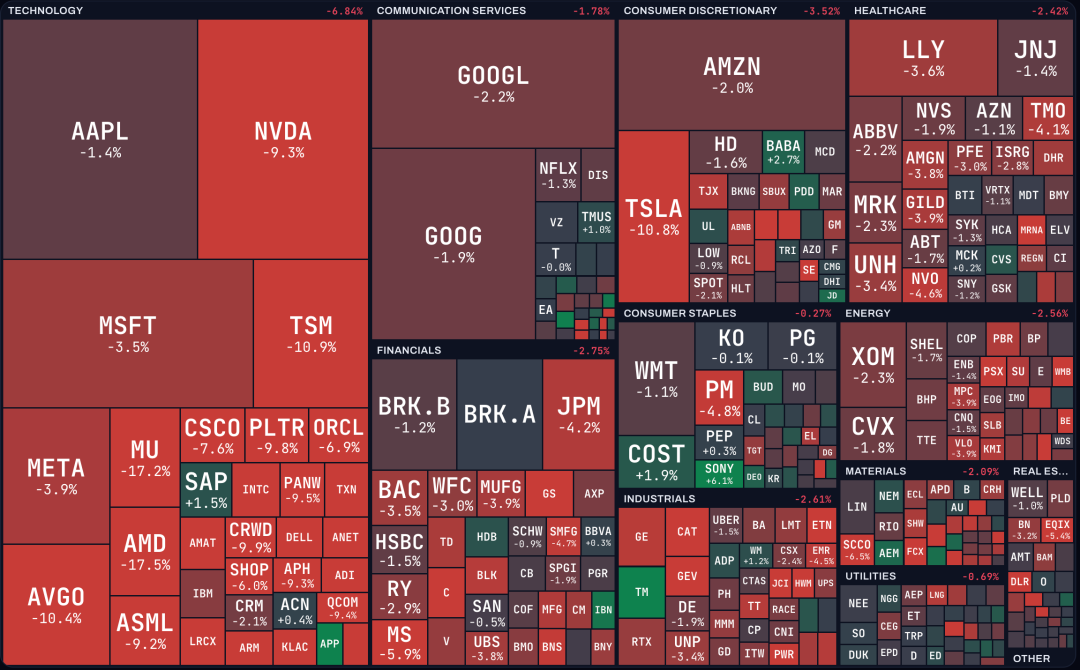
Image: Heatmap of major declines in US technology and semiconductor sectors
Note: There may be discrepancies in stock performance data across different market platforms; the numbers in the image may slightly differ from the data cited in the text.
The color of the stock market sharply contrasts with the ballots. One of the major triggers for this sell-off is the market's concern that the new US Congress and local governments may restrict the construction of AI data centers. The high electricity and water usage of data centers, along with their impact on local infrastructure, has become an important political issue in the US.
UBS estimates that about 30% of the additional data center capacity that was originally planned for the US by 2028 could be affected by potential construction suspensions.
In this sell-off, the IPO that Anthropic is preparing has become an important window for observing the AI market.
Anthropic is not only a buyer of massive computing power but also a model developer selling AI services directly to enterprises and consumers. Investors are worried whether the significant AI investments can translate into sustained revenue and profits, which ultimately need to be assessed from the company's operational performance.
The sharp volatility in the stock market has also increased the pricing difficulty of this deal. Institutional investors will refer to the valuations, earning expectations, and market risks of existing tech stocks to decide at what price they are willing to subscribe to new shares. When AI-related stocks fall broadly, even if they still view Anthropic's long-term prospects positively, they may demand a lower issue price or reduce their subscription amounts.
An earlier expectation was that Anthropic could raise up to $100 billion. Such a large issuance scale requires attracting enough institutional investors, and if subscription demand falls short, the company may need to reduce its valuation, scale back fundraising, or wait for market stability before going public.
On November 5, according to foreign media reports, some potential investors questioned whether Anthropic could start its roadshow during the week of November 9 and complete its listing within November. Some investors believe that the previously discussed valuation of about $1.5 trillion is still overly high and hope for a larger valuation discount. Anthropic declined to comment.
This deal, which was originally expected to create a record in global IPO financing, is now facing dual pressures: institutional investors continuously lowering valuation expectations, and the originally expected listing timeline starting to be questioned.
However, it should be noted that Anthropic has not yet announced the official issue price or listing date. The company only stated in its prospectus that it "plans to conduct a public offering as soon as possible after the SEC registration statement becomes effective," and the previous November listing arrangement mainly came from informed sources.
Valuation Drops from $2 Trillion to $1.1 Trillion, Listing Timeline Questioned by Institutions
In fact, Anthropic has been under valuation pressure for some time. The $2 trillion valuation expectation was only fleeting in September this year, and the capital market's attitude seems to have cooled with the temperature.
On October 14, Anthropic held an investor day, disclosing third-quarter financial data to potential investors. The company's revenue grew about 45% quarter-over-quarter, reaching $16.8 billion, still maintaining rapid growth, but showing a significant slowdown compared to the second quarter's roughly 145% quarter-over-quarter growth rate. The next day, some media reported that some investors began to lower their IPO valuation expectations for Anthropic from about $2 trillion to $1.5 trillion.
The $500 billion valuation expectation evaporated just before the official listing. Some media even commented that Anthropic might have missed the best listing opportunity; if the company could have gone public in June, capitalizing on the strongest momentum of revenue growth, it could have achieved a more favorable valuation.
On November 2, Anthropic updated its prospectus, adding third-quarter performance: revenue for the quarter was $16.956 billion, with a quarter-over-quarter growth of about 47%, and long-term compute procurement and leasing commitments reached $895.4 billion. On the same day, it was reported that institutional investors preparing to participate in the IPO hoped to keep the valuation between $1.5 trillion and $1.6 trillion.
Now, even this discounted price is beginning to be questioned.
According to foreign media reports, as the tech stock market worsens, some potential investors are discussing a valuation range of $1.2 trillion to $1.3 trillion, with even some considering lowering the valuation to $1.1 trillion.
There are also reports that some investors are waiting for Anthropic's October revenue data to determine whether the company's revenue growth can rebound after the slowdown in the third quarter. This data has not been disclosed separately in the updated prospectus on November 2.
Meanwhile, Anthropic is also facing talent poaching from competitors.
On November 3, US time, Cat Wu, the former product head of Claude Code, announced her departure, ending her nearly two-year tenure at Anthropic. She was involved in the process of developing Claude Code from an internal experimental tool to a commercial product and was one of the most representative members of this product. Just two days later, Cat Wu announced her joining OpenAI, where she will be responsible for core product management, reporting to Tibo Sottiaux.
Austin Lau, Anthropic's first growth marketing position employee, also announced on the same day that he was joining OpenAI. He was previously involved in building Claude's user growth system, responsible for attracting more users to use the product. Anthropic had specifically highlighted in January how he used Claude Code to develop marketing tools, reducing the time to produce advertising materials from 30 minutes to 30 seconds.
At the crucial time when Anthropic and OpenAI are competing for the enterprise market, it's notable that those who switched to OpenAI were two individuals who had previously helped Anthropic win users. One drove Claude Code towards commercialization, while the other was in charge of making more people access and use Claude; now both have joined the ranks of their former competitor.
Interestingly, Anthropic had just emphasized its talent advantages in its prospectus. The company stated that as of September 30, the overall "regrettable turnover rate" was only about 1%. However, this statistic does not account for the departure of core personnel since the end of October.
As for the reasons for leaving, the individuals did not provide explanations that were directly related to the IPO prospects. Cat Wu even clarified that the ability to sell company shares early was not a consideration for her departure.
Racing for Funding Against OpenAI, Two Giants Compete for Billions
As Anthropic's IPO valuation continues to decline, OpenAI is also finding it difficult to maintain its own position.
On October 19, foreign media reported that OpenAI is accelerating its efforts to raise about $30 billion, hoping to lock in investor funds before Anthropic goes public, with a target valuation exceeding $1.4 trillion. However, by October 30, OpenAI's fundraising target had been reduced to about $20 billion, and its target valuation was also lowered to $1.25 trillion. On November 6, OpenAI was reported to have completed its first batch of about $11 billion in funding, with the remaining funds still being raised.
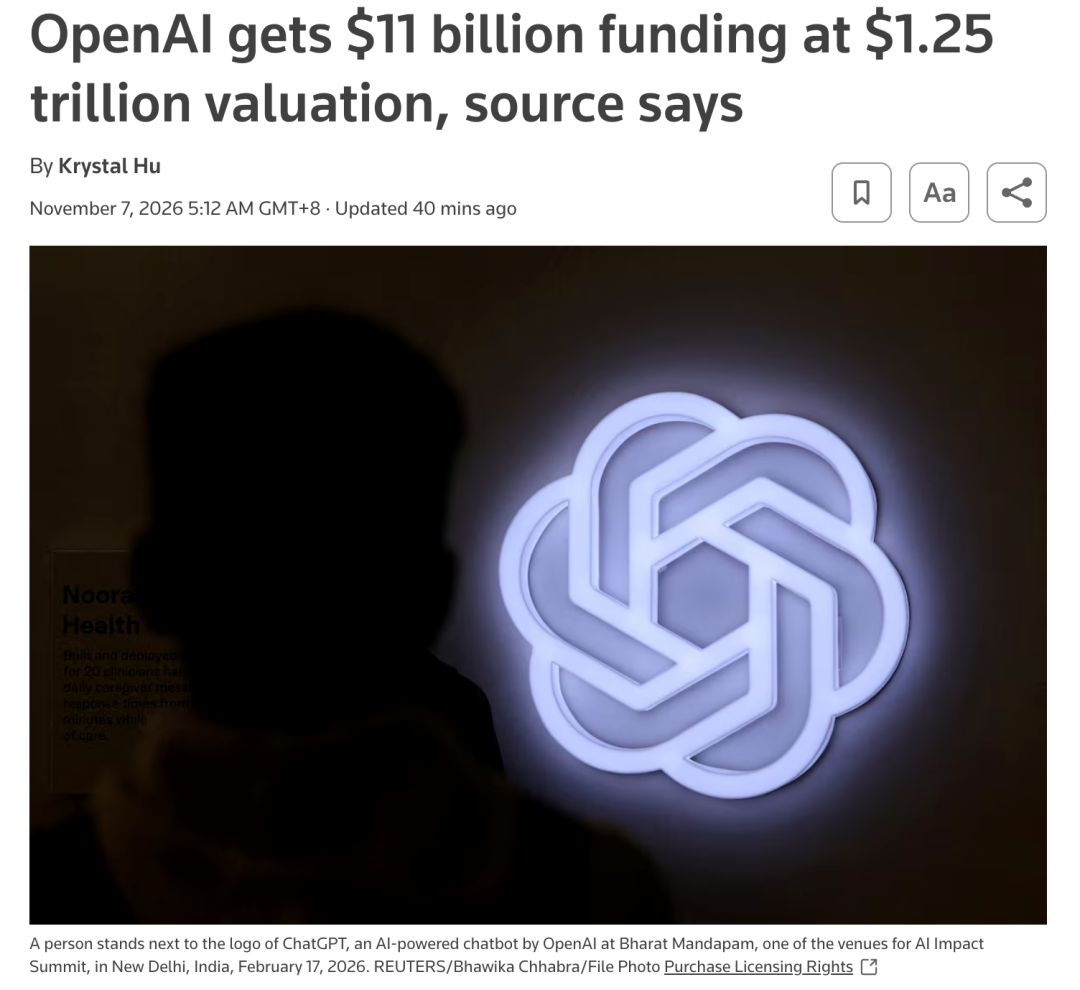
Image: Foreign media reporting OpenAI finalizing $11 billion funding and a valuation reaching $1.25 trillion
OpenAI is hurriedly trying to raise money ahead of Anthropic, while Anthropic hopes to create a financing record through its IPO. Now, both companies are facing market pressure to reduce prices. They are vying for the same batch of investors and must confront similar fundraising obstacles.
Anthropic has become one of the few companies still persisting in this wave of AI IPOs, while most other AI companies preparing to go public this year have chosen to temporarily exit this fundraising race.
As of October 22, data center operators Switch, AI infrastructure company Nscale, and SoftBank-backed SB Energy have all postponed their IPOs, while Nvidia-backed Firmus and Blackstone-supported AirTrunk REIT have withdrawn or suspended their issuance plans. Reports indicated that at that time, some enterprises were even unwilling to compete for institutional investor funds and attention against Anthropic. Many large investors still view Anthropic positively, believing it to be one of the few opportunities to invest directly in leading AI companies.
Just two weeks later, Anthropic's issuance arrangements have also come under scrutiny.
Compared to already listed chip manufacturers and cloud computing giants, OpenAI and Anthropic, which directly develop pioneering models, still lack public market valuation references. Anthropic was originally expected to become the first frontier AI model company to go public in the US, making its issuance results highly anticipated.
If the listing goes smoothly, even if the valuation is lower than previously expected, the capital market would finally have a chance to directly price such companies. Investors could determine how high a valuation a leading AI company is worth based on Anthropic's revenue growth, profitability, and computing power costs. This would provide an important comparison point for other unlisted AI companies, like OpenAI.
Massive Computing Debt Looming, AI Valuation Logic Facing Reconstruction

Image: Official promotional poster from Anthropic
It is worth noting that delaying the IPO will not immediately plunge Anthropic into a funding crisis. According to the latest prospectus, as of September 30, the company still holds about $131.9 billion in cash and short-term investments, providing a considerable financial buffer.
However, if the IPO continues to stall and other financing channels begin to tighten, the situation could become much more complicated.
Anthropic has entered into nearly $900 billion in long-term compute procurement and leasing commitments, with about $69.8 billion expected to expire by the end of September 2027. If financing costs continue to rise and new funds are difficult to secure, the company may have to slow down its expansion pace or even readjust some investment plans. The data centers, chip suppliers, and financial institutions relying on its future orders could also be affected.
For Anthropic, missing one listing window might still allow for waiting on the next one. However, if the capital market's valuation logic for the entire AI industry changes, the next opportunity might not be better than the present one.
免责声明:本文章仅代表作者个人观点,不代表本平台的立场和观点。本文章仅供信息分享,不构成对任何人的任何投资建议。用户与作者之间的任何争议,与本平台无关。如网页中刊载的文章或图片涉及侵权,请提供相关的权利证明和身份证明发送邮件到support@aicoin.com,本平台相关工作人员将会进行核查。


