Author: Zuo Ye Wei Bo Mountain
Deep Tide Guide: After controlling Nvidia for 33 years, Jensen Huang is caught in the whirlpool of antitrust and geopolitical challenges, with the board of directors and the swift political shift in Washington pushing him to the brink of a power handover. Tech giants can no longer solely rely on computing power and commercial narratives for survival; instead, they have become bargaining chips in a phase of political and national security struggles between the two parties.
When the technology cycle encounters the political cycle, the costs of computing hegemony and monopoly rents are being re-evaluated. This article deeply analyzes the inevitable logic behind the curtain call of Jensen Huang’s Nvidia era from the multi-dimensional perspectives of historical politics, equity governance, and industrial competition, alongside the survival dilemma of Chinese tech elites.
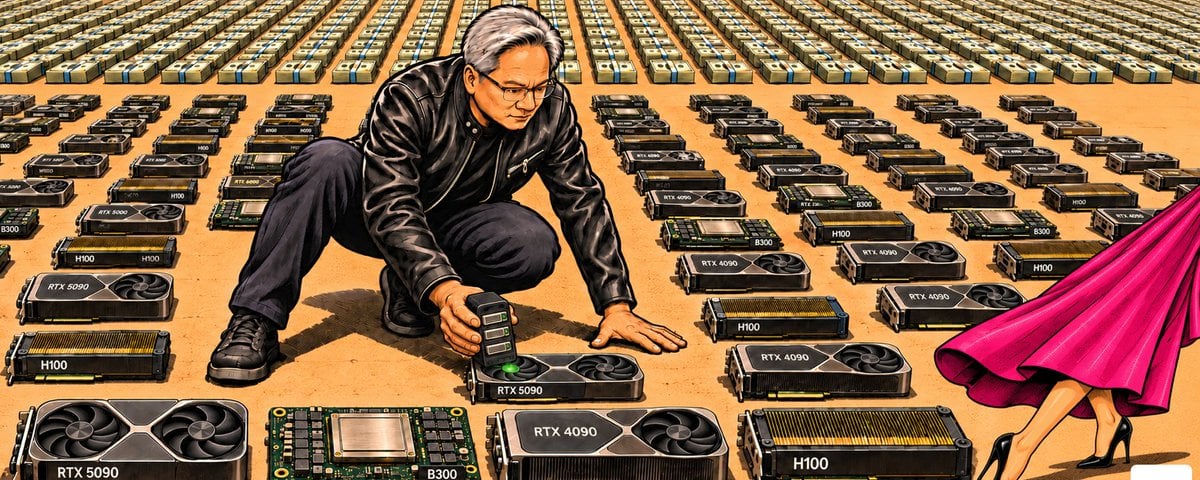
There is a kind of victory called retreat, and a kind of failure called occupation.
Nvidia rose with the spinning of GPU fans, but Jensen Huang descended with the stirring of winds; a cannon shot from the New York Times sounded, signaling a blue trumpet for AI worldwide.
However, none of this concerns Old Huang now; on reflection, whether he has become the terminator of the AI bubble, whether it is a thrilling escape or an appetizer inviting others into a trap, the judgement of success or failure is left to future generations.
Despite 88% of employees hoping he remains, the interim CEO with a finance background is hardly capable of taking the helm, but political patron Trump has quietly accepted reality, and the Justice Department under him has begun antitrust investigations; a lame duck cannot support alone.
But one thing is certain: Jensen Huang’s Nvidia era has officially come to an end.
Perhaps, there was only Jensen Huang in the times, and no so-called Huang era.
Small Cells Can Go to Jail, Big Ones Can Exit
“A Legend replaces a Legend!”
Elections are a fool's game.
In 2008, when the first African American president entered the White House, people optimistically believed that America could withstand the financial crisis.
But the National Treasure Bank, merely a small Chinese bank in New York's Chinatown, fell victim to an unforeseen disaster. It was the only "subprime crisis" related bank to be investigated. Yes, the ones prosecuted were not Goldman Sachs or Morgan, but a credit union-level Chinese bank.
In 2026, as Nvidia dances on the crest of the China-US AI wave, it had to disgracefully dismiss a CEO who had served for 33 years and was also a company founder, simply because he did not support the loser of the last election.
Not interested in politics but leaning towards the Democratic Party was the mainstream choice for West Coast tech companies before 2016, but the Silicon Valley right represented by Peter Thiel changed everything, making it impossible to choose both parties; one must choose one side.
Before the 2024 election, Bezos and Zuckerberg's last-minute efforts to please Trump will pale in comparison to the backlash faced by Huang and Musk.
The delicate blue line can easily cut the current president's throat, while also eagerly hoping to sever the heads of the disgraced; it is hard to tell whether this is merely an ideological bias represented by The Economist or if deep-seated racism is at play.
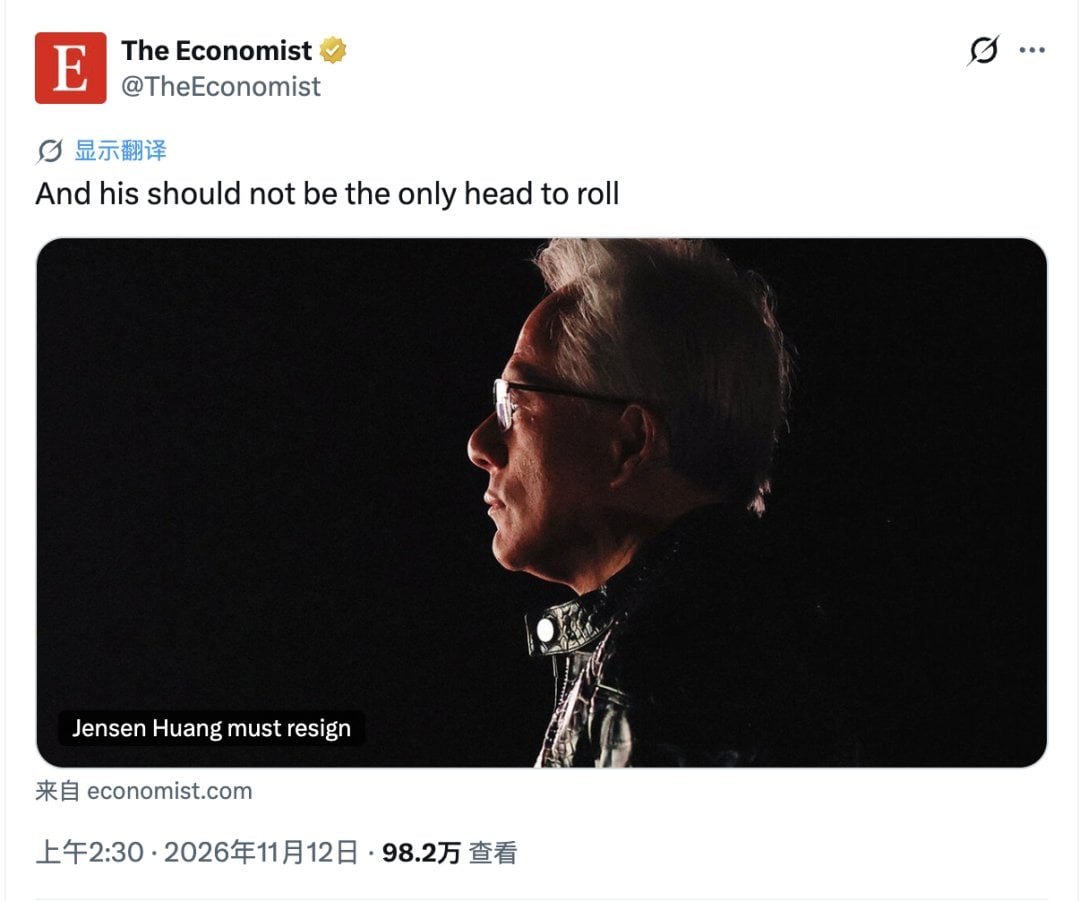
Image: Heads Rolling (Source: @TheEconomist)
If it is to punish competitors, Jensen Huang surely bears three sins:
① Anthropic is about to go public, the path accelerated by "American chips" of the Chinese open-source model must be cut off; the value of Huang's happiness lies in dramatically gathering all elements of a security narrative;
② Data centers must get going, but the political noise must be sourced from the Republican Party; Huang's value is in ending the over-politicization of data centers since the mid-term elections, allowing them to operate quietly;
③ The personal gossip-like strategy, under the tide of DEI, ignited in zero seconds, initially denouncing and critiquing in public opinion, ultimately bringing tech companies back to the trajectory of pre-2016.
One could boldly predict that Huang's skin color is fit for sacrifice, while Musk's connections are suitable for capture, blended oppositely, projecting an air of prosperity.
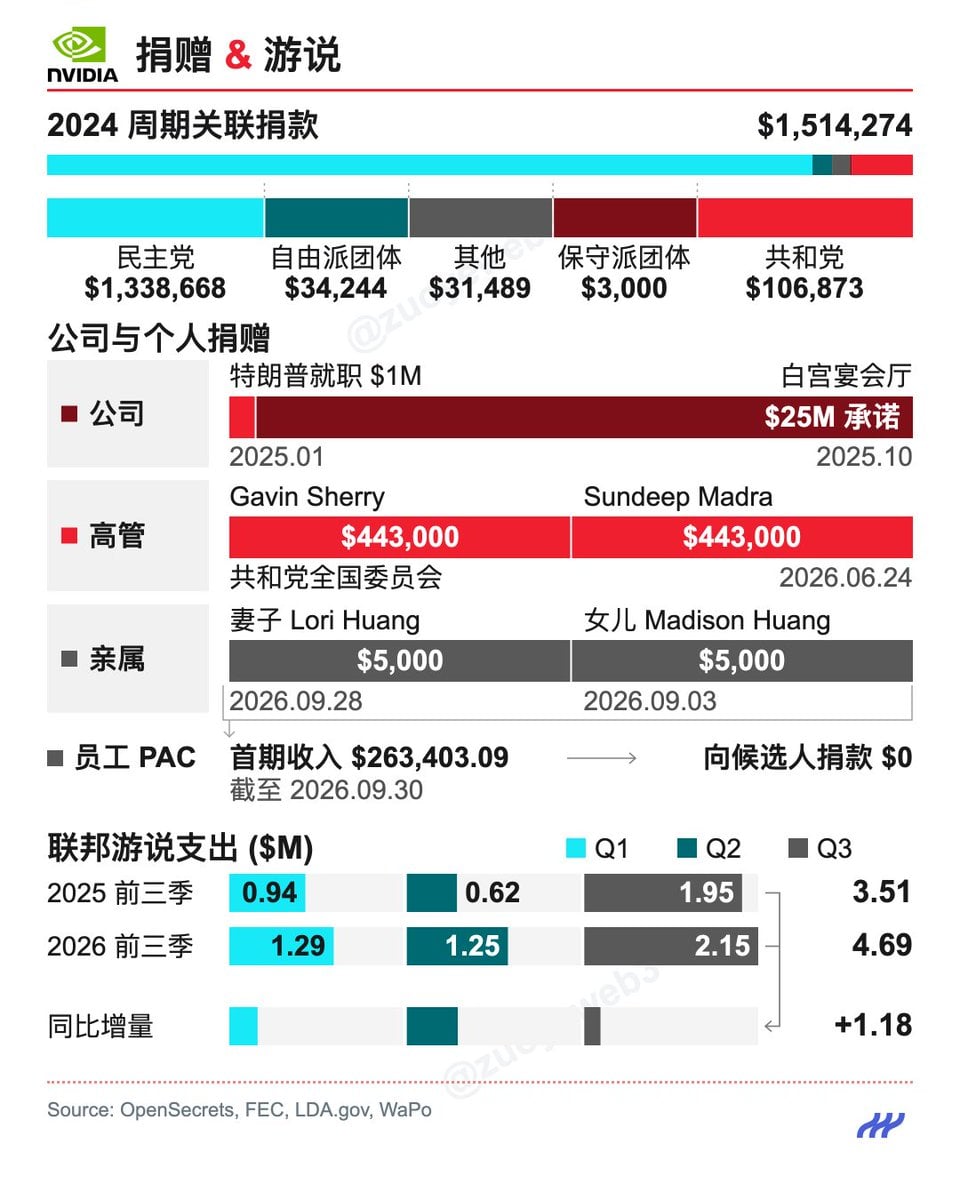
Image: Shelf Life of Only Two Years (Source: @zuoyeweb3)
Before 2024, Nvidia’s employees were still supporters of the Democratic Party, but since 2025, Jensen Huang and Trump have grown closer, "America's unique advantage lies in President Trump."
Moreover, lobbying far outweighs donating; this itself is a signal of who is supported centrally, but in the current political polarization, loyalty is not absolute; a lack of absolute loyalty is absolute disloyalty.
Thinking of danger, retreat, and change, the political winds are not suitable for long-term adherence; CUDA can be laid out for years, but the iteration of B300/H200/A200 accelerates year by year.
From a macro perspective, economic cycles are a financial bubble caused by a technological crash.
No one knows whether AI will bubble. Huang has always conversed with China on business terms, while China serves as the largest external variable, continuously impacting the American AI narrative; no one knows what else the US is hiding.
Whether to delay the bubble or actively burst it, Nvidia can no longer dominate alone; professional managers must be brought in to act as political spokespersons and, when necessary, detonated in advance, letting the fallout occur during Trump's presidency.
AI hardware from firms like AMD and Intel is also in the hands of Chinese; there are many perfect scapegoats left for the American economy, akin to how Israel acts as a political placeholder, while WASPs encourage Jews and Chinese to fight among themselves, appearing as spectators while actually being the eternal masters.
A legend will not be replaced by another legend; the leather jacket may not wrinkle, but it is gradually fading.
Let Imagination Seize Power
“Live by the sword, die by the sword.”
In 1968, facing the Eastern monsoon that arrived two years late, students in Paris grew increasingly angry, hoping to shatter an old world and create an eternal new one.
The unlimited pursuit of new things gave rise to unrestricted fantasies, and everything followed hormones into nihilism, with the old world not replaced by a program, system, or doctrine.
But reality is material. The silent majority invited de Gaulle back with votes; compared to fellow Chinese or Musk, Nvidia is suited for a blowup.
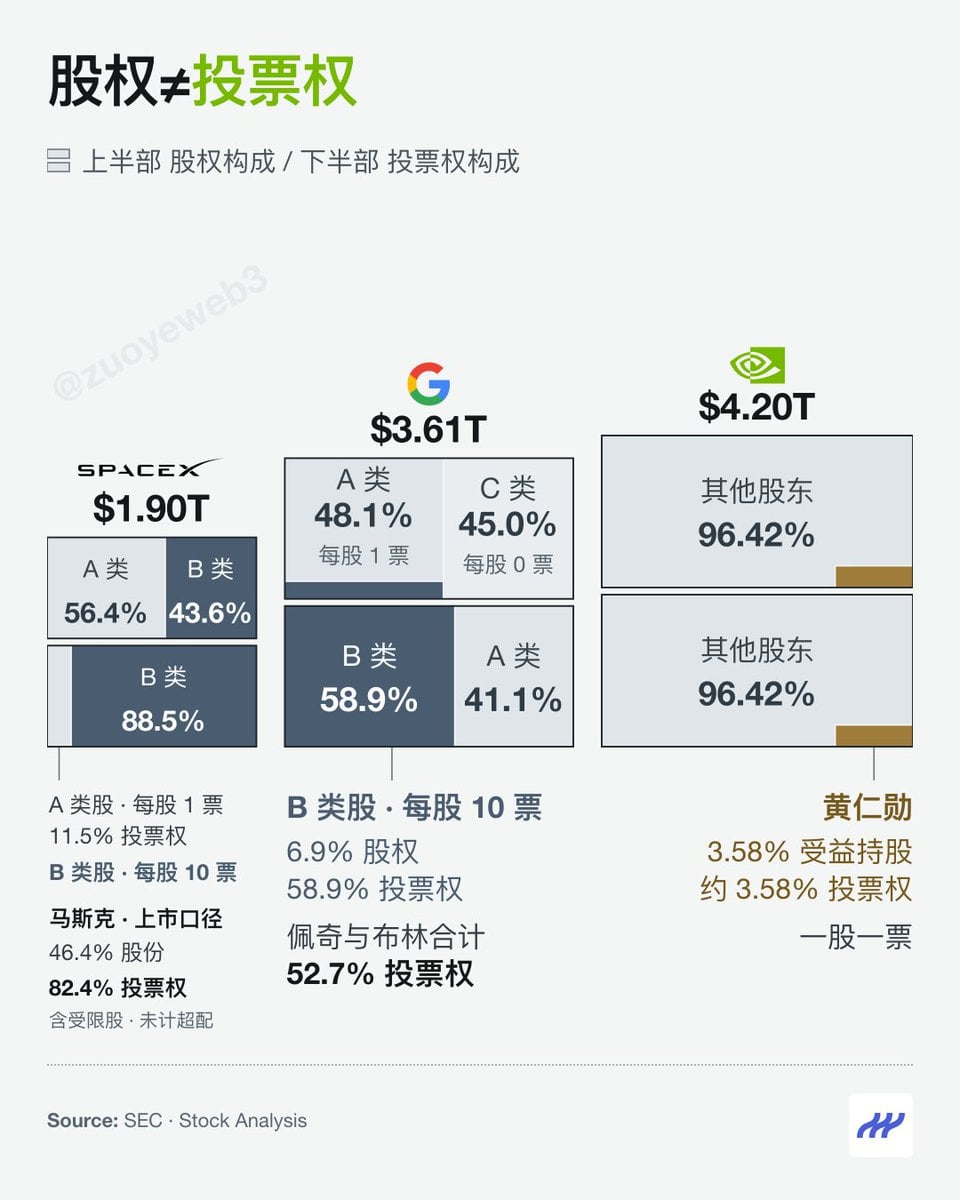
Image: The 3% Achilles’ heel (Source: @zuoyeweb3)
Founders of American tech companies, yearning for capital markets yet fearing loss of power, established a "dual-class stock" system; however, Nvidia was formed too early, or we could say Huang attempted to use the trust of the Chinese community to replace the property rights of capitalism.
Musk has absolute control over SpaceX, Google belongs to a duet of Page and Brin, but Huang relied on the absolute support of the board; a simple majority of 6/11 can withhold support.
If someone claims multi-sign wallets are unsafe, you can tell them that Nvidia's $40 trillion isn't doing much better.
Point crises are indeed terrifying, but group blind obedience is even more irrational; outsiders will not defend your hard work; they only care about their Title and stocks.
After the fervor and passion, France did not settle down completely; street protests persisted for decades, regardless of left, right, or centrist.
They, the intellectuals, saw through the rotational game of elections, contemplating how to defeat capital and power, how to control capital and power; this became a core curriculum for intellectuals post-WWII and during the Cold War.
From Soros inheriting Popper's open society concept to Reagan developing a collection of Soviet jokes, and finally Obama combining various strengths to launch a multicultural weapon.
Younger generations are forever angry, and the realm of public opinion is perpetually elevated.
Everything is merely coincidence; the New York Times published an article on October 29, which did not initially provoke an uproar until the Financial Times report on October 6, a tsunami rose in between, merely a week after the Republicans lost the mid-term elections.
The world has changed colors, and AI has exchanged owners.
The collapse of FTX stemmed from a report by CoinDesk, and Huang's downfall began with an NYT report, concluding with a statement from the board.
When you defend Jensen Huang, you can’t even find a competitor. Even if A makes a move, multiple Pulitzer Prize winners are in the mix; even if the Democrats take offensive, the moral stance on national security cannot be countered.
Perhaps one should be thankful this is 2026, without many focusing on gender issues like during the Biden era.
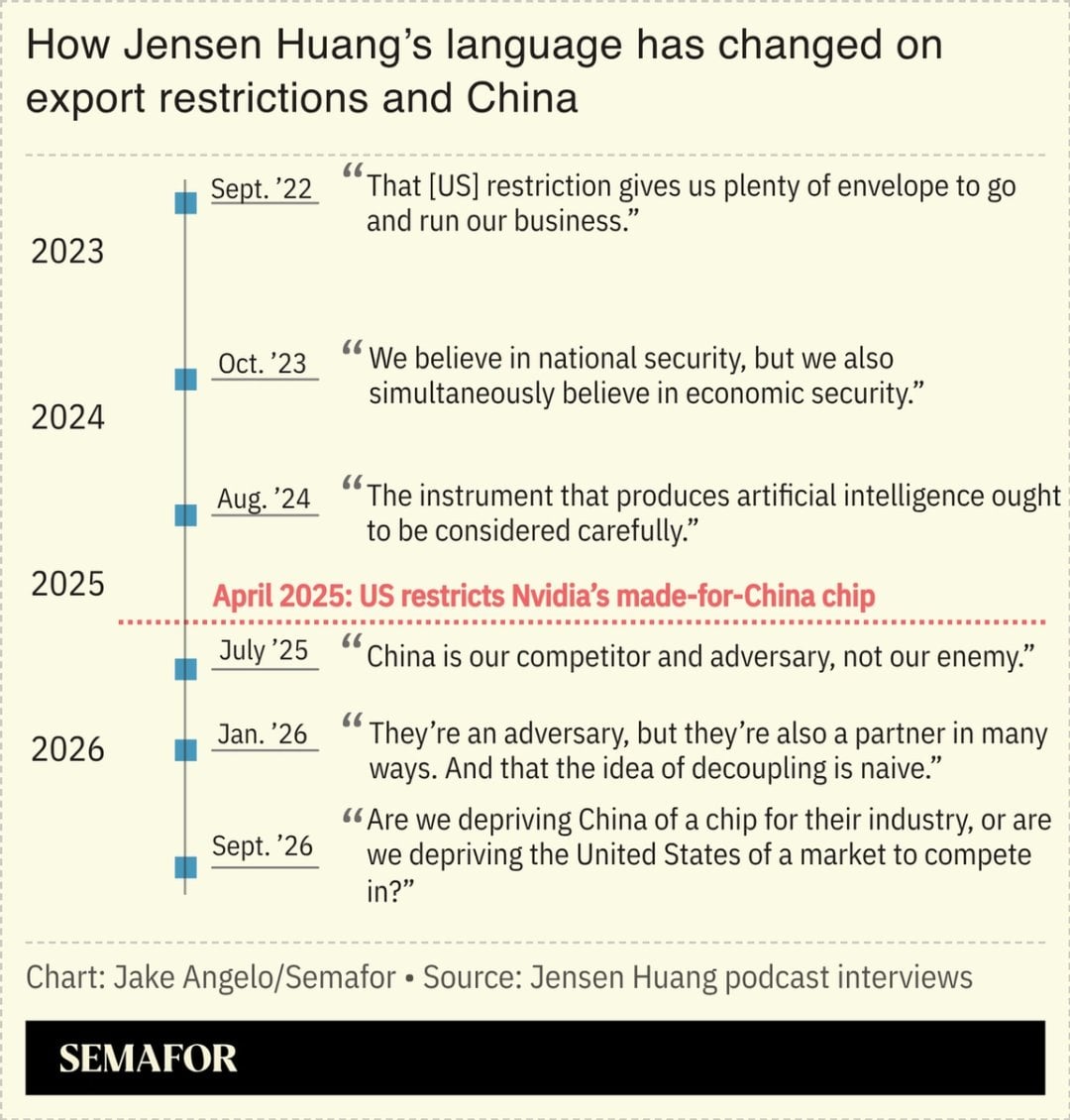
Image: In the Name of Justice (Source: @semafor)
With sword drawn, I glance around in confusion, but who can I specifically target?
Even the Democrats lack overall representation; Binance can be blamed on General Kim, yet the President of the United States remains a Republican, and the Democratic National Committee merely functions as an electoral body, lacking a Lenin-style political bureau.
Unable to defend nor possess enemies, the owner of 𝕏 Musk can only offer support, but Trump too cannot save a company CEO; the machinery of the state must still conduct investigations.
Everyone is within the game, needing to play their roles; the bystanders also play a part.
The Old World is Behind You
“Strike the shepherd, and the sheep will scatter.”
The economic cleansing is ongoing, politically the Defense Secretary Hegaseis has become the new target; someone must bear responsibility for the failure of the war in Iran, and Trump has become a pitiful fallen old man.
Yet Jensen Huang must be held accountable for the victory; Americans believe in the absolute advantage of the US in the China-US AI chip competition, but someone must be responsible for the rise of large models in China; Liang Wenfeng cannot be selected, and O’s company is being pushed back by A, with Nvidia, maintaining its absolute lead, becoming the easiest target without harming its current advantages.
Because I stand on moral high ground, I can lower the bottom line.
Internal purging has long been a millennia-old tradition in Europe and the US, from the Inquisition to the KKK; their core is remarkably similar, and in the long process, Europe has long set industry principles for America.
The US politically supports Europe, but from the perspective of value output, Europe remains America's spiritual strict father.
Faced with multinational tech companies that rose after WWII, nation-states need to control their wings while also colluding to carve up the world; early antitrust measures increasingly fall short of actual situations, dismantling domestic advantageous enterprises, leading to the strengthening of foreign countries.
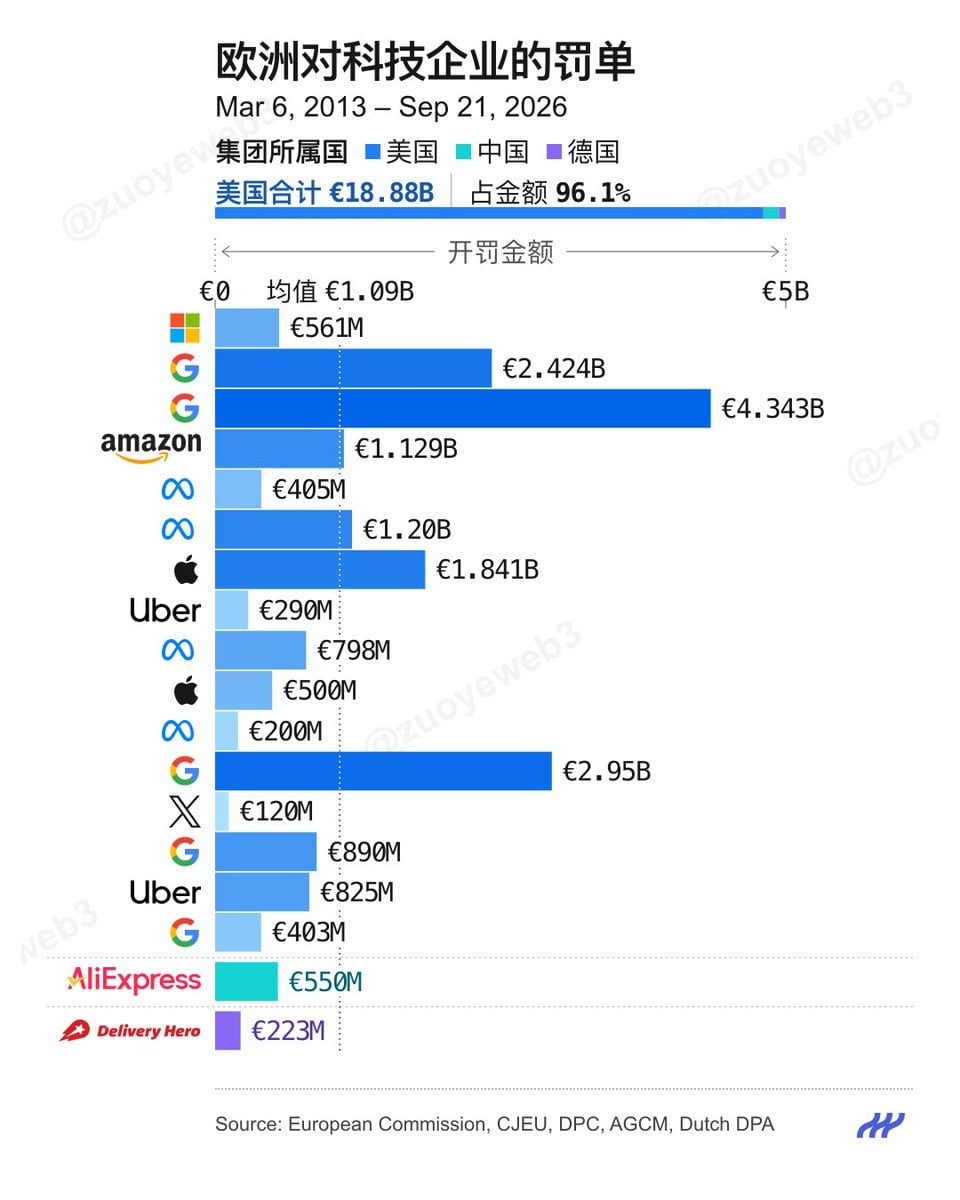
Image: Fines Cannot Cultivate Competitiveness (Source: @zuoyeweb3)
After market competition ends, companies typically need to bind deeply with politics to enjoy monopoly rents.
Since AT&T sacrificed Bell Labs, antitrust measures have basically only been seen as constraints, rarely truly enforced; EU fines act as tax covering mechanisms, neither supporting local enterprises nor obstructing foreign ones, with the only function being the maintenance of a vast bureaucracy.
Then there are rating mechanisms like ESG, and compliance measures like GDPR infiltrating enterprises in various countries, ironically allowing major companies to meet compliance standards; whether in China or the US, spiritual compliance equates to the EU’s regulations.
Ultimately, America sells chips, Europe sells luxury goods, and China sells large models at a bargain price.
When Chinese work collectively in America selling chips, worth and value diverge; politics can seize everything with the agency of public opinion.
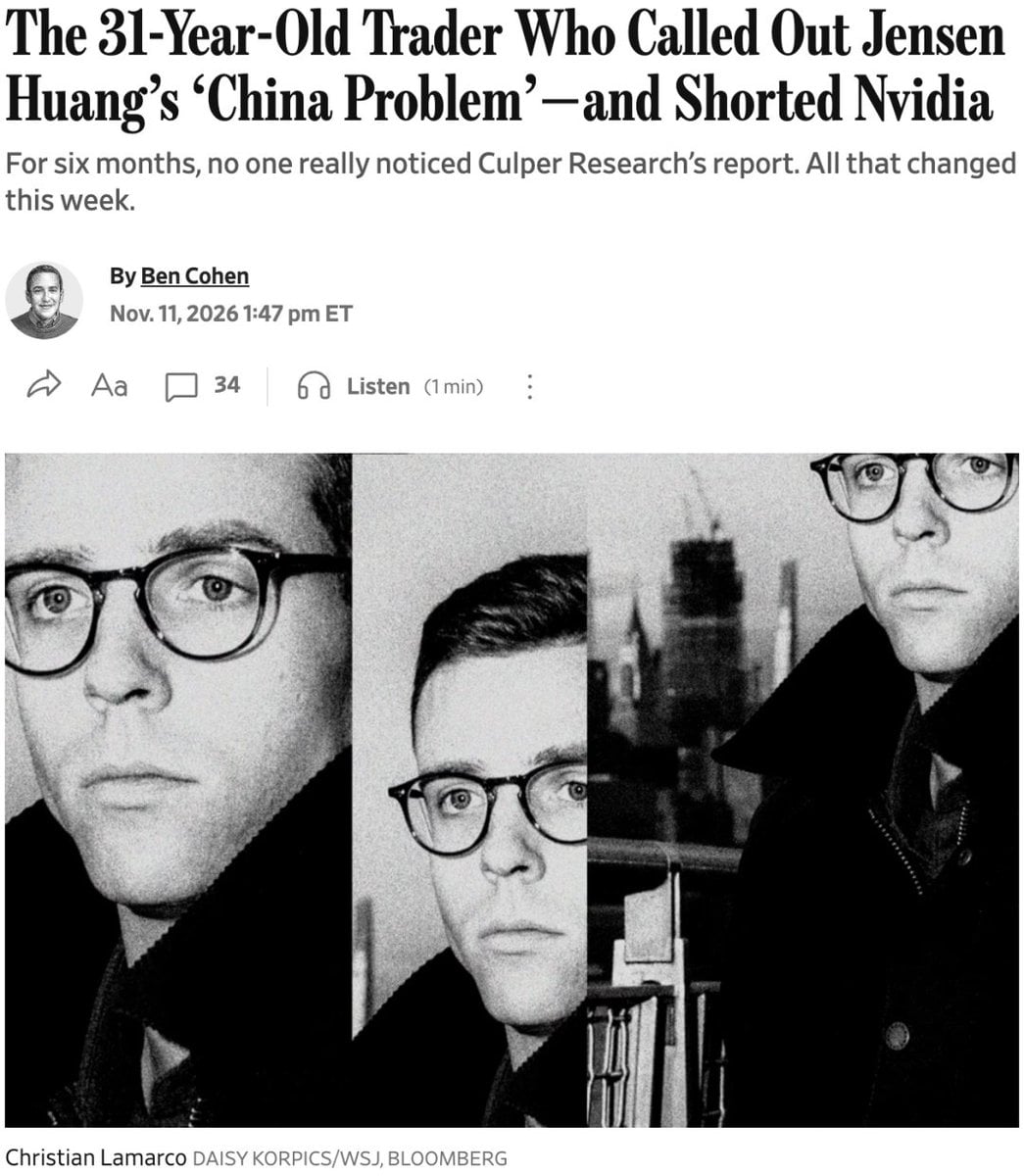
Image: Short Selling has Long Begun (Source: @WSJ)
This is by no means alarmism; as early as 2024, the White House already took note of Huang’s happiness, and half a year ago, someone had publicly released short-selling reports on Nvidia, but all these were merely dramatic plots in a week's mini-drama.
A tangible big hand may evoke your hatred, but next will come the invisible big hand’s stage; the only question is whether the ideologically insane have the ability to run a high-tech industry.
Sam Altman of OpenAI believes in AI, but Dalio had already attained the insight of Scaling Law in Baidu before losing his testicles—the subsequent transcendence is merely the inevitable conclusion of a long narrative.
Jensen Huang has completed his mission, but the entire AI industry and the situation of Chinese in the US will not improve, for the system no longer rewards correctness, only political correctness.
If China’s AI does well, it indicates that American Chinese have not implemented the ban properly; if American AI does poorly, it shows that American Chinese have reservations about their intellectual contributions to America.
What if America does well in AI?
Then it would be the strongest chip company led by Americans.
From Wang An's computers to Jensen Huang's GPUs, it is merely a larger laundromat and massage parlor.
Conclusion
It is not because people invented science that they ceased hunting witches, but because they no longer hunted witches that they invented science.
When FTX collapsed, SBF ultimately gave up resistance, turning to gaming, most likely using Nvidia's GeForce series.
We find it challenging to know what sort of emotional journey Old Huang experienced from October 8 to October 12, and whether he remembered the past of GPU mining. That was the earliest collective memory of Huang in the cryptocurrency circle.
In the 2013 Xiaomi launch, Huang was thrilled to share the stage with Lei Jun; by the 2019 PoW ETH, the constantly struggling gaming industry faced disaster; amidst the rising and falling tides of mining, Old Huang finally found his second growth curve.
Then came the AI large models that took off in 2022; after years of adherence, Nvidia encountered its destined moment, unexpectedly ending up as a scapegoat.
免责声明:本文章仅代表作者个人观点,不代表本平台的立场和观点。本文章仅供信息分享,不构成对任何人的任何投资建议。用户与作者之间的任何争议,与本平台无关。如网页中刊载的文章或图片涉及侵权,请提供相关的权利证明和身份证明发送邮件到support@aicoin.com,本平台相关工作人员将会进行核查。