Author: Jae, PANews
While Wall Street is in heated debate over whether Anthropic's IPO valuation can reach 2 trillion dollars, the crypto market has already staged a feast of arbitrage.
Similarly, for Anthropic's Pre-IPO perpetual contract, Binance's quote surged to 1,700 dollars last week, while Trade.xyz on Hyperliquid was only around 110 dollars, with a nominal price difference exceeding 15 times.
Behind this huge price difference is not a drastic divergence in market judgment on Anthropic's valuation, but rather a detail overlooked by most traders: the number of shares corresponding to each contract. Utilizing this rule difference, some traders have achieved nearly 20% returns in the past two weeks, while by the time the story reached most ears, the price difference had already been filled in by crowded trading.
This is a unique pricing game in the crypto market, where those who understand the rules first often make the money.
The Same Pre-IPO Target, Two Share Denominators
The prices of Anthropic Pre-IPO perpetual contracts on Binance at 1,700 dollars and on Trade.xyz at 110 dollars do not imply a tenfold arbitrage opportunity; the real difference lies in their use of different “share denominators.”
According to the initially announced share parameters for Anthropic Pre-IPO perpetual contracts, Binance estimates the share capital at 1 billion shares. When Binance quotes 1,700 dollars, it corresponds to an implied valuation of about 1.7 trillion dollars for Anthropic.
Trade.xyz, on the other hand, employs a different logic. It was designed from the start as “one share corresponds to one contract,” trading at a price per share, and directly converts to a perpetual contract tracking common shares after listing, without needing further adjustments to the share count.
Currently, Binance quotes based on 1 billion shares, while Anthropic's IPO plans to issue 13 billion shares, requiring a Rebase (base adjustment) when the contract matures, meaning the contract quantity and unit price are adjusted proportionally to ensure the total value of holdings remains unchanged.
Based on the 1,700 dollar quote and the share capital of 13 billion shares, the original 1 contract will become 13 shares, and the unit price will be diluted from 1,700 dollars to about 130.77 dollars. This price can then be compared with Trade.xyz's 110 dollars.
The approximate 18.9% price difference represents the profit space for arbitrage.
The strategy is not complicated. Go long on the lower-priced platform and short on the higher-priced platform after conversion, balancing positions according to the corresponding number of shares in the contract. Traders do not need to bet on whether Anthropic's stock price will rise or fall, allowing them to profit from the converging price difference.
However, there is an important premise for the strategy to work: traders need to predict how much share capital the exchange will ultimately use for conversions.
This is precisely the most important and controversial aspect of the entire arbitrage game.
12.7 Billion or 16.9 Billion? Arbitrage Bets on the Interpretation of the Rules
In early November, the market for Anthropic's Pre-IPO perpetual contracts effectively split into two camps.
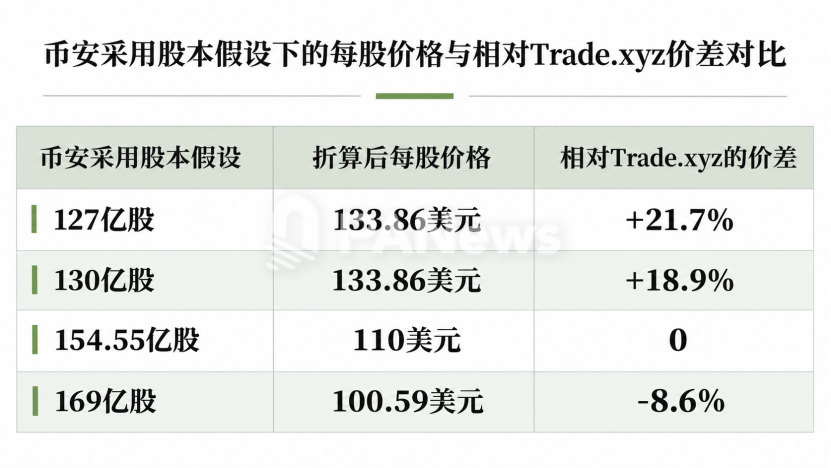
One group of traders believes that the exchange will adopt the “issued common shares” standard, meaning the actual number of shares issued after the IPO completion will not include unexercised options and unvested restricted stock. Based on this standard, the market commonly estimated that the share capital for Anthropic after going public would be about 12.7 billion shares.
The other group remains cautious. Anthropic’s equity structure is far more complex than that of ordinary companies, with employee options, restricted shares, convertible bonds, special class shares, and other layers intertwined. If the exchange adopts the “fully diluted share capital” standard, the total could approach 16.9 billion shares.
The gap of 4.2 billion shares is enough to determine trading profits and losses.
According to the market price on Binance at 1,700 dollars at that time, if 12.7 billion shares are adopted, a long position on Trade.xyz and a short position on Binance could yield more than 20% profit; if 16.9 billion shares were used, the same operation would actually incur an 8.6% loss; the break-even point is about 15.455 billion shares.
In other words, the disagreement stems from how the exchange will interpret a still-unfinalized Anthropic listing document.
The camp supporting “issued share capital” pointed to SpaceX’s precedent. Arbitrage trader Silicon Bird Ray noted that when SpaceX went public in June this year, both Binance and OKX adjusted based on the number of issued shares disclosed in the prospectus without including all options and unvested shares. He also dissected the various components of Anthropic’s preferred stock conversion, issued common stock, foundation shares, convertible bonds, IPO new stock, concluding that the total falls around 12.7 billion shares.
Cautious trader Psyche reminded that SpaceX is just an isolated case, and exchanges hold the final discretionary power over the rules. Especially with convertible bond clauses, there exists a certain degree of flexibility that could influence the final count of shares included. More importantly, “issued share capital” is not the same as what the market commonly refers to as “freely tradable shares”; locked shares and non-listed class stocks could also be included in the calculation.
Until November 10, the market welcomed a crucial turning point.
Prospectus Reveals: The Guess of 12.7 Billion Shares Ultimately Becomes 13.1 Billion Shares
That day, the long-awaited shoe finally dropped regarding the share capital standard.
Anthropic submitted a second revised S-1/A prospectus to the U.S. SEC, revealing core data of the IPO for the first time, stating that the company plans to issue 825 million Class A common shares at a price between 70-78 dollars.
It explicitly stated that after completing the IPO and simultaneous private placement, Anthropic’s estimated number of issued shares will be approximately 13.087 billion shares.
The next day, OKX was the first to respond, announcing its reference share capital for the IPO of about 13.116 billion shares. Based on the figures from the prospectus, it included a small number of subsequent acquisition newly added shares and shares donated for public interest, while completely excluding unexercised options, unsettled RSUs (restricted stock units), and unissued reserved shares, to some extent confirming the market's judgment on the "issued shares" standard.
On November 12, OKX officially executed a Rebase adjustment for Anthropic's Pre-IPO perpetual contract with a ratio of 1.3116, while Binance's share capital parameter adjustment has not been officially announced yet.
As the key rules gradually clarified, the anxiety weighing on arbitrageurs began to dissipate, and the increase in certainty also started to reflect in the prices.
Arbitrage Window Basically Closed
As the rules became increasingly clear, the price differences began to narrow at a visibly rapid pace.
As of November 13, after converting to a unified price per share, the quotes from exchanges such as Binance, OKX, and Hyperliquid had all converged to the range of 102-104 dollars. The previously exceeding 20% price difference now remained at only around 1%.
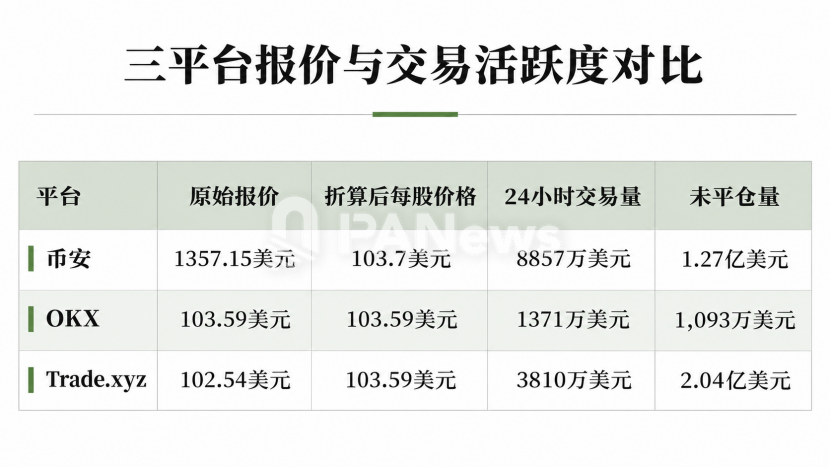
Clearly, the nature of arbitrage across exchanges for Anthropic has changed; the margin for error has significantly shrunk, while profits are negligible, altering the risk-reward ratio for those entering at this time.
Moreover, funding rates, transaction costs, and margin occupation costs are all “invisible killers” of profits.
This is the harsh reality of the crypto market, where the most lucrative opportunities typically belong to the few who first grasp the rules and dare to place bets amid uncertainty. By the time most people notice, it is no longer an opportunity.
This arbitrage around Anthropic's Pre-IPO perpetual contract also serves as a “cognitive lesson” on market pricing mechanisms.
As more and more unicorns yet to go public are packaged into Pre-IPO perpetual contracts, the pricing game is spreading from the investment bank's roadshow room to the continuous 24/7 crypto market.
Most people are accustomed to watching candlesticks trying to guess price movements, while only a few are willing to browse the contract terms, calculate share capital standards, and study the historical processing rules of exchanges, but the excess returns are hidden in these details that no one wants to take the time to delve into.
免责声明:本文章仅代表作者个人观点,不代表本平台的立场和观点。本文章仅供信息分享,不构成对任何人的任何投资建议。用户与作者之间的任何争议,与本平台无关。如网页中刊载的文章或图片涉及侵权,请提供相关的权利证明和身份证明发送邮件到support@aicoin.com,本平台相关工作人员将会进行核查。