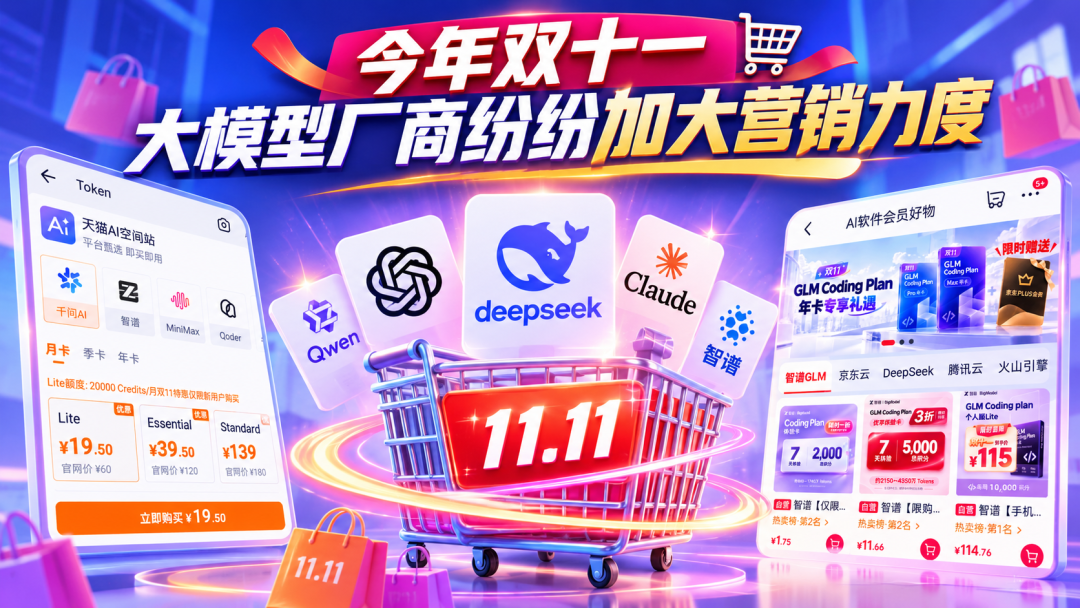
This year's Double Eleven, large model vendors have increased their marketing efforts on e-commerce platforms.
On Taobao: MiniMax offers all three monthly cards at 50% off; Alibaba Cloud's Token Plan starts at 50% off for two monthly cards (Lite package 19.5 yuan/month); Zhipu Weekly cards start at 50% off; Qianwen Office basic version monthly cards are 30% off for the first month; Qoder monthly cards are 33% off, as low as 19.9 yuan.
On JD: Zhipu new user trial card is 10% off; weekly cards start at 30% off; DeepSeek's 100 million Token resource package is 10% off, as low as 9.3 yuan; Doubao video model 1 million Token resource package is 43% off, 9.9 yuan; JD Cloud Token point package is limited to 10% off.
At first glance, JD seems to be more aggressive. However, if we break down the discount terms one by one, we can find that the focus of the two companies is quite different.
First, it’s important to clarify something to avoid any misunderstanding: the product forms of both companies are actually mixed. Taobao sells weekly cards, monthly cards, and annual cards, while JD also sells trial cards, weekly cards, and Pro/Max annual cards; Taobao's monthly cards contain Token quotas, and JD's resource packages can also be purchased on a cyclical basis. Neither is limited to selling just one type.
The real difference lies in the focus of the discounts: Taobao's discounts are mainly on the "cards"—weekly cards, monthly cards, and the first month, which are time-locked; JD, in addition to cards, has laid out a large number of standardized small packages—100 million Tokens for 9.3 yuan, 1 million Tokens for 9.9 yuan, and 10,000 points for 0.01 yuan, which greatly compresses the price.
Cards are used to lock time, while packages are used to test the waters. This emphasis difference explains the two companies' strategies better than "who is cheaper."
Taobao is competing for "category definition rights"
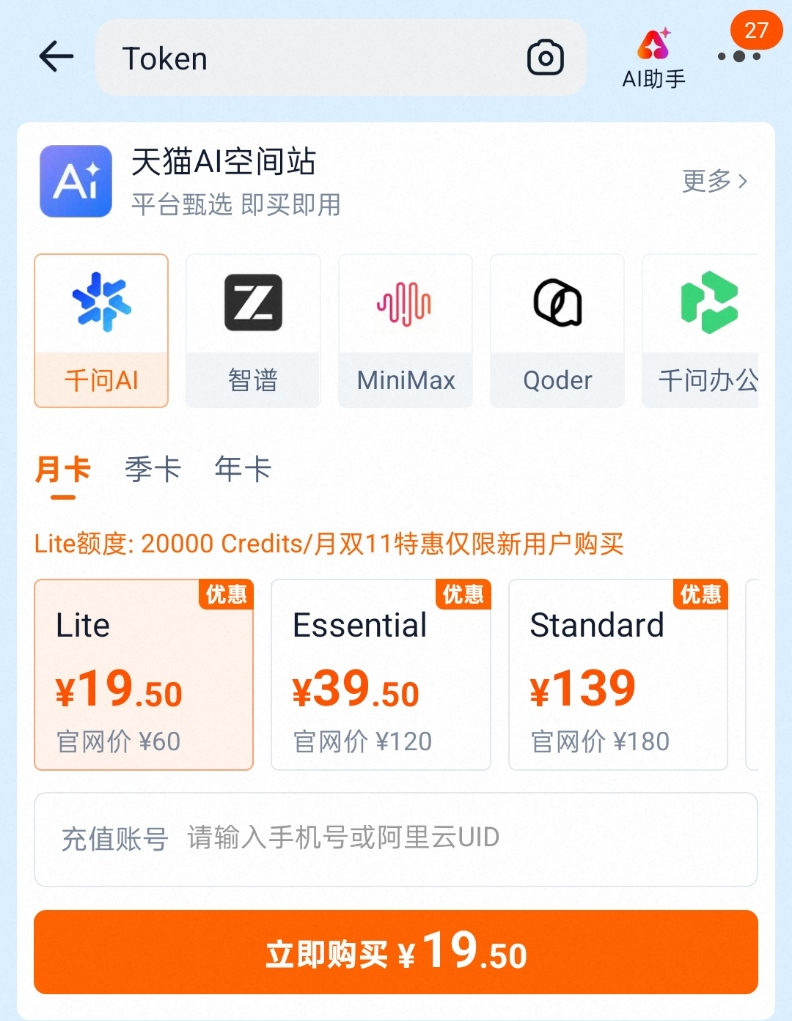
Tmall has been preparing for this Double Eleven for more than two months.
On September 2, Zhipu opened an official flagship store on Tmall, listing four types of Token packages—this is the first time that large model vendors have placed subscription packages as standardized products on mainstream e-commerce. The next day, Tmall launched the "AI Space Station" Token recharge center, with the first batch integrating Alibaba Cloud, Zhipu, Kimi, MiniMax, and DeepSeek. By the Double Eleven, Alibaba Cloud's Bailian, Qianwen Office, Qoder, Dark Side of the Moon, and Jueyue Xingchen all settled in, and MiniMax even opened its first brand official flagship store.
Then came the explosive event on November 2: in Li Jiaqi's live broadcast room, Qianwen Office's personal membership monthly card was reduced from 28 yuan to 1 cent, selling nearly 100,000 copies in half an hour, amounting to about 20 trillion Tokens. On the first day of Double Eleven sales, the transaction volume of Taobao Token categories surged by 450% month-on-month.
However, the actual revenue from these 100,000 copies, at 1 cent each, amounts to about 1,000 yuan. Not enough to buy an entry-level smartphone.
Therefore, this live broadcast was not about making money, but rather an awareness education for millions of people—letting those who do not know what Tokens are understand: AI can be purchased monthly or by quantity, just like phone bills.
The real ambition is hidden in two details.
The first: In Taobao's recharge center, the Token entry is right next to recharging phone bills, data charges, and paying water, electricity, and gas. This position is not arbitrary.
The second: Tmall introduced the "AI Software and Application Product Release Specification" in April, requiring merchants to clarify token limits, model versions, and API validity periods, and has prohibited phrases like "never get banned."
The second detail is the key. In the past, how Tokens were priced was entirely up to the vendors, and users received an API bill, never having the opportunity to make a horizontal comparison. Now, similar products are listed side by side on one page, and prices can be viewed together for the first time.
Tmall is practicing "retail before standardization"—forcing standards through shelves and driving transparency through price comparisons.
Once users are accustomed to comparing prices on the same page, the pricing power shifts from the vendors to the platform.
JD is competing for "attach rate"
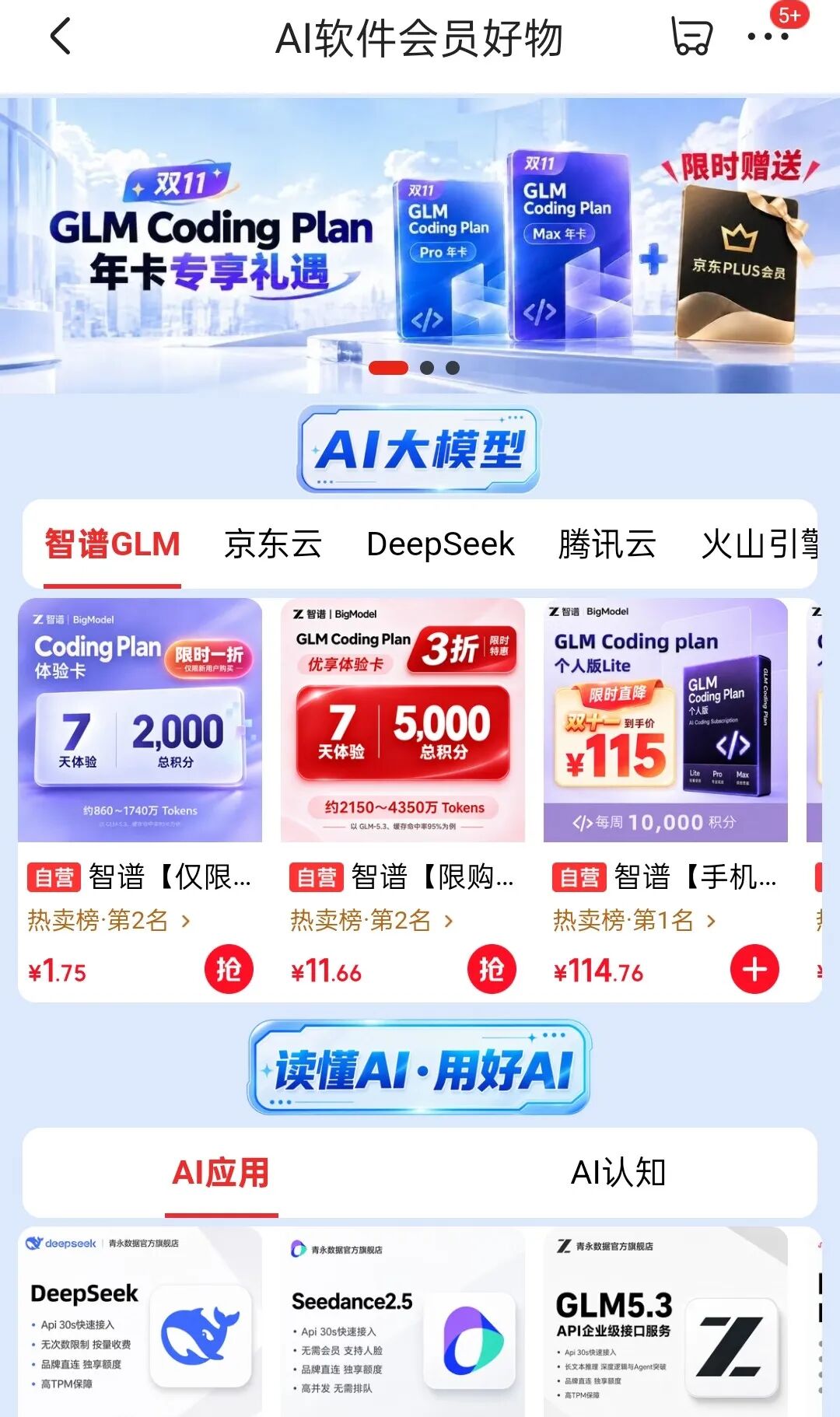
In September, JD launched "AI Software Recharge Pavilion" and "AI Token Service Station," gathering JD Cloud, DeepSeek, Zhipu GLM, Volcano Seed, MiniMax, Kimi, Qianwen, allowing users to recharge everything on the same page. Zhipu opened its self-operated flagship store on JD, and packages like the Coding Plan are consistent with its official website.
Both companies are walking the path of selling standalone products. JD's recharge pavilion has an independent entrance and has created an AI large model section, not less than Tmall.
The difference appears in the next step—JD clearly does more in the act of stuffing Tokens into hardware orders than Taobao.
When purchasing Dell Inspiron 16 Plus, XPS 13 Air, Alienware Starship 16X, ThinkPad T14p, a 13,000-point JD Cloud Token starter package is given with the order, supporting more than 70 mainstream open-source models and JD’s self-developed models, compatible with tools like WorkBuddy and Cursor. When buying AI workstations like the Amaychi F9A and the Xiaoqing Computing XQ 395, Zhipu Token packages are given. When purchasing 3C digital products with a “JD supplement contract,” Tokens can be acquired at up to 70% off.
The Plus membership benefits are also integrated: Zhipu Pro/Max annual cards grant JD Plus membership, and Plus users can exchange a Zhipu weekly card with just 1 point from the lifestyle service package.
The logic behind this strategy is clear: Tokens are not the goal on JD, but rather a reason for you to decide to change your computer.
JD's users are inherently those who are looking to buy hardware—developers, AI creators, digital enthusiasts. This group has the highest acceptance of the Token billing model and knows best how much "an extra 13,000 points" is worth. Therefore, JD does not need to educate the market; it only needs to slip in an additional item at the moment users are already spending money.
Combined with extremely low price anchors: a newcomer JD Cloud point package costs 0.01 yuan for 10,000 points, Kimi K3's 10,000 Tokens cost 0.01 yuan, and Zhipu's 7-day trial version costs 0.09 yuan, totaling less than 0.11 yuan, enough to try all mainstream models. The advanced package of Seedance 2.5 plus DeepSeek V4 Pro each 1,000 points costs a total of 0.68 yuan. The 19.9 yuan "AI triple gift" package includes 5 million generic Tokens, a monthly iQIYI gold member card, and a 10 yuan phone voucher.
0.01 yuan, 0.68 yuan, 9.9 yuan—these numbers are not for making money, but to create the illusion of "losing out if you don't buy."
Emphasis of the two strategies
When we put the actions of both companies together, we can see a clearer emphasis:
Taobao seems more like creating a new category, while JD appears to be adding accessories to an existing category.
Taobao is building a space for "AI consumption" from 0 to 1, and its opponent is "users do not even know AI can be bought." So it requires Li Jiaqi, needs super IPs, needs to place entry next to utilities, needs a nationwide public education, and also needs a category specification to set rules.
JD is looking to increase the average order value from 1 to 1.2, and its opponent is "users simply do not want to change computers at the moment." So it needs bundling, needs freebies, and needs to integrate Plus membership benefits, allowing computing power to move along with the hardware.
Taobao is competing for category mindshare, while JD is competing for attach rate.
Of course, this is not an either-or situation. JD is also engaging in category education (the 7-fold increase in search volume indicates a real demand), while Taobao is also making hardware connections (shelves in live broadcasts display AI computers built with Qianwen office and DingTalk A1). The focus is just different.
Interestingly, neither company is making much profit right now.
A study by Tencent Research Institute in May 2026 shows that 95.6% of respondents have used large AI models in the past three months, but only 9.8% are paying customers. Moreover, there is a clear K-shaped differentiation—61.1% of paying users stated they would continue to increase spending in the next three months, while 61.4% of free users prefer to continue using for free.
In plain language: those willing to spend will spend more and more, and those unwilling to spend won't spend regardless of discounts.
So for this Double Eleven, both companies are actually doing the same thing—spending money to buy user habits. Taobao uses 50% off to buy into the idea that "AI can be purchased like phone bills," while JD uses freebies to buy the action of "changing computers along with some computing power."
As for which strategy is more advantageous, in the short term, JD’s conversion efficiency is higher—those with a hardware need are likely to purchase; in the long term, Taobao's category mindshare is more valuable because AI consumption will ultimately be goal-oriented: there will come a day when you specifically go to buy computing power, rather than just doing so by chance.
An overlooked flaw
Finally, let’s mention a detail that nobody has pointed out.
Some media have noticed that a certain monthly card in JD's self-operated store has a positive review rate of 67%, and some reviews complain about the recharge process not being smooth and requiring manual assistance to get the payment through.
This figure is more worth noting than any GMV.
Selling virtual goods is harder than selling physical goods, because delivery is not under one’s own control. You pay the money, but the goods must be attributed to the other party's account system; if there is a break in the chain, users have to seek manual support.
This precisely shows that Tmall’s "AI Software and Application Product Release Specification" from April is not about meddling—it requires clarity on token quotas, model versions, and API validity, essentially filling the "last mile" gap.
Putting the products on the shelf only requires an event, but delivering the goods to users requires a whole set of standards.
Conclusion
First, let’s note the positive aspects; both companies are indeed doing practical work this time.
The threshold has been lowered. Buying Tokens used to require understanding API keys, entering the console, and placing orders on various official websites; now you can search for two words to make payments, and it supports two delivery methods: card codes and direct recharge. A user from Wuhu, Anhui, who works in AI film and television, took advantage of the promotion to buy an annual package originally priced at 37,000 yuan for just 18,299 yuan, and also received three additional months and 200,000 points—this kind of heavy user really saved money.
Price comparison has also become possible for the first time. In the past, each company had different billing rules, with the Kimi Pro package charging 26 yuan for every million Tokens input and 136 yuan for output, while DeepSeek charged 1 yuan for input and 4.5 yuan for output during idle times, with differences of dozens of times, making it impossible for ordinary users to calculate. Now at least they can be viewed together.
For those preparing to place orders, here are two pieces of advice:
First, understand what the "10% off" and "50% off" are applied to. JD's 10% off mostly applies to trial cards and small resource packages, while Taobao's 50% off mostly applies to the first purchase of monthly cards. The former is a tasting price, while the latter is a first-month price; renewal returns to the original price.
Second, choose according to your usage, not based on discount strength. For occasional use, the 0.01 yuan package is enough; for daily use, subscribing directly is more cost-effective. If you buy too much and can't use it all, the Tokens will expire.
As for which of the two companies can win, my judgment is: this is not entirely a platform battle, it’s a habit battle.
E-commerce selling Tokens is not about selling computing power; it’s about the idea that "AI can be bought like phone bills."
The one that makes this idea a part of daily life first will gain access to the entrance for the next decade.
免责声明:本文章仅代表作者个人观点,不代表本平台的立场和观点。本文章仅供信息分享,不构成对任何人的任何投资建议。用户与作者之间的任何争议,与本平台无关。如网页中刊载的文章或图片涉及侵权,请提供相关的权利证明和身份证明发送邮件到support@aicoin.com,本平台相关工作人员将会进行核查。


