
Author: CoinFound
On June 12, SpaceX went public on NASDAQ at $135 per share, issuing approximately 555.6 million shares and raising about $75 billion, reaching $164 on the first day. Around this highly anticipated IPO, retail investors could buy more than four types of "SpaceX" before the listing, similar codes but legally distinct. The market presented the tokenization of new shares as "pulling back the velvet rope of new offerings for everyone to participate," but what was truly exposed this week is the fragility of the tokenized category at the delivery level—dependent on xStocks for collective cancellation and refunds, while completely non-equity synthetic perpetuals operated as usual.
To understand this matter clearly, first we need to consider the first layer of our RWA tracking framework: credit/ownership. The fundamentals of SpaceX have not changed; what has become fragile is "whether the token you purchased actually represents rights to the company and whether it can be delivered to you."
Four paths can be lined up in a lineage of decreasing ownership. The strongest is the real NASDAQ shares allocated by U.S. brokerages, corresponding to full shareholder ownership. Second is the SPCX from Backpack on Solana—licensed U.S. brokerages buy and custody real shares 1:1, allowing holders to redeem for the underlying stocks through ACATS/DTCC, making it the closest form of ownership token. Next are the xStocks tracking certificates from Kraken and Bybit: claimed to be 1:1 supported by custody shares, but Kraken's own FAQ states, "does not include shareholder rights, voting rights, or any legal claims to the underlying shares," and Bybit's terms explicitly state that collateral "may not always be the underlying shares" and they do not independently verify it. The weakest are synthetic perpetuals (Coinbase, BitMEX, OKX, Hyperliquid, etc.), which do not hold shares at all and only replicate prices. The same code represents four different things.
The ones that cracked were precisely those tracking certificates that had been marketed as "tokenized stocks," and the crack occurred at the delivery level, not at the technology level. SpaceX's allocation was oversubscribed by about four times, and the pre-allocated quotas received by xStocks were far less than expected; the subscriptions relying on it from Binance, Bybit, and Bitget Wallet were collectively canceled and refunded at the last moment, resulting in each recipient receiving only about 4.28 shares, leaving many with nothing. The bottleneck is the availability of the underlying IPO shares, not the on-chain technology—the tokenized subscriptions placed delivery reliance on a single upstream allocation channel, which was then disrupted.
When placing success and failure side by side, the structural differences become clear. Only two routes truly completed delivery: the real shares from traditional brokerages and the Backpack path of "licensed brokerages holding real shares + DTCC redeemable." Their commonality is not the label of "tokenization" but that there are indeed real stocks at the underlying level, along with regulated delivery and redemption channels.
What is even more intriguing is that the only one that completed pricing beautifully is precisely that class which never promises delivery of stocks. Before the IPO, SpaceX perpetuals were trading on multiple platforms, with $4.6 billion in transactions on IPO day and a peak of $500 million in outstanding contracts across eight venues; its price broke $220 in mid-May, then converged toward the issue price of $135—synthetic contracts provided credible real-time price discovery precisely because they never pretended to be supported by an actual stock. The problem has never been with the derivatives themselves but with packaging items that lack ownership as "stocks."
We tend to believe that as more popular IPOs get tokenized, the next high-demand tokenized new issue will still repeat under-allocation unless its structure follows the path of "licensed brokerages holding real shares + DTCC redeemable"; observable signals will be which structure actually delivered shares for the next iconic IPO and which issued refund announcements.
For different participants, the implications differ: investors need to verify the issuer and whether there is indeed a real share, redemption pathway, and attached rights before treating any "SpaceX" token as holding that stock; distribution platforms must understand that promises of tokenized new offerings without a controllable allocation channel inherently carry delivery risks; the recent classification of tokenized securities by regulatory bodies is precisely what the market needs at this moment. The combinability layer will spread this risk—if a tracking certificate stating "collateral may not be the underlying shares" is used as on-chain collateral, the uncertainty of ownership will be compounded in borrowing and settlement. Tokenization moves the new offerings on-chain, reducing geographical and threshold barriers, but does not change the essential truth that "there must indeed be a share behind it, and someone must be able to deliver it to you." Translating "what exactly did you buy" into verifiable standards is Coinfound's mission.
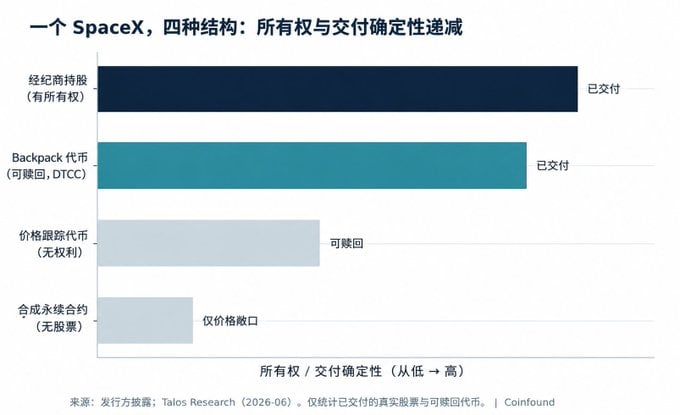
The same SpaceX, four structures along the spectrum of ownership and delivery certainty decrease; only real stocks and Backpack redeemable tokens truly delivered (Source: disclosures from various issuers; Talos Research, 2026-06)
Disclaimer: This article is for informational reference only and does not constitute any investment advice; product terms are subject to the official documents of each issuer.
免责声明:本文章仅代表作者个人观点,不代表本平台的立场和观点。本文章仅供信息分享,不构成对任何人的任何投资建议。用户与作者之间的任何争议,与本平台无关。如网页中刊载的文章或图片涉及侵权,请提供相关的权利证明和身份证明发送邮件到support@aicoin.com,本平台相关工作人员将会进行核查。


