When HYPE refreshes records, does anyone notice that ecological projects are shutting down one after another?
Written by: Sanqing, Foresight News
On June 16, HYPE reached 76.965 USDT, refreshing its historical high once again, with a daily increase of about 10%, triggering short liquidations exceeding 11.5 million US dollars. At the same time, according to SoSoValue data, the three U.S. spot HYPE ETFs accumulated approximately 180 million US dollars in net inflows in their first month, with institutional funds continuing to flow in.
However, the situation on the Hyperliquid ecological side is entirely different. From May to June, several protocols in various fields, including lending, NFTs, stablecoins, and DEX, announced their shutdowns one after another.
HYPE is an "application stock"
Hyperliquid injects about 97% of its protocol fees into the Assistance Fund, continuously repurchasing HYPE on the open market and permanently destroying it. According to buildix data, the current daily repurchase is approximately 34,000 HYPE (about 2.57 million US dollars), with an annualized repurchase scale of about 940 million US dollars, and annualized protocol revenue of about 976 million US dollars, with a P/E ratio of about 73 times and a buyback yield of about 5.6%.
According to DefiLlama data, Hyperliquid's trading volume in the last 30 days exceeded 240 billion US dollars. This is the fuel driving the repurchase machine, supported by HyperCore's highly diversified revenue structure from perpetual contract trading. Cryptocurrency perpetual contracts (BTC, ETH, SOL, etc.) contribute about 55% of daily fees, commodities (crude oil, gold, silver) about 22%, stock indices (S&P 500, Nasdaq) about 12%, and spot trading about 6%.
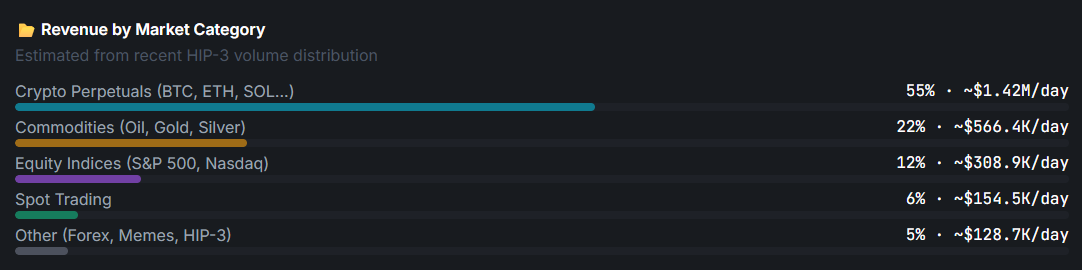
This means that HYPE resembles an "application stock" more than a "ecological token" in the traditional sense. Its value capture is anchored in the trading fees of HyperCore and is almost unrelated to the TVL scale of HyperEVM or the number of surviving DeFi protocols.
This is entirely different from the value logic of ETH. The pricing assumption for ETH is that ecological prosperity drives gas consumption, which in turn pushes up the token price; therefore, the death of any ecological project is a negative signal for ETH.
But HYPE's fee source is almost unrelated to HyperEVM; whether HyperEVM projects live or die does not change the trading volume of HyperCore and does not affect the repurchase rhythm of the Assistance Fund. The risk exposed to HYPE holders is not the risk of a particular DeFi protocol but the operating risk of "the Hyperliquid perpetual contract trading business."
Five announcements
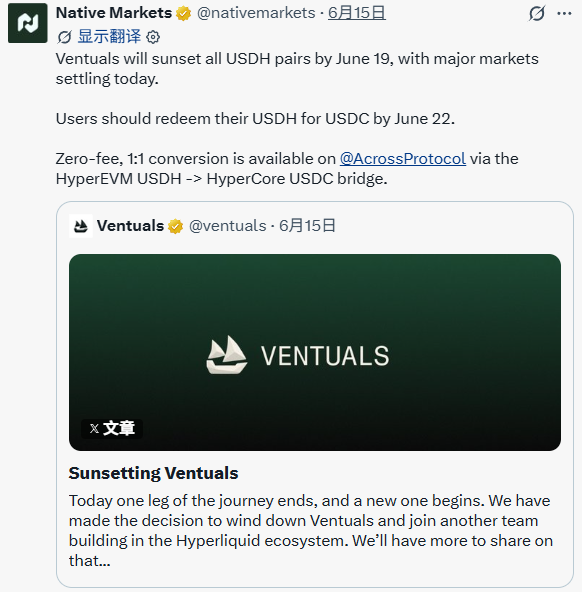
Ventuals (June 15) accumulated a trading volume of over 650 million US dollars, serving more than 11,000 traders, and the announcement received 470,000 views. The team wrote: "Today, one section of the journey has ended, and a new one has begun." The shutdown process was extremely orderly, listing the settlement times and pricing mechanisms of 11 markets including OpenAI and Anthropic, with users receiving refunds for their HYPE on a 1:1 basis.
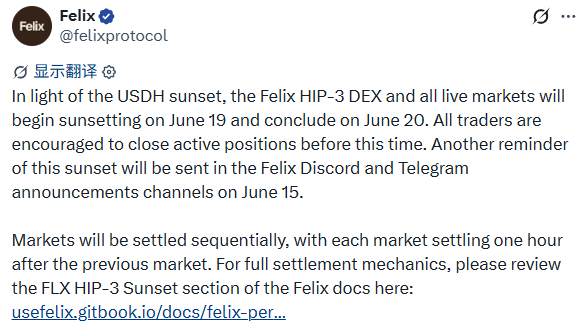
Felix (June 8 announcement, ends June 20) announced: "Given the discontinuation of USDH, Felix HIP-3 DEX and all active markets will begin discontinuation on June 19 and conclude on June 20."
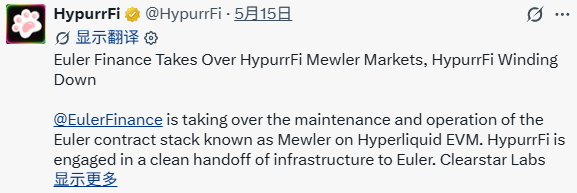
HypurrFi (May 15) was once a leading lending protocol in HyperEVM, with a TVL peak of over 300 million US dollars. The announcement stated: "There are no security vulnerabilities. No exploitation. No emergencies. This is a well-considered operational decision." The brand exited, and the infrastructure was handed over to Euler Finance, with the pooled market completing final settlement on July 15.
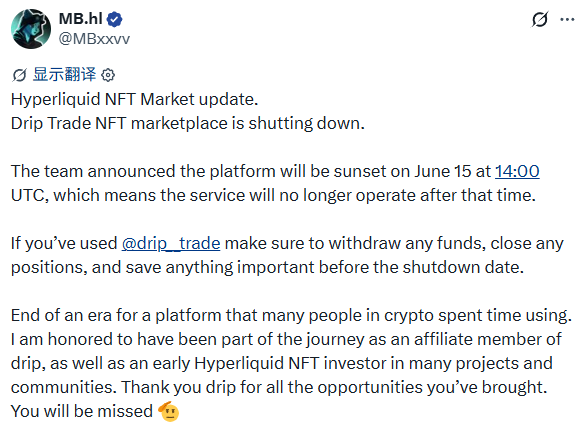
Drip.Trade (June 15) is the only NFT exchange on HyperEVM. Hyperliquid ecological KOL @MBxxvv relayed the official news: "The platform will go offline at 22:00 on June 15, and services will no longer operate afterward."
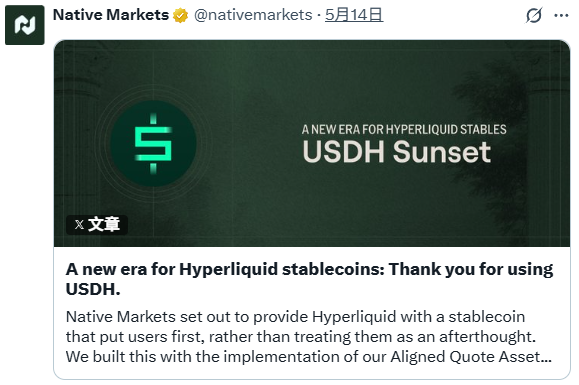
USDH / Native Markets (May 14) announced by Native Markets, stated that the brand rights of the USDH stablecoin would be transferred to Coinbase, making Coinbase the official USDC deployer on Hyperliquid.
These five projects cover lending, NFTs, stablecoins, RWA private market, and DEX, nearly representing the main categories of DeFi infrastructure on HyperEVM. They are not marginal projects but protocols that once had real users and real trading volumes in the ecosystem.
The stronger the core, the harder it is for the ecology to survive
If HYPE's rise and the death of ecological projects were merely two independent trajectories, then this crisis would just be a "failure of peripheral projects" with nothing worth probing. But upon closer inspection, these two incidents are not just happening in parallel.
The design philosophy of Hyperliquid is minimalism: provide the chain and infrastructure without interfering in operations.
Since its launch in February 2025, HyperEVM has attracted over 170 projects to deploy, but there have been no official grants, no coordinated market-making arrangements, and no initiation of liquidity support from the start. It faced a fully competitive secondary market immediately upon launch. The core team rarely participates publicly in collaborative interactions with HyperEVM project parties, and protocol project parties are assumed to be self-sufficient.
When on-chain products are scarce, functioning protocols naturally bring in traffic. However, the market in 2026 is already saturated; the survival of new protocols is not a technical issue but a cold start issue. Without official endorsement and liquidity guidance, the vast majority of projects cannot withstand the cold start phase at all.
Moreover, the HIP-3 mechanism allows anyone to directly deploy perpetual contract markets on HyperCore, which was originally an outlet for liquidity overflow but also divides the attention and user traffic of protocol project parties.
The leading project on HIP-3, TradeXYZ, has already captured about 97% of the same market share, leaving almost no living space for newcomers. This means that protocol project parties are not only competing with external competitors but also competing with Hyperliquid's own liquidity siphoning effect.
The more successful HyperCore is, the more traffic and funds it attracts, making it harder for projects on HyperEVM to share in the benefits. This is not a technical failure of HyperEVM; rather, Hyperliquid's business model naturally keeps the highest quality resources at the core while structurally compressing the survival space on the periphery.
免责声明:本文章仅代表作者个人观点,不代表本平台的立场和观点。本文章仅供信息分享,不构成对任何人的任何投资建议。用户与作者之间的任何争议,与本平台无关。如网页中刊载的文章或图片涉及侵权,请提供相关的权利证明和身份证明发送邮件到support@aicoin.com,本平台相关工作人员将会进行核查。


